Key Points :
- Hormuz, Bab el-Mandeb and the Egypt-Suez corridor are dual energy-data chokepoints.
- In a crisis, repair access and attribution uncertainty may matter more than the physical cutting of a cable.
- Gulf data center and AI ambitions now depend on maritime routes that were already strategic for energy.
- Redundancy requires more than one alternative route; it requires route diversity, repair capacity, legal access and crisis coordination.
- Pressure on submarine cables can shape the military, economic and diplomatic rhythm of a conflict, even when physical damage is limited.
In the March 2026 crisis examined here as a scenario-informed case, U.S.-Iran tensions in the Gulf looked familiar: oil prices rose, and warships moved into the region. The less visible vulnerability lay below the surface. Submarine fiber-optic cables passing through Hormuz and the Red Sea, which carry important segments of intercontinental data traffic, were also exposed.
The article’s core claim is that submarine cable vulnerability in the Gulf should be treated alongside energy security. If it remains a secondary technical issue, future regional crises may place growing strain on digital infrastructure and make recovery harder.
The analysis focuses on Hormuz, Bab el-Mandeb and the Egypt-Suez corridor, where energy and data infrastructure share the same geography. Farrell and Newman’s concept of weaponized interdependence helps frame what is at stake: pressure on network nodes can translate into political weight without ever crossing into open conflict.
The article examines the geopolitical setting, the cable ecosystem, below-threshold pressure mechanisms, and the implications for war dynamics and policy choices.
The Middle East can no longer be understood only through pipelines and tankers. Gulf data centers, cloud infrastructure, and AI projects now rely on many of the same chokepoints that have long shaped energy security.
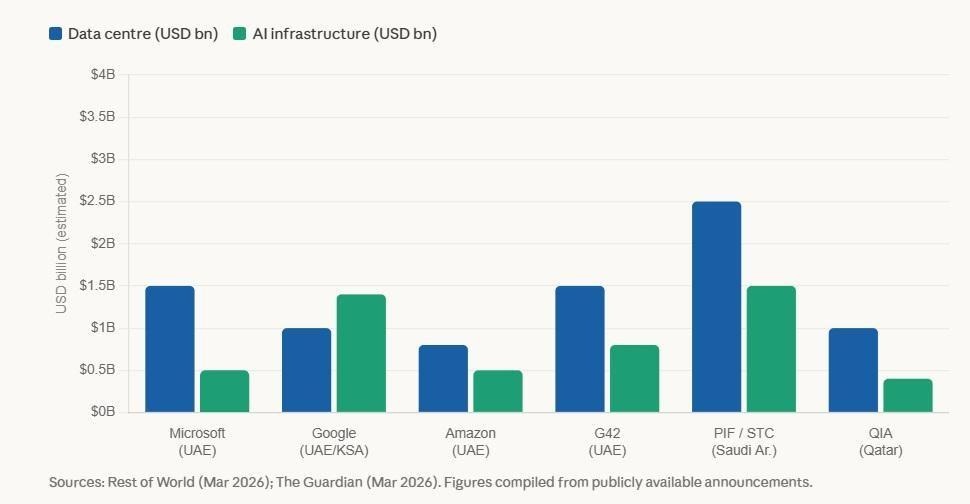
Table 1. Investments in Data Center and Artificial Intelligence Infrastructure in the Gulf (2026, Estimated, Billion USD)
Building on Farrell and Newman’s account of networked coercion, this article argues that submarine cable chokepoints are not merely technical bottlenecks. They are places where concentrated infrastructure can be turned into political pressure.
The Gulf’s data-center and AI investment cycle shows why this vulnerability matters. The UAE, Saudi Arabia and Qatar are expanding data center and AI capacity, yet their external connectivity still depends heavily on Hormuz and the Red Sea-Bab el-Mandeb corridor. The crisis did not create this dependency; it exposed it.
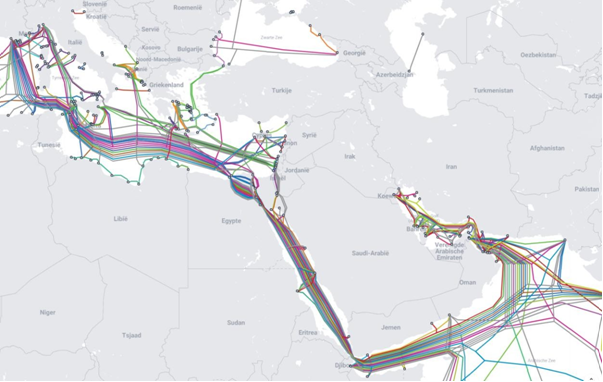
Hormuz is 33 kilometers wide, but traffic is concentrated in narrow lanes. Roughly one-fifth of global oil trade passes through the strait, and submarine cable traffic also concentrates in these waters. Repair activity in such an environment becomes as much a security and access problem as a technical task.
Bab el-Mandeb connects the Red Sea to the Gulf of Aden and carries a large share of Asia-Europe data traffic through a dense submarine cable corridor.
The Houthi presence and broader conflict risk have made this route vulnerable by raising concerns about insurance, escort, and safe access.
Geography alone does not explain the vulnerability. What makes a chokepoint dangerous is the combination of physical narrowness, an insecure environment, and concentrated infrastructure. When these three come together, a strait becomes something more than a passage.
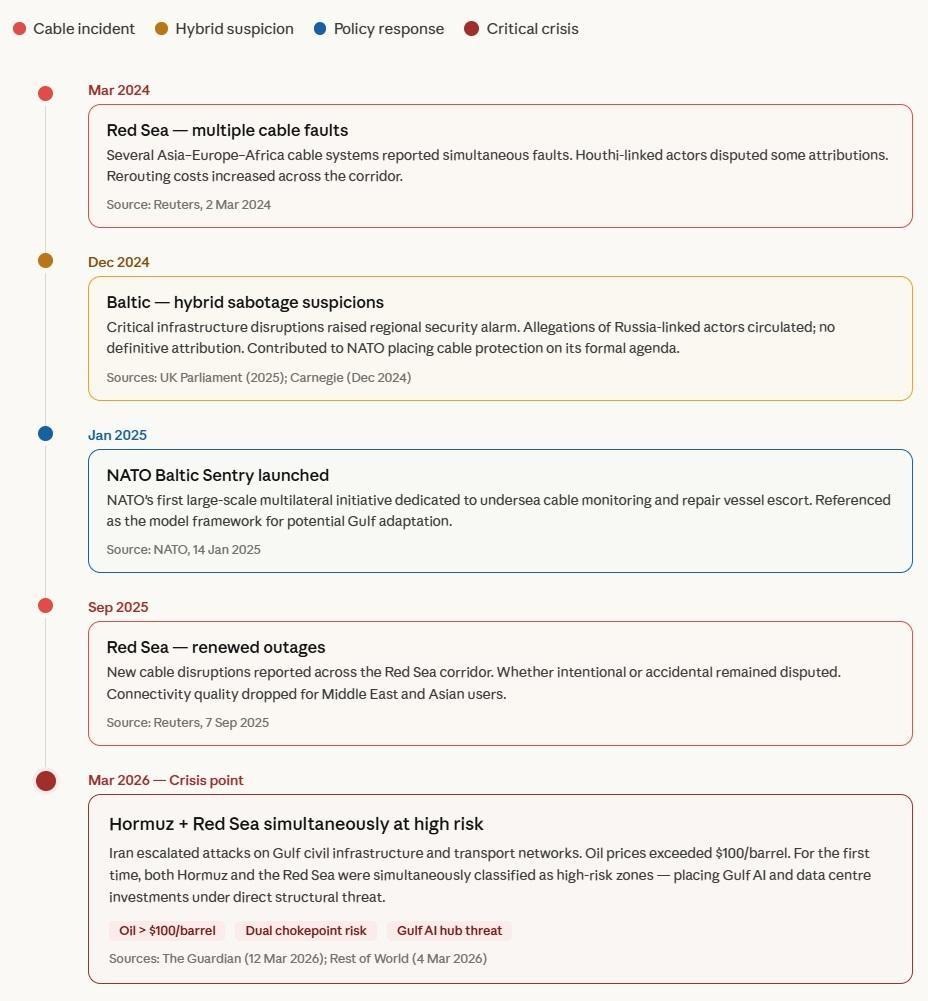
Since 2023, submarine cable security has become part of the geopolitical debate. The chronology below highlights selected developments. Where attribution is unclear, the term “suspected” is retained because responsibility often shapes political consequences as much as physical damage.
The chronology should therefore be read as a selected open-source timeline, not as a comprehensive database of all cable incidents.
Table 2. Critical Developments in Submarine Cable Security: 2024-2026 Chronology
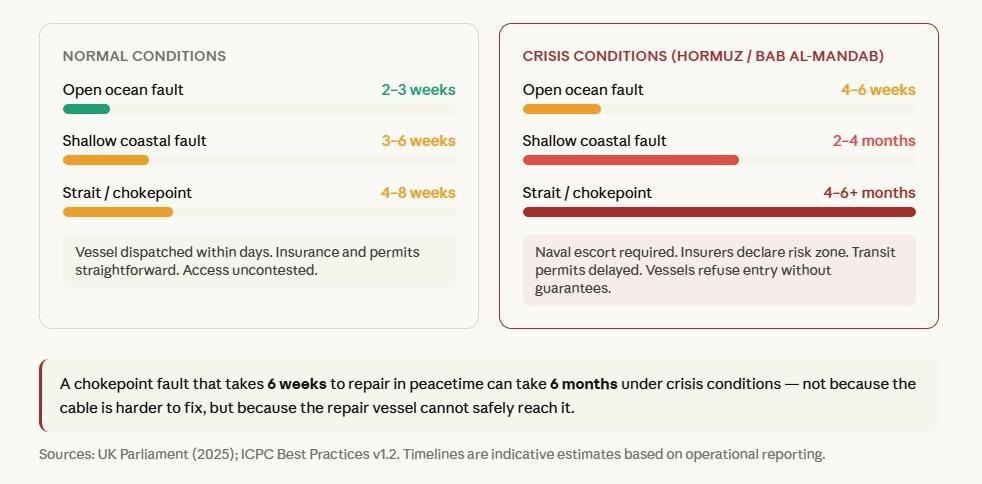
A cable outage immediately raises a practical question: “When will it be fixed?”
The answer often depends less on engineering than on logistics and geopolitics: repair-vessel availability, coastal-state permissions, insurance classification, and the security environment. In a crisis, a repair that normally takes weeks can stretch much longer.
Table 3. Submarine Cable Repair Times: Normal Conditions and Crisis Environment
The idea that “Iran will cut the cable” is tempting but incomplete. Direct cable cutting is technically difficult, easier to attribute and more likely to trigger a sharper international response. Below-threshold pressure may provide a comparatively flexible option for Tehran, particularly when direct attribution would carry high diplomatic costs.
Iran-linked pressure options can weaken digital continuity without directly targeting cables: slowing repairs, increasing uncertainty and imposing operational friction.
Such tools are more likely when external pressure rises and when signaling resolve without open escalation becomes politically useful.
When Would Direct Targeting Become a Realistic Option?
Iran would be more likely to target cables directly only if the conflict had already widened, energy infrastructure was being openly struck, and attribution no longer carried the same deterrent cost. In March 2026, below-threshold pressure offered a more useful path: complicating repairs, heightening risk perceptions, and imposing costs without leaving a clear signature.
Table 4. Pressure Without Cutting: Iran’s Submarine Cable Impact Mechanisms
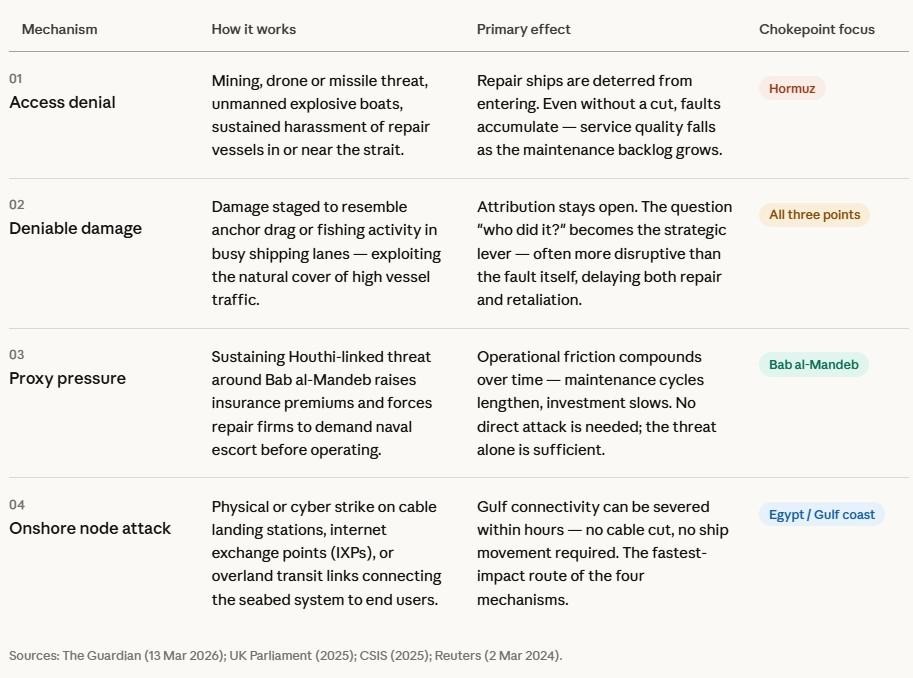
The four mechanisms share a common logic. Each one aims to cause maximum disruption without a traceable cut. Blocking repair access, engineering ambiguity, raising risk premiums through proxies, and striking onshore nodes are all different routes to the same destination: a network degraded not by what was severed, but by what could no longer be maintained.
The March 2026 crisis would not only affect the immediate maritime actors. Its wider impact would be felt through digital connectivity, energy systems, financial services and labour-dependent economies linked to major chokepoints. The matrix below should therefore be read as a scenario-based exposure estimate, not as measured economic loss.
Table 5. Chokepoint Risk Matrix and Economic Exposure by Country and Region
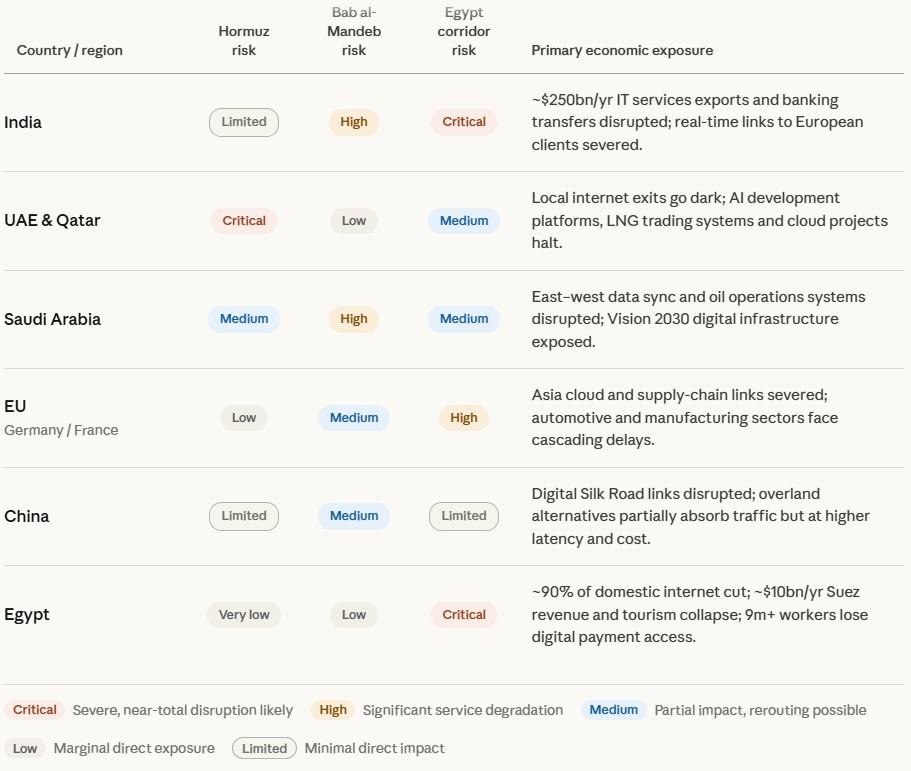
What the Matrix Shows
The table highlights three different forms of vulnerability. India’s main exposure comes from real-time digital services and Europe-Asia connectivity. The UAE and Qatar are more exposed through proximity to Hormuz, cloud infrastructure, LNG-linked systems and emerging AI projects. Egypt stands out because several critical functions converge in the same corridor: Suez revenue, cable landing stations, terrestrial crossings, digital payments and remittance flows.
This does not mean all countries would face the same level of disruption. It shows that a maritime crisis can spread through infrastructure dependencies long before it becomes a direct military or economic shock. In that sense, chokepoint risk is not only about ships and energy flows. It is also about data, payments and the daily services that depend on stable maritime corridors.
When three chokepoints come under pressure simultaneously, individually manageable shocks can begin to interact. The table below is a scenario-based estimate of combined exposure, not an observed loss.
Table 6. If All Three Points Collapse: Economic Impact Projection by Sector (30 Days)
The figures are not forecasts. They show how trade, insurance, data reliability, and public confidence can interact under combined stress.
First, proximity can amplify vulnerability: Gulf states that turn geographic position into economic advantage also inherit concentrated exposure. Second, larger economies may be affected indirectly through Asian supply chains even without a direct cable cut. These findings matter because resilience cannot be reduced to cable count alone; it depends on the interaction between geography, repair access, route diversity, and crisis governance.
Egypt remains among the most exposed nodes within this framework; the country profile above captures why a corridor hosting many cables and terrestrial crossings would be difficult to replace quickly.
For decision-makers, the implication is that cable resilience cannot be judged by cable count alone; it depends on repair access, jurisdiction, route diversity and the ability to coordinate public and private actors during a crisis.
If pressure on the three chokepoints persists, a plausible baseline path over the next 3-12 months would be continued below-threshold pressure rather than a direct cable-cutting campaign: uncertainty around repair access, higher insurance and escort costs, cautious routing, and gradual investment in alternatives. The scenarios below are a spectrum, not forecasts, and are organized around four variables: degree of physical damage, repair access, attribution clarity, and spillover into energy markets.
This scenario depends on diplomatic channels remaining open and on Iran avoiding further escalation. Repair ships, protected where necessary, restore critical links while Tehran signals that the straits will remain open.
Outcome: connectivity gradually improves. The lasting effect is not rupture but institutional learning: insurers, investors, and governments begin treating infrastructure security as a core variable in Gulf digital strategy.
In this scenario, military escalation remains contained, but political and technical fragmentation gradually widens. Iran may deepen cyber isolation while operators and states reassess how much critical traffic should continue to pass through contested routes.
Result: East-West data flows become slower and more politically sensitive. The “splinternet” logic does not immediately split the internet into two blocs, but it accelerates fragmented and geopolitically filtered connectivity.
This severe tail-risk scenario assumes that energy infrastructure is targeted alongside submarine cable pressure and that maritime security around Hormuz deteriorates sharply. It should be treated as a stress case rather than the baseline.
Outcome: disruption around Hormuz could tighten oil supply and push prices sharply higher. If degraded data connectivity coincided with energy stress, latency, routing instability, settlement uncertainty, and insurance pressure could amplify volatility. The risk is not a simple domino effect; it is an interaction among confidence, liquidity, logistics and crisis coordination.
Recent maritime-security practice suggests that trade routes, mine threats and submarine data cables are no longer entirely separate categories (NATO, 2025; UK Parliament, 2025). This does not mean every cable incident will produce systemic collapse, but it does mean submarine data cables should increasingly be assessed alongside mine warfare and maritime transport routes.
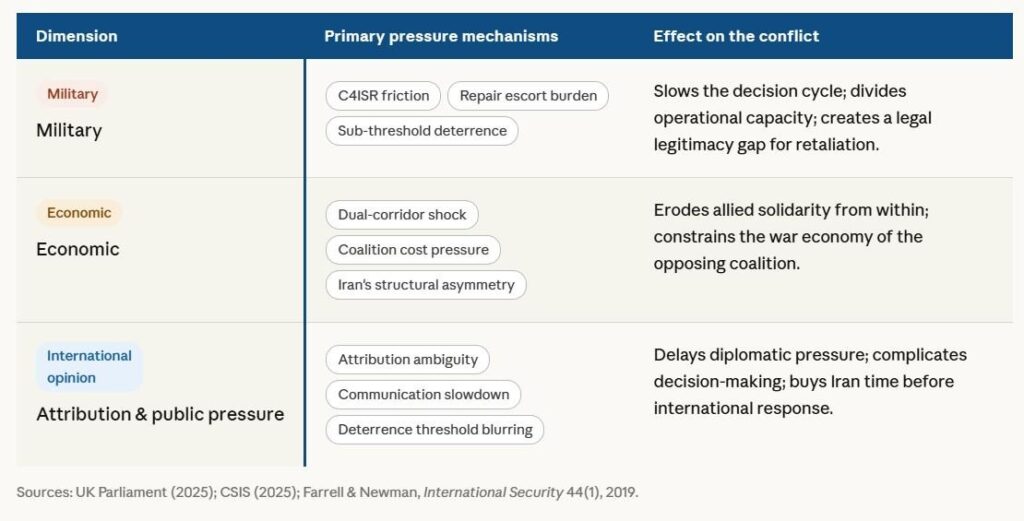
Cable pressure shapes how a conflict is managed as it unfolds. Its effects are rarely automatic or total. Resilience and redundancy reduce the risk of paralysis, but they can still be strained when military decision-making, economic cohesion, and public opinion are affected together.
Pressure on submarine cables may be better understood as friction than as a weapon in itself. It can complicate command, coordination and situational awareness, but it does not automatically paralyze military systems.
U.S. and allied command infrastructure does not depend solely on civilian fiber-optic networks, but these networks are part of the wider communications ecosystem. A disruption could reduce bandwidth, complicate intelligence sharing, or force traffic onto backup routes (UK Parliament, 2025; Carnegie, 2024).
Repair-vessel protection creates another burden. Naval escorts divert resources from other missions, and cable security must coexist with broader operational priorities (NATO, 2025).
Below-threshold pressure also complicates response options. If cable-related pressure remains ambiguous and falls short of an overt attack, legal and diplomatic justification for a military response becomes harder to establish.
Economic pressure can shape how long a conflict is politically sustainable. Submarine cable disruption would not determine the outcome of a war, but it can transmit costs to coalition partners, private operators and markets.
Coalition cohesion may come under strain as indirect costs rise. That does not automatically fracture a coalition, but it can narrow the political space for prolonged military action.
A Hormuz crisis can link energy-market stress with financial uncertainty through insurance costs, shipping delays, market volatility, and concern over data reliability.
Iran’s sanctions-adapted economy may soften some immediate financial shocks, but it would not shield the country from prolonged disruption in energy exports, prices, connectivity and domestic resilience.
The primary public-opinion pressure point is attribution uncertainty. If an outage cannot be officially attributed, claims are harder to substantiate, and neutral actors may wait. When one side reads an incident as a technical fault and the other as provocation, deterrence becomes harder to manage.
A single backup line, alternative route, or satellite layer cannot offset the three-chokepoint risk alone. What is needed is layered resilience: route diversity, repair access, legal clarity and public-private crisis coordination.
Table 7. Comparative Analysis of Redundancy Strategies
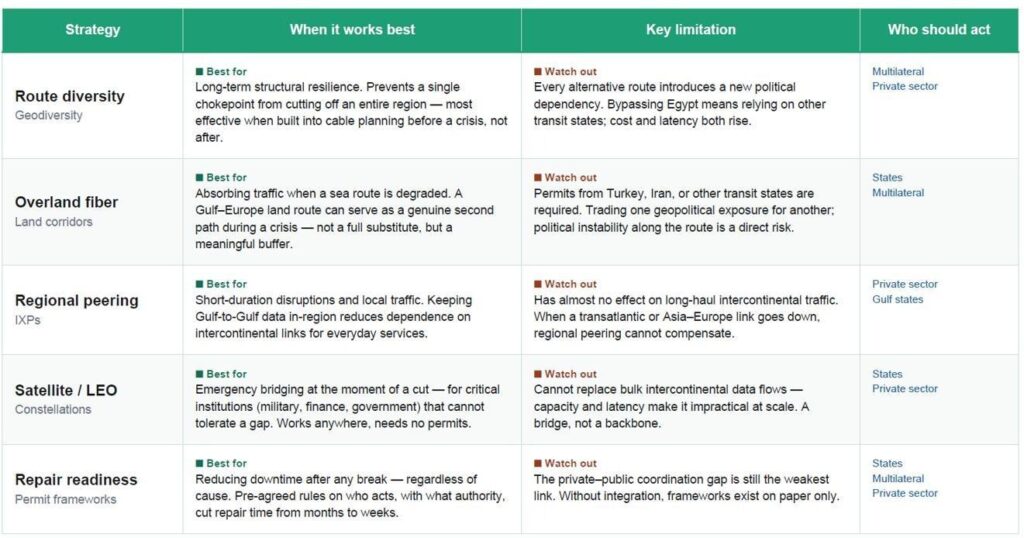
Technical solutions alone are not sufficient. The recommendations below are framed as practical options rather than instructions.
Repair-vessel protection should be treated as an enabling condition for resilience. UNCLOS does not provide a clear wartime framework for repair vessels; a protocol developed through ITU and IMO channels would be worth considering, while recognizing that diplomacy would be gradual.
A joint Digital Infrastructure Resilience Fund could also be explored. Alternative-route investments are often not profitable enough for the private sector to carry on its own, while governments tend to postpone them under budgetary pressure.
A Gulf-specific cable monitoring and repair-escort mechanism would be useful, though it should not be treated as a direct copy of Baltic Sentry. A limited region-specific arrangement would be more realistic than a broad NATO-style framework.
Egypt would benefit from a focused vulnerability-reduction plan. As the country profile above shows, its cable corridor carries both economic and human exposure. Landing-station security and alternative-route investment should therefore be prioritized over time.
Finally, a workable public-private crisis protocol is needed. The ITU IAB framework can serve as a starting point for clarifying who contacts whom, who authorizes action, and which repair assets move first when a cable is disrupted.
The 2026 crisis showed that submarine cables are no longer merely technical infrastructure. They now form part of global/national security and national resilience, even when their effects are indirect and difficult to attribute.
First, shallow-water conflict is becoming more important. Landing points, repair access and escort requirements now matter alongside open-sea operations. Uncertainty that blocks repair can become a strategic pressure tool even when physical damage remains limited.
Second, international law is lagging behind operational reality. UNCLOS does not provide a clear wartime framework for the protection of repair vessels. As infrastructure moves faster than legal adaptation, institutional delay becomes more costly.
Third, weaponized interdependence now has a cable-security dimension. Cable pressure may slow decision-making, test coalition cohesion, and delay diplomatic responses due to attribution uncertainty, although the effects depend on duration, scale, and resilience.
For parties to the crisis, direct cable cutting may not be the most advantageous option in every scenario. A clear trace of sabotage would increase attribution risk and create a stronger basis for counteraction. By contrast, below-threshold pressure could raise the cost of the crisis by delaying repairs and keeping responsibility harder to establish.
Modern conflict in chokepoint environments is increasingly difficult to assess only through sea lanes or mine warfare. Sea lanes, energy flows, mine threats and data cables increasingly belong to the same operational picture. The practical lesson is that repair-vessel protection, public-private coordination and route resilience should be addressed before the next crisis, not improvised during it.
In infrastructure-dependent crises, strategic pressure may increasingly be generated without territorial occupation. Disrupting a few centimeters of fiber-optic cable beneath the sea, or merely sustaining the perception that this is possible, can generate uncertainty and impose costs.
- Farrell, H. & Newman, A. (2019). Weaponized Interdependence: How Global Economic Networks Shape State Coercion. International Security, 44(1), 42-79. https://doi.org/10.1162/isec_a_00351
- Reuters (2026). The Hormuz digital chokepoint: How does the Iran war threaten subsea cables? April 28, 2026. https://www.reuters.com/business/media-telecom/hormuz-digital-chokepoint-how-does-iran-war-threaten-subsea-cables-2026-04-28/
- U.S. Energy Information Administration (2025). Amid regional conflict, the Strait of Hormuz remains critical to the oil trade. June 16, 2025. https://www.eia.gov/todayinenergy/detail.php?id=65504
- ENISA (2023). Subsea Cables – What is at Stake? July 2023. https://www.enisa.europa.eu/publications/undersea-cables
- UK Parliament (2025). Subsea telecommunications cables: resilience and crisis preparedness. September 19, 2025. https://publications.parliament.uk/pa/jt5901/jtselect/jtnatsec/723/report.html
- CSIS (2025). The Strategic Future of Subsea Cables: Egypt Case Study. November 12, 2025. https://www.csis.org/analysis/strategic-future-subsea-cables-egypt-case-study
- ITU (2026). IAB WG1 Recommendations. February 2026. https://www.itu.int/digital-resilience/submarine-cables/wp-content/uploads/sites/2/2026/02/IAB-WG1-Recommendations.pdf
- ICPC Best Practices v1.2. https://www.iscpc.org/documents/?id=3733
- NATO (2025). NATO launches Baltic Sentry to enhance security of critical infrastructure. January 14, 2025. https://www.nato.int/en/news-and-events/articles/news/2025/01/14/nato-launches-baltic-sentry-to-increase-critical-infrastructure-security
- Besch, S. & Brown, E. (2024). Securing Europe’s Subsea Data Cables. Carnegie Endowment for International Peace, December 16, 2024. https://carnegieendowment.org/research/2024/12/securing-europes-subsea-data-cables?lang=en
- TeleGeography (2025). Submarine Cable Map 2025. https://submarine-cable-map-2025.telegeography.com/
- S&P Global (2025). Houthi attacks boost insurance rates, but ship traffic is not yet affected. July 9, 2025. https://www.spglobal.com/energy/en/news-research/latest-news/shipping/070825-houthi-attacks-boost-insurance-rates-ship-traffic-not-yet-affected
- Rest of World (March 4, 2026). War in the Gulf: The Fragile Geometry of Subsea Cables and AI Ambitions. https://restofworld.org/2026/us-iran-war-gulf-ai-submarine-cables/
- Rest of World (March 11, 2026). Gulf Overland Data Cables and the War in Europe. https://restofworld.org/2026/gulf-overland-data-cables-europe-war/
- The Guardian (March 7, 2026). Drone strikes cast doubt on the Gulf’s status as an AI superpower. https://www.theguardian.com/world/2026/mar/07/it-means-missile-defence-on-data-centres-drone-strikes-raises-doubts-over-gulf-as-ai-superpower
- The Guardian (March 12, 2026). Iran escalates attacks on infrastructure and transport. https://www.theguardian.com/us-news/2026/mar/12/first-thing-iran-escalates-attacks-infrastructure-transport
- The Guardian (March 13, 2026). What is the Strait of Hormuz? Can the US stop Iran from blocking it? https://www.theguardian.com/world/2026/mar/13/what-is-strait-hormuz-can-us-stop-iran-blocking-it
- Reuters (March 2, 2024). Yemen’s Houthis blame UK, US for glitch in Red Sea undersea cables. https://www.reuters.com/world/middle-east/yemens-houthis-blame-uk-us-glitch-red-sea-undersea-cables-2024-03-02/
- Associated Press (2025). Undersea cables cut in the Red Sea, disrupting internet access in Asia and the Middle East. September 7, 2025. https://apnews.com/article/red-sea-undersea-cables-cut-internet-disruption-yemen-b79fe7b9764647ac0851b9390a313e70
- Encyclopaedia Britannica. Strait of Hormuz. https://www.britannica.com/place/Strait-of-Hormuz
- gCaptain (2018). Bab el-Mandeb explainer. https://gcaptain.com/explainer-what-is-the-bab-el-mandeb-strait-and-why-is-it-important/
click HERE to download as PDF.