

Key Points :
- Two-level game theory frames international negotiation as bargaining that happens simultaneously abroad and at home
- The US–Iran talks of 2026 have produced a tentative memorandum of understanding but no durable peace
- Treating Israel as an external veto player rather than a junior partner is the missing variable.
When a government negotiates with a foreign adversary, it is never only negotiating with that adversary. That is the core insight of the framework political scientist Robert Putnam introduced in his 1988 article on the logic of two-level games. Putnam described diplomacy as two interlocking boards. At Level I, national leaders bargain across the table to reach a tentative deal. At Level II, each leader must take that deal home and win ratification from the constituencies, legislatures, bureaucracies, and interest groups that can block it.
The pivotal concept is the win-set: the range of possible Level I agreements that a leader’s Level II audience would actually accept. An agreement is only possible where the two sides’ win-sets overlap. A larger win-set makes a deal more likely; a small one makes a leader a tougher bargainer but raises the risk that no overlap exists at all. The chief negotiator sits between the boards as a kind of gatekeeper and can sometimes use domestic constraints as leverage (e.g. “I’d love to agree, but my parliament will never ratify it.”) Putnam derived the model partly from his study of Western economic summitry in the late 1970s, where he noticed governments adopting policies they would not have chosen in the absence of their negotiating partners.
The model’s most useful warning concerns what Putnam called “involuntary defection”: a leader negotiates in good faith, strikes a deal at the table, and then cannot deliver because ratification fails at home. The agreement collapses not from bad faith but from a misjudged win-set. As this piece argues, the US–Iran talks are a textbook case, but with a twist Putnam did not fully anticipate.
The diplomacy now underway is the latest cycle in a relationship that has repeatedly swung between negotiation and bombardment. After roughly six weeks of fighting, Pakistan brokered a conditional two-week ceasefire in early April, and talks resumed in Islamabad. They failed on the one issue that mattered. President Trump reported that most points were agreed but the only point that really mattered, nuclear, was not, describing Iran as unyielding, while Tehran’s foreign minister insisted a deal was “inches away” and blamed American maximalism. By late May, negotiators had reached a tentative memorandum of understanding that would open the Strait, lift the US blockade, and begin a 60-day window to settle the fate of Iran’s stockpile of highly enriched uranium. However, Trump had not signed off, and the hardest nuclear questions remained unresolved.
Then the talking and the shooting resumed at once. In early June, Iran struck Kuwait’s international airport, killing one person and wounding dozens, and traded fire with US forces. Days later the US military said it had struck Iranian coastal radar sites at Sirik and on Qeshm Island after shooting down drones Iran launched toward Hormuz; Tehran called the strikes a clear violation of the ceasefire.
The pattern is the point. Negotiations continue, ceasefires are announced, frameworks are drafted but yet no decisive termination of the war arrives, and the fighting keeps re-erupting. In the language of the model, the two boards keep yielding a Level I text, but the win-sets do not durably overlap on the core question: the future of Iran’s nuclear program. To see why, look at each side’s second level.
Iran’s ratifying coalition has been reshaped by the very strikes meant to coerce it. The killing of Khamenei and of Ali Larijani, a central figure in the negotiations, removed the actors most associated with a diplomatic track and elevated a leadership that must now prove its resolve to a wounded establishment. The Islamic Revolutionary Guard Corps, the new Supreme Leader’s circle, and a hawkish parliament are the constituencies any Iranian negotiator must satisfy. Parliament speaker Mohammad Bagher Qalibaf captured the mood with the posture that Tehran extracts concessions through missiles rather than dialogue and trusts only actions, not words.
The resulting win-set is narrow and rigid. Iran has insisted on a right to enrich uranium (while calling the level negotiable), refused to transfer its enriched stockpile abroad, demanded some $270 billion in reparations, sought firm international guarantees against future attack, and rejected further temporary ceasefires in favor of a comprehensive settlement. Against US demands for “zero enrichment” and curbs on missiles and proxies, that leaves only a sliver of common ground. A leadership that has just absorbed a decapitation strike cannot ratify a deal that looks like the surrender its enemies demanded, even if the negotiators at the table would privately take it. Iran’s win-set, in short, contracted at the exact moment Washington needed it to expand.
The American second level is more layered than the model’s standard one-audience setup. Two domestic ratifiers are pulling against the war. The first is public opinion. Polling through the conflict has shown majorities souring on it: one survey found a clear majority judging the war had done more harm than good, and earlier polling found pluralities opposing the airstrikes and strong resistance to any deployment of ground troops. The economic backlash with higher fuel prices tied to the disruption of Hormuz has sharpened that discontent.
The second is Congress. In a string of votes, lawmakers have tried to invoke the War Powers Resolution to force the president to seek authorization or wind down the conflict. In June 2026 the House passed such a resolution 215 to 208, with four Republicans crossing the aisle-a bipartisan rebuke even if unlikely to become law. The Senate had advanced a parallel measure in May, with several Republicans defecting, though such efforts have so far been thwarted. These ratifiers do not, by themselves, force an exit. But they shrink the president’s room to sustain an open-ended war and should, in a conventional two-level reading, push Washington toward a deal.
So why does the deal keep slipping? Because there is a third audience, the standard model does not seat.
The decisive complication is that the United States must satisfy not only its public and its Congress but also Israel. It’s an actor outside the American polity whose disapproval nonetheless carries real domestic and strategic cost, and whose objectives diverge sharply from Washington’s. Analysts across the spectrum have documented the gap. The Carnegie Endowment described diverging US and Israeli goals over oil and leadership targets, noting that Trump appeared drawn to a “Venezuela model” of dealing with a pragmatic insider and accessing resources, while Netanyahu kept regime change as the central objective. Reporting on the alliance found the two governments fighting the same war toward different definitions of victory: the US defense secretary declared “this is not a regime change war,” even as Netanyahu repeatedly described regime change as essential.
The divergence is structural, not personal. As one regional analysis put it, while Washington seeks to contain Iran and protect energy markets, Israel has pursued a far more maximalist aim of collapsing the regime and therefore views any US–Iran diplomatic breakthrough as a threat rather than a prize. Israel’s foreign minister has called the removal of enriched uranium from Iran a precondition for ending the war; its prime minister has said unfinished goals will be completed “either through diplomacy or by fighting.” When Israel struck Iran’s South Pars gas field, Trump publicly said he had told Netanyahu not to, underscoring that the ally can act unilaterally in ways that detonate the American negotiating position. The Israeli leadership and public, having absorbed years of existential framing around Iran, would regard a deal that leaves the Iranian state intact and a residual nuclear capacity in place as, in the words of one Israeli commentary, an epochal failure.
Here is the crux. Israel is not a formal ratifier of a US–Iran agreement. It holds no vote in Congress and casts no ballot in an American election. Yet it functions as a quasi-ratifier whose objection imposes costs that a US president must price in: political costs through domestic constituencies and allied lawmakers, and strategic costs through Israel’s capacity to spoil any deal by acting on its own. In effect, Washington’s effective win-set is bounded not only from within, by public and congressional limits, but from outside, by an ally whose acceptable range barely overlaps with Tehran’s. When the American win-set is squeezed simultaneously by a war-weary public that wants out and an ally that wants the war prosecuted to regime collapse, the space for an agreement that also fits Iran’s shrunken win-set can vanish entirely.
Putnam’s framework can absorb this, but only if it is extended. The standard model assumes the negotiator’s constraints are internal, such as voters, legislatures, bureaucracies. Iran fits that assumption. The United States does not, because one of its most binding constraints is an external state. The fix is to treat Israel as an “external veto player” in the sense developed in the veto-player literature: an actor whose assent is functionally required for a stable agreement and whose preferences therefore reshape the feasible set. Scholars adapting Putnam to the European Union have already shown that some negotiations are better modeled as three-level games, where an intermediate or external block sits between the international table and the purely domestic one. Others have shown that win-sets are not fixed by formal institutions alone but are dynamically reshaped by “super-influencers” and transnational actors outside the formal ratification chain.
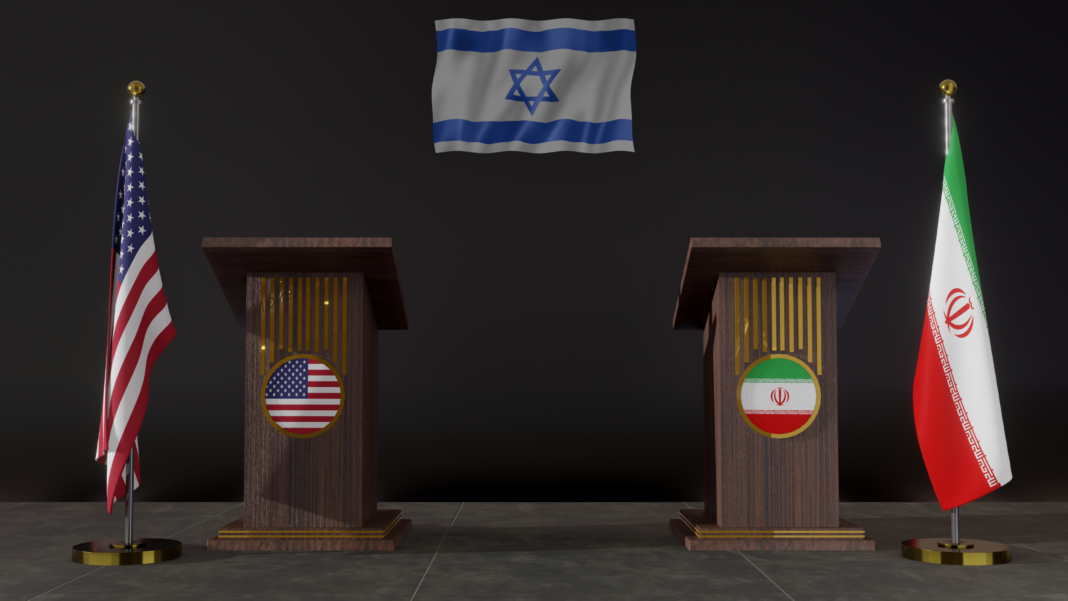
Applied here, the US–Iran negotiation may be read as a three-level game. Level I is the table in Islamabad or Muscat. Level II is the American domestic board of public and Congress. A new Level I-and-a-half, an allied board-seats Israel, whose approval is informal but materially decisive. A durable agreement requires the simultaneous overlap of three win-sets, not two. And the model’s warning about involuntary defection becomes its central prediction: even when Washington and Tehran converge at the table, an Israeli strike like the one on South Pars, or an Israeli precondition like the removal of enriched uranium, can collapse the deal from the outside before it is ratified. That is precisely the dynamic visible in the fraying ceasefire, which is the text agreed at one board, blown apart at another.
The extension is not merely academic. It points to two practical paths for any US negotiator. The first is to bring Israel inside the win-set, specifically by co-opting it through security guarantees, intelligence assurances, or staged commitments that make an imperfect deal tolerable to Israeli ratifiers. The second is to insulate the agreement from external spoiling, specifically building enforcement, monitoring (the IAEA has warned that any deal without resumed inspections is an “illusion of an agreement”), and reciprocal restraints robust enough to survive an ally’s unilateral action. A negotiator who models only two boards will keep being surprised by the third.
The US–Iran talks of 2026 are not failing because diplomats are inept or because a deal is unimaginable. They are failing because the negotiation is being played as a two-level game when it is in fact a three-level one. Tehran’s win-set has contracted around the demands of a hardline coalition forged in war. Washington’s has been squeezed between a public that wants the war ended and an ally that wants it to be won outright. The overlap among all three, Iran, the American domestic board, and Israel, is, for now, close to empty. That is why frameworks are signed and then violated, why ceasefires hold for days and not months, and why the latest exchange of strikes around Hormuz looks less like a rupture than like the structure of the problem revealing itself.
Putnam taught that the hardest part of diplomacy is often not persuading the adversary but delivering one’s own side. In this war, the United States has a third side to deliver, and it sits at a table no one has formally set. Until the analysis and the diplomacy account for the external veto, the cycle of talk, truce, and renewed fire is likely to continue.
- Putnam, Robert D. “Diplomacy and Domestic Politics: The Logic of Two-Level Games.” International Organization 42, no. 3 (Summer 1988): 427–460. Cambridge University Press. https://www.cambridge.org/core/journals/international-organization/article/abs/diplomacy-and-domestic-politics-the-logic-of-twolevel-games/B2E11FB757C4465C4097015BD421035F
- Putnam, Robert D. “Diplomacy and Domestic Politics: The Logic of Two-Level Games.” International Organization 42, no. 3 (Summer 1988): 427–460. Cambridge University Press. https://www.cambridge.org/core/journals/international-organization/article/abs/diplomacy-and-domestic-politics-the-logic-of-twolevel-games/B2E11FB757C4465C4097015BD421035F
- Facts about deceased Iranian security chief Ali Larijani, March 17, 2026. Reuters, https://www.reuters.com/world/middle-east/facts-about-deceased-iranian-security-chief-ali-larijani-2026-03-17/
- Loft, Philip. “US-Iran ceasefire and nuclear talks in 2026.” House of Commons Library, 3 June 2026. https://commonslibrary.parliament.uk/research-briefings/cbp-10637/
- “US and Iran reach tentative agreement though Trump hasn’t signed off on it.” CNN, 28 May 2026. https://www.cnn.com/2026/05/28/world/live-news/iran-war-us-news
- “U.S. and Iranian negotiators reach tentative deal to extend ceasefire and start new nuclear talks.” PBS NewsHour, 28 May 2026. https://www.pbs.org/newshour/world/u-s-and-iranian-negotiators-reach-tentative-deal-to-extend-ceasefire-and-start-new-nuclear-talks
- Da Silva, Chantal, and Abigail Williams. “Iran attacks Kuwait, trades strikes with U.S. in test to ceasefire.” NBC News, 3 June 2026. https://www.nbcnews.com/world/iran/iran-attacks-kuwait-strikes-us-ceasefire-peace-talks-trump-rcna348213
- “Ceasefire faces further strain as US and Iran launch strikes.” CNN, 6 June 2026. https://www.cnn.com/2026/06/06/world/live-news/iran-war-trump-israel-lebanon
- “Trump ends Iran meeting without announcing ‘final determination’ on deal.” CNBC, 29 May 2026. https://www.cnbc.com/2026/05/29/trump-iran-deal-hormuz-nuclear-war.html
- “US House passes Iran war powers resolution in rare pushback against Trump.” Al Jazeera, 3 June 2026. https://www.aljazeera.com/news/2026/6/3/us-house-of-representatives-passes-war-powers-resolution-in-rebuke-to-trump
- “Red line on Iran? Majority of Americans say ‘no’ to boots on ground.” Angus Reid Institute, via Opinion Today, 6 March 2026. https://opiniontoday.substack.com/p/260306
- “What’s next for the War Powers Resolution on Iran? PolitiFact explains.” PBS NewsHour, 4 June 2026. https://www.pbs.org/newshour/politics/whats-next-for-the-war-powers-resolution-on-iran-politifact-explains
- Lob, Eric. “The Diverging U.S. and Israeli Goals in Iran Are Making the Endgame Even Murkier.” Carnegie Endowment for International Peace, 3 April 2026. https://carnegieendowment.org/emissary/2026/03/iran-us-israel-goals-diverge-oil-leaders
- “The U.S. and Israel are fighting the same war — but not always toward the same goals.” MSNBC, 30 March 2026. https://www.ms.now/news/iran-war-us-israel-regime-change-disagreement
- “Why diverging US-Israel goals complicate how the Iran war ends.” The New Arab, 28 March 2026. https://www.newarab.com/analysis/why-diverging-us-israel-goals-complicate-how-iran-war-ends
- “Reported terms of Trump’s Iran deal would confirm the war as an epochal failure.” The Times of Israel, May 2026. https://www.timesofisrael.com/reported-terms-of-trumps-iran-deal-would-confirm-the-war-as-an-epochal-failure/
- “The Interaction Effects of Bargaining Power: The Interplay Between Veto Power, Asymmetric Interdependence, Reputation, and Audience Costs.” Negotiation Journal 34, no. 3 (2018). MIT Press. https://direct.mit.edu/ngtn/article/34/3/219/121616/The-Interaction-Effects-of-Bargaining-Power-The
- Bonvicini, Gianni. “Playing Three-Level Games in the Global Economy.” EU Diplomacy Papers, College of Europe, 2008. https://aei.pitt.edu/9599/1/EDP_4_2008.Bonvicini.pdf
- “Domestic Veto Players and Negotiation Dynamics: Canadian Internal Politics and International Agreements.” Negotiation Journal, MIT Press, 2025. https://direct.mit.edu/ngtn/article/doi/10.1162/NGTN.a.41/134143/Domestic-Veto-Players-and-Negotiation-Dynamics
click HERE to download as PDF.