

Key Points :
- Pilot scarcity, force structure constraints, and China’s public MUM-T demonstration are driving a procurement surge that is already behind schedule for most Western militaries.
- MUM-T solves five structural problems simultaneously – survivability, affordable mass, cognitive load, saturation defense, and persistent ISR – at a cost conventional force design cannot match.
- Doctrine, legal accountability, and procurement pace are the binding constraints – not technology. NATO formations already failed against low-cost drone operators in 2025 exercises.
- Ukraine’s conditional autonomy model – autonomous operation when comms are jammed – achieves 80 percent hit rates and is available for adoption now, without waiting for the next conflict.
- Autonomy software is the decisive economic and strategic chokepoint; platform primes hold contracts but software-first firms hold the leverage that determines interoperability and export dependency.
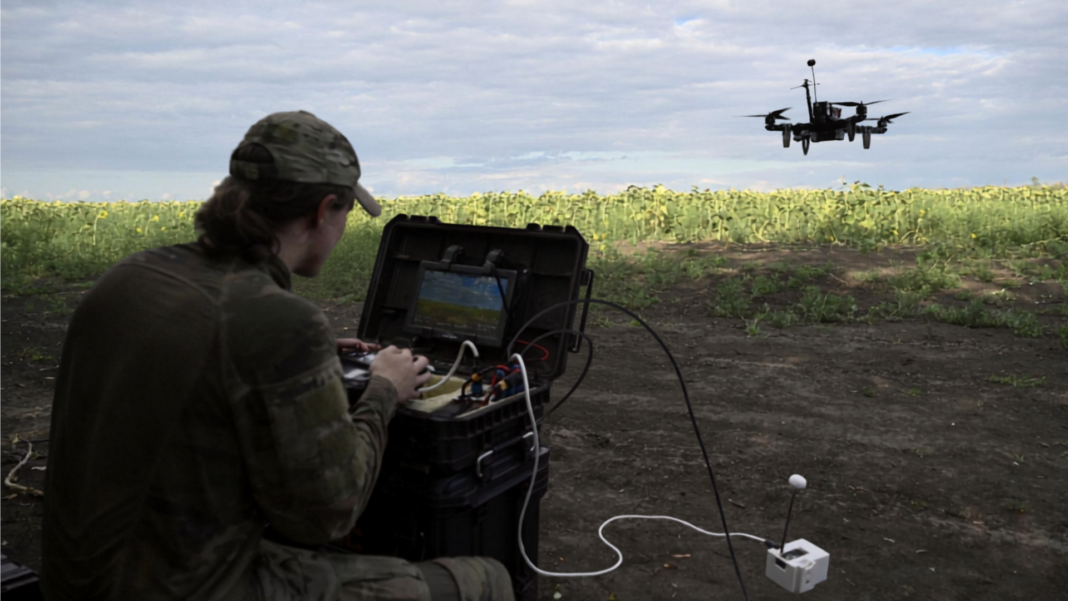
Ten Ukrainian drone operators rendered two NATO battalions combat-ineffective in twelve hours. That exercise result, recorded in 2025, is the sharpest summary of why the United States, Australia, the United Kingdom, China, and a widening circle of middle powers are committing billions to manned-unmanned teaming – and why the race is already behind schedule for most of them.
Three converging realities explain the investment surge. The first is the cost and scarcity of human pilots. A modern combat pilot requires roughly a decade and $10 million to produce. Sending one into the forward edge of a contested airspace – where advanced integrated air defences are optimised to kill expensive crewed aircraft – is a command decision taken reluctantly and only when necessary. An autonomous wingman absorbs that risk instead. If it is shot down, the loss is measured in dollars and production capacity, not in trained aircrew.
The second is force structure. Western militaries have contracted steadily for thirty years while the threat environment has not. A single pilot directing two to eight autonomous aircraft generates the tactical mass of a larger formation without the manning, the training pipeline, or the basing footprint. The U.S. Air Force’s Collaborative Combat Aircraft programme is built on exactly this logic, explicitly targeting 100 to 150 autonomous drones in Increment 1 – expanding the effective fleet at a fraction of the cost of additional crewed aircraft.
The third is competitive pressure. China publicly demonstrated a J-20 stealth fighter operating alongside a GJ-11 stealth drone and a J-16D electronic warfare aircraft in November 2025. When a strategic competitor publicly shows a formation that combat simulations suggest could achieve a 95 percent win rate against a solitary F-22, the investment case ceases to be optional.
The operational benefits span five distinct problems that conventional force structures cannot solve cost-effectively.
Survivability is the most immediate. Autonomous platforms operate in the highest-threat zones while crewed aircraft remain at standoff range, directing rather than leading. The kill probability that makes forward ISR and suppression missions dangerous for human crews becomes acceptable when the platform absorbing that probability costs a fraction of a crewed equivalent and carries no aircrew.
Affordable mass follows directly. Autonomous wingmen cost roughly 10 to 30 percent of a crewed aircraft. Fielding 80 autonomous platforms alongside 20 crewed aircraft generates the numerical advantage of a 100-aircraft fleet at the budget of a 30-aircraft one. The U.S. Congressional Research Service confirmed a budget allocation of $8.9 billion for the CCA programme across fiscal years 2025 to 2029 – substantial, but a fraction of what an equivalent crewed fleet would cost.
Cognitive load reduction is where AI earns its value. A modern combat mission demands simultaneous management of navigation, threat assessment, weapons systems, formation coordination, and sensor fusion. MUM-T architecture assigns the data-intensive tasks – processing sensor feeds, monitoring the electromagnetic environment, maintaining track files – to autonomous systems, presenting the pilot with a synthesised operational picture and reserving human attention for the decisions that require it.
Saturation defence has emerged as a fourth critical application following Iran’s March 2026 drone campaign against Gulf Cooperation Council states, which produced more than 1,450 strikes in its first week. High-end interceptors costing hundreds of millions cannot economically defeat Shahed-class platforms costing $20,000 to $50,000 per unit in a sustained campaign. Autonomous interceptor layers that match the attacker’s cost structure are the structural answer – and Ukraine has already proven the concept in offensive operations.
Persistent ISR completes the capability picture. Unmanned platforms can maintain continuous surveillance of an operational area for durations that crewed aircraft cannot. Ukraine’s conflict has translated this from a theoretical advantage into a baseline reality: the transparent battlefield created by ubiquitous unmanned ISR is now the environment in which all future land and maritime operations will be conducted.
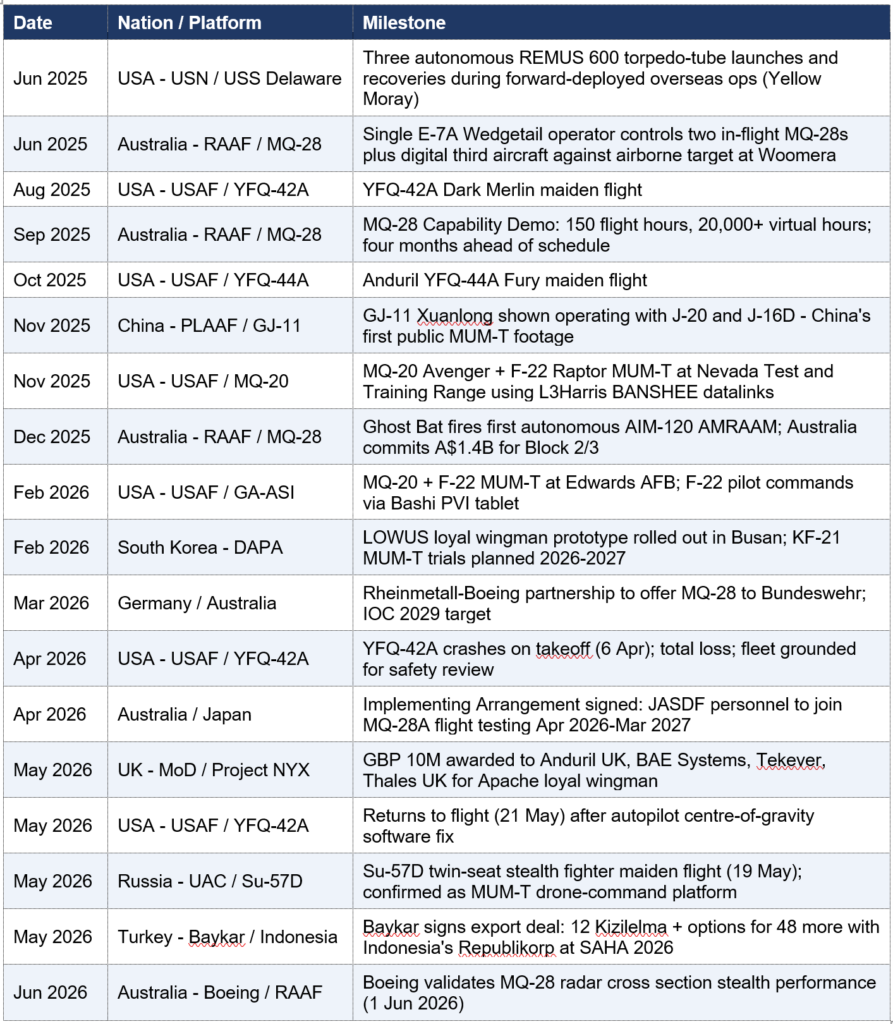
Progress across the major programmes has been rapid and, in one case, honest about setbacks. The table records verified milestones from primary sources.
The binding constraint in MUM-T is not the technology. The platforms fly. The weapons engage. The data links work. What has not kept pace is the institutional infrastructure needed to use the capability.
The doctrine gap is the most consequential. The 2025 NATO exercise result – ten Ukrainian operators defeating a British brigade and Estonian units over twelve hours, destroying 17 armoured vehicles and rendering two battalions combat-ineffective – was not a demonstration of superior hardware. The Ukrainian operators used commercially available ISR drones and FPV strike platforms. NATO formations failed because they had no trained response to ubiquitous unmanned surveillance and no doctrine for contesting a drone-saturated environment. The same gap operates at a higher level of complexity in the CCA programme: there is no established aviation doctrine for a single F-22 or F-35 pilot directing eight autonomous wingmen in a contested environment. The UK’s Project NYX principle of commanding rather than controlling – crews issue mission objectives, autonomous platforms make independent tactical decisions within those parameters – is the correct conceptual direction, but the boundary between mission command and tactical control has not been defined, tested, or trained against.
Legal accountability remains an open problem that major military powers are actively avoiding. At the UN General Assembly in May 2025, officials from 96 countries met to address autonomous weapons systems. Human Rights Watch identified the structural difficulty: holding operators criminally liable for the unpredictable actions of a machine they cannot fully control is both legally untenable and arguably unfair, while the chain of responsibility back to software developers and programme managers has no clear basis in existing law. The Group of Governmental Experts on lethal autonomous weapons systems has been deliberating since 2014. No binding treaty exists. The United States, China, and Russia have each resisted binding restrictions that would constrain their programmes.
Electronic warfare vulnerability is real but a solution path exists. The most effective counter to autonomous systems in Ukraine has been jamming RF communications links and spoofing GPS. Both sides have converged on the same answer: fibre-optic FPV drones that use a physical tether immune to jamming. Russia was producing an estimated 50,000 or more per month by September 2025; Ukraine adopted the technology in parallel. Integrating this tri-modal architecture – RF for long-range management, low-earth-orbit satellite links as a resilient backup, fibre-optic for the terminal phase – into formal MUM-T platforms is an engineering challenge, not a fundamental barrier.
Procurement pace is the structural mismatch that the others compound. Ukrainian drone curricula are revised every two weeks. Designs one year old are tactically obsolete. The formal defence acquisition cycle runs in years. The answer – open-architecture software platforms that accept capability updates at software release speeds rather than weapons programme timelines – is known. Applying it inside traditional procurement institutions is a different problem, and one that no major MUM-T programme has yet resolved.
The most immediately actionable opportunity is the operational evidence Ukraine has already generated. The conditional autonomy model – in which a platform operates under human guidance when communications are intact and executes the mission autonomously when the link is jammed – has achieved approximately 80 percent hit rates in heavily contested electromagnetic environments. That performance is demonstrably higher than fully human-controlled operation under the same conditions. Formal MUM-T programmes can adopt this architecture now, without waiting for the next conflict to validate it.
Coalition interoperability offers a second structural opportunity whose deterrent value exceeds any single national programme. U.S. Special Forces used Ukrainian Magura-type unmanned surface vessels at Exercise Balikatan 2026 near Taiwan to sink a target vessel – a direct operational transfer of combat-proven Ukrainian doctrine into allied practice within months of the conflict demonstrating it. Japan’s participation in Australia’s MQ-28 testing, Singapore’s integration with Anduril’s Lattice platform, and the Rheinmetall-Boeing partnership offering the Ghost Bat to Germany all point toward a coalition autonomous mass architecture whose combined effect creates switching costs for adversaries that no single national programme generates alone.
The economic value chain runs through four tiers. Platform primes – Boeing, Lockheed Martin, BAE Systems, Airbus – sit at the top as system integrators and capture the largest contract values. But the decisive assets are increasingly held in the tier below them: autonomy software firms such as Anduril, Shield AI, and Palantir, which provide the AI, edge computing, and swarm coordination that determines operational performance. Component and sensor suppliers – radar, EO/IR sensors, datalinks, processing hardware – form the third tier, and a fourth layer of services, simulation environments, and training completes the chain.
The strategic value chain is distinct but intersecting. It runs through five nodes: force multiplication without force expansion; export leverage as partner nations integrate into a supplier’s autonomy architecture and data standards; standard-setting, since whoever defines interoperability protocols shapes coalition architecture for a generation; industrial base as deterrence signal, because a production capacity that atrophies in peacetime cannot be surged in a crisis; and competitive position against China, whose civil-military fusion strategy means MUM-T investment simultaneously develops military capability and commercial AI leadership. The White House America First Arms Transfer Strategy of February 2026 formalised what had previously been a commercial by-product: the production of a prioritised sales catalog directing which platforms the United States would encourage allies and partners to acquire.
The two chains converge on a single chokepoint – the autonomy software layer. This layer is simultaneously the highest-value economic asset (captured by software-first firms rather than the traditional platform primes) and the decisive strategic differentiator (whoever controls the autonomy stack controls interoperability, export dependency, and operational performance under contested electromagnetic conditions). Nations and firms that cede this layer, even while retaining the airframe or hull, forfeit the leverage the programme was designed to generate. The intensifying race among stakeholders to dominate autonomy standards and interoperability frameworks is not a commercial competition with military implications. It is a strategic competition expressed through commercial activity.
The near-term development path is defined by existing programme schedules. The USAF is advancing to CCA Increment 2, engaging more than 20 companies, with the autonomy software competition between Shield AI’s Hivemind and Collins Aerospace’s Sidekick producing a government reference architecture that both YFQ airframes must support. Australia’s Ghost Bat Block 2 is on track for 2028 service entry, with Japan’s participation in flight testing laying the groundwork for the first formal allied loyal wingman interoperability arrangement. The UK’s Project NYX targets 2030 initial operating capability. FCAS and GCAP demonstrators are planned for the early 2030s.
The most important next step is not on any of those programme schedules. It is the institutional work of absorbing the operational evidence that Ukraine has already generated – revising doctrine, restructuring training, and reforming acquisition to match the pace at which autonomous systems capabilities now change. The French Institute of International Relations identified the risk directly: systematic battlefield data collection by Chinese and Russian AI models already poses a risk of NATO losing a technological competition in the current development cycle, not in a future conflict. The window for absorbing that lesson on allied terms is open. It will not remain open indefinitely.
MUM-T has left the experimental phase. It is operational in air, maritime, and ground domains, funded at scale across the world’s leading militaries, and validated under sustained high-intensity combat in Ukraine. The milestones of 2025 and 2026 – the first autonomous fighter-class aircraft flights, the first autonomous air-to-air missile engagement, the first torpedo-tube autonomous recovery deployment – show a programme delivering, not promising.
The investment logic is sound and the problems it addresses are structural, not temporary. Pilot scarcity, force size constraints, cognitive load in multi-domain operations, and the economics of saturation attack are not going away. MUM-T provides a coherent answer to all four, at a cost structure that conventional force design cannot match.
The obstacles are institutional rather than technical. Doctrine can be written. Legal frameworks can be agreed if political will catches up with operational reality. Procurement can be restructured around open-architecture software. None of these requires a technology breakthrough. They require decisions.
The nations that close the doctrine gap, secure the autonomy software layer, and build interoperability into their programmes from the outset will field systems that function in the electromagnetic environments peer adversaries can create. Those that treat MUM-T as a hardware procurement and neglect the software, the doctrine, and the coalition integration will arrive at the next conflict with excellent platforms and no adequate answer to an adversary who understood the lesson first.
- MQ-28 Ghost Bat autonomous AIM-120 engagement / Capability Demo 2025 – Boeing Investor Relations https://investors.boeing.com/investors/news/press-release-details/2025/Boeing-RAAF-Achieve-CCA-Missile-Fire-from-MQ-28-Ghost-Bat/default.aspx
- MQ-28 Capability Demonstration 2025 – 150 flight hours, ahead of schedule – Boeing Investor Relations https://investors.boeing.com/investors/news/press-release-details/2025/Boeing-RAAF-Prove-MQ-28-Operational-Effectiveness/default.aspx
- USAF designates YFQ-42A and YFQ-44A mission design series – U.S. Air Force (af.mil) https://www.af.mil/News/Article-Display/Article/4092641/air-force-designates-two-mission-design-series-for-collaborative-combat-aircraft/
- GA-ASI / USAF MUM-T with F-22 and MQ-20 at Edwards AFB and NTTR – General Atomics Aeronautical Systems https://www.ga-asi.com/ga-asi-and-usaf-demonstrate-manned-unmanned-teaming-with-f-22-and-mq-20-in-joint-autonomy-exercise
- Anduril’s YFQ-44A Begins Flight Testing for the Collaborative Combat Aircraft Program- Anduril We https://www.anduril.com/news/anduril-yfq-44a-begins-flight-testing-for-the-collaborative-combat-aircraft-program
- U.S. Navy Highlights Breakthrough UUV Operations Using HII-Built Technologies https://www.hii.com/news/u-s-navy-highlights-breakthrough-uuv-operations-using-hii-built-technologies
- REMUS 620 first torpedo-tube recovery; DIU production TTLR contract – HII Newsroom https://www.hii.com/news/remus-620-conducts-first-torpedo-tube-recovery-and-swimout
- Shield AI Hivemind controls BQM-177A defensive CAP at Point Mugu – USNI Proceedings https://www.usni.org
- British-based firms lead the way for Apache helicopter support drones https://www.gov.uk/government/news/british-based-firms-lead-the-way-for-apache-helicopter-support-drones
- Shield AI Hivemind and Collins Sidekick confirmed as CCA autonomy finalists – FlightGlobal https://www.flightglobal.com/military-uavs/us-air-force-confirms-selection-of-first-autonomous-fighter-coming-by-year-end/166441.article
- Rheinmetall-Boeing partnership to offer MQ-28 to Bundeswehr – Rheinmetall AG https://www.rheinmetall.com/en/media/news-watch/news/2026/03/2026-03-31-rheinmetall-and-boeing-partner-on-german-mq-28-ghost-bat
- YFQ-42A crash on takeoff 6 April 2026; returns to flight May 2026 – FlightGlobal https://www.flightglobal.com/military-uavs/2026/05/yfq-42a-returns-to-flight-tests-after-software-fix/
- YFQ-42A returns to flight 21 May 2026 after autopilot CG software fix – General Atomics Aeronautical Systems https://www.ga-asi.com/yfq-42a-returns-to-flight-testing
- MQ-28 logs first international flights in allied airspace https://www.boeing.com/features/2026/05/mq-28-logs-first-international-flights-in-allied-airspace
- MQ-28 stealth expands mission options for customers https://www.boeing.com/features/2026/06/mq-28-stealth-expands-mission-options-for-customers
- Australian Government – A$1.4B funding for MQ-28 Block 2/3 – Australian Minister for Defence https://www.minister.defence.gov.au/media-releases/2025-12-09/funding-boost-australian-made-ghost-bat
- Australia-Japan Implementing Arrangement for MQ-28A flight testing – Army Recognition https://www.armyrecognition.com/news/aerospace-news/2026/australia-approves-japanese-participation-in-mq-28a-ghost-bat-drone-testing-under-new-agreement
- South Korea LOWUS loyal wingman prototype unveiled in Busan – The War Zone https://www.twz.com/air/south-koreas-loyal-wingman-air-combat-drone-unveiled
- GJ-11 Xuanlong with J-20 and J-16D – China’s first public MUM-T footage – The Aviationist https://theaviationist.com/2025/11/11/gj-11-ucav-flying-with-j-20-j-16/
- Su-57D twin-seat stealth fighter first flight – confirmed MUM-T platform – Army Recognition https://www.armyrecognition.com/news/aerospace-news/2026/su-57d-twin-seat-stealth-fighter-drone-control-first-flight
- Baykar Kizilelma export deal with Indonesia – 12 units plus options – QUWA Defence News https://quwa.org/podcasts/defence-uncut/is-the-pakistan-air-force-planning-to-buy-turkiyes-bayraktar-kizilelma-drone/
- FCAS fighter market shift to MUM-T – combined programme value $13.89B – Shephard Media / DSEI 2025 https://www.shephardmedia.com/news/air-warfare/dsei-2025-the-fighter-market-shift-to-manned-unmanned-teaming-mum-t/
- America First Arms Transfer Strategy – prioritised platform sales catalog – White House Executive Order https://www.whitehouse.gov/presidential-actions/2026/02/establishing-an-america-first-arms-transfer-strategy/
- UK Defence Industrial Strategy – drones and autonomous systems as dual-use growth sectors – UK Ministry of Defence / HM Government https://assets.publishing.service.gov.uk/media/68bea3fc223d92d088f01d69/Defence_Industrial_Strategy_2025_-_Making_Defence_an_Engine_for_Growth.pdf
- Defence R&D crowds in private R&D with significant productivity gains and international spillovers – Review of Economics and Statistics / MIT Press https://direct.mit.edu/rest/article/107/1/14/114751/The-Intellectual-Spoils-of-War-Defense-R-amp-D
- Autonomous weapons accountability gap – 96 countries at UNGA May 2025 – Human Rights Watch https://www.hrw.org
- Legal accountability for AI-driven autonomous weapons – Lieber Institute – Lieber Institute West Point https://lieber.westpoint.edu
- CCA programme funding $8.9B FY2025-2029 – Congressional Research Service https://crsreports.congress.gov/product/pdf/IF/IF12740
- Eight lessons from Ukraine on autonomous systems – Institut Francais des Relations Internationales (IFRI) https://www.ifri.org/en/studies/mapping-miltech-war-eight-lessons-ukraines-battlefield
click HERE to download as PDF.