Key Points:
- Israeli security discourse should be analysed, not accepted.
- Lebanon may be theatre shaping before Iran.
- Hezbollah is the output of a wider system.
- Air power alone cannot transform Iran.
- Syria shapes Hezbollah’s logistical depth.
- Türkiye’s non-entry constrains regional escalation.
- Israel’s objective is denial and preparation.
- Regeneration is the decisive operational variable.
Executive Summary
This paper does not endorse Israel’s security framing or the positions of Israel, Hezbollah, Iran or any other actor. It treats Israeli security discourse as an analytical entry point, not as a sufficient explanation. The purpose is to examine how border security, deterrence and civilian protection narratives may also function as cover for a more offensive operational logic: shaping Lebanon as a preparatory battlespace before a possible renewed Iran phase.
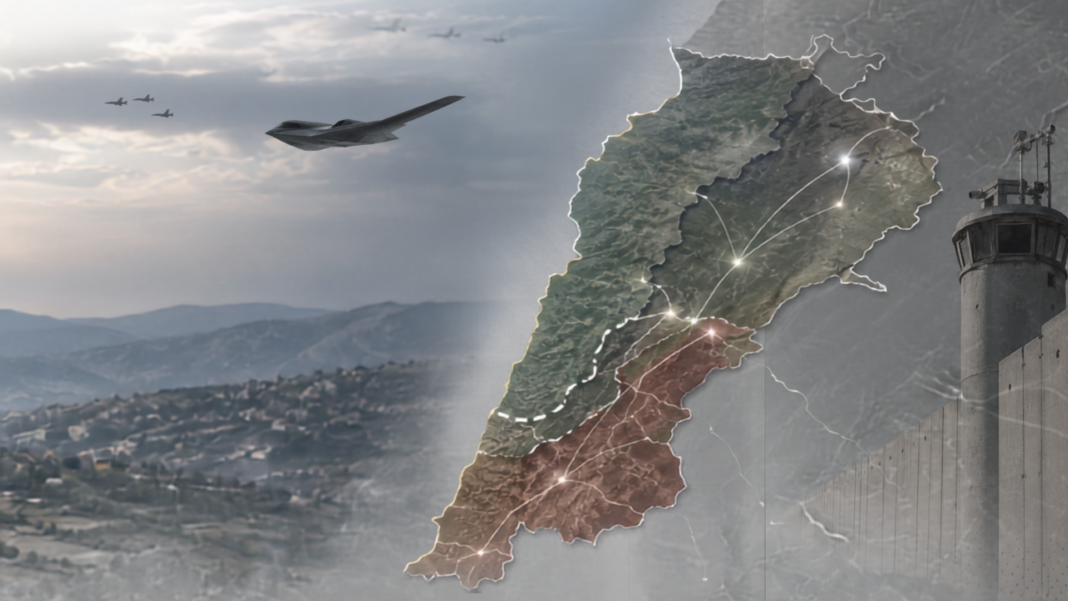
Israel’s renewed focus on Lebanon after direct confrontation with Iran should therefore not be read simply as a defensive response to Hezbollah or as a shift away from the Iranian file. It is better understood as movement into one of the most immediate operational layers of the same strategic contest. Iran remains the strategic reference point, but Lebanon is where Iranian influence becomes geographically close, militarily usable and politically deniable through Hezbollah.
This paper argues that Hezbollah is not the whole problem Israel faces in Lebanon. Hezbollah is the most visible military manifestation of a wider Adaptive Operational Security System: an environment in which military threat is regenerated through interacting political, military, economic, social, informational, infrastructural, geographic and temporal conditions. Weak Lebanese sovereignty, Iranian sponsorship, social embeddedness, information warfare, dual-use infrastructure, defensive terrain and time-based regeneration all sustain this system.
PMESII-PT provides the paper’s principal intelligence framework. Rather than treating Political, Military, Economic, Social, Information, Infrastructure, Physical Environment and Time as separate descriptive chapters, the paper uses them as fused variables to explain why Lebanon can be read as more than a conventional border threat. It becomes a system through which Israeli military action can be justified as security necessity while also serving a wider regional sequencing logic.
The core finding is that Israel’s challenge in Lebanon is systemic, but so is Israel’s response. Political weakness enables Hezbollah’s military autonomy. Hezbollah gives Iran a forward pressure tool. Economic fragility weakens Lebanese state enforcement. Social embeddedness provides resilience. Infrastructure and terrain support concealment, mobility and recovery. Time allows Hezbollah and Iran to adapt after every round of conflict. Israel’s offensive logic is to disrupt this system before it can again serve Iran in a renewed confrontation.
A sharper operational reading is therefore necessary. If air power alone did not generate the expected political effect against Iran, Israel has reason to shape the surrounding operational environment before any renewed Iran phase. Lebanon is central to that effort because Hezbollah gives Iran an immediate, deniable and adjacent pressure system against Israel. In this sense, Lebanon is not only an operational layer of the Iran problem. It may also be a preparatory battlespace for a possible second operational phase of the Iran-centred regional conflict.
Syria adds an uncertain second layer. If Syria becomes a barrier to Iran-linked logistics, Israel gains depth against Hezbollah’s eastern supply lines. If Syria remains fragmented or penetrated by competing external networks, Hezbollah’s regeneration system remains adaptive. Türkiye is the decisive regional constraint in this wider equation. Its most stabilising role is non-entry combined with active diplomacy. Türkiye’s involvement through ground operations, air operations, basing support, targeting assistance or intelligence-enabled co-belligerence would widen the conflict rather than stabilise it. Türkiye matters here not as a direct battlefield actor, but as a state whose non-entry helps keep the conflict geographically bounded.
The key issue is therefore not whether Israel can damage Hezbollah. It can. The more important question is what Israel’s Lebanon campaign does operationally: it reduces Hezbollah’s utility for Iran, weakens the northern front before a renewed Iran phase and preserves Israeli freedom of action under the language of security necessity. The northern front will remain central because it gives Iran proximity without direct exposure and gives Israel a theatre where military force can be presented as defensive while functioning as regional preparation.
click HERE to read full analysis.