
Key Points :
- Türkiye is losing its strategic non-entry position.
- The pact links Gulf security to NATO.
- Israel is its main indirect beneficiary.
- Deterrence may intensify conflict below the war threshold.
- The agreement risks widening the regional war.
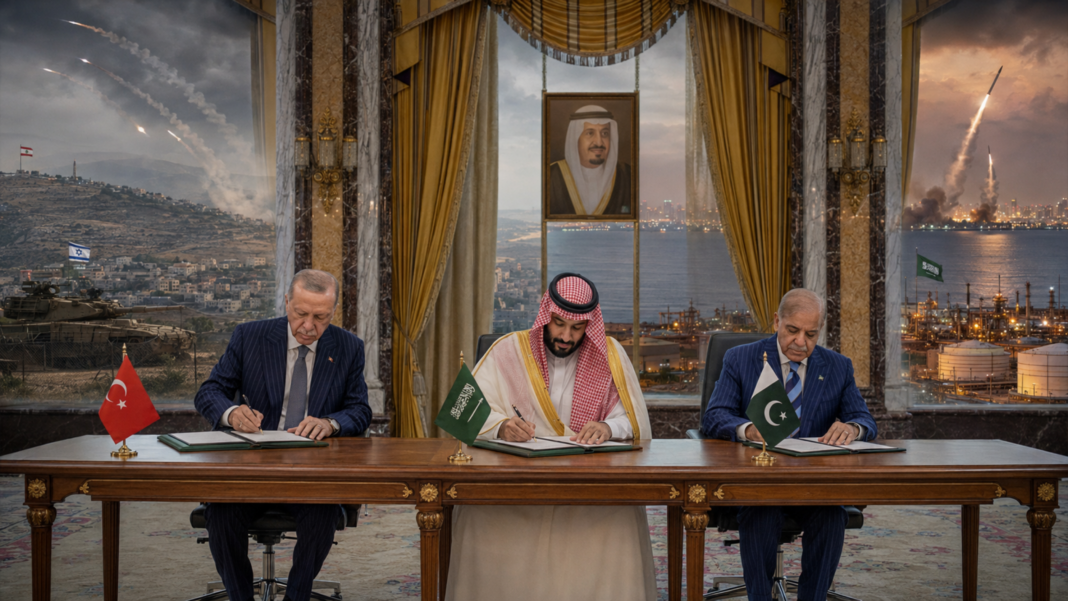
The Mecca Joint Defence Agreement does more than connect Türkiye, Saudi Arabia and Pakistan. It creates a potential pathway through which the Iran conflict could reach Turkish territory and enter NATO’s political and military agenda. The pact is not merely an additional security guarantee. It is an escalation transmission belt linking Saudi security, the Iran conflict, Turkish territory and NATO decision-making.
Türkiye has accepted that an attack against one signatory will be treated as an attack against all three. This commitment places Erdogan Government inside a conflict structure that it previously sought to influence from outside. The agreement may deter a direct Iranian attack on Saudi Arabia. It also increases the likelihood of proxy attacks, cyber operations, maritime disruption and disputed incidents that could gradually pull Türkiye into the war.
Israel is not a party to the pact. Yet it stands to gain from a regional arrangement that strengthens Saudi Arabia, restricts Iran’s freedom of action and places greater pressure on Tehran’s links with Syria and Lebanon. The pact should therefore be understood not as a new peace architecture but as part of the regional military realignment surrounding the Iran conflict
Türkiye formally signed the agreement through its own constitutional and political authority. However, it is difficult to describe the decision as the result of a fully independent strategic environment.
The agreement emerged during a period shaped by the Iran war, Israeli military operations across the region, attacks on Gulf infrastructure and growing doubts about the reliability of the existing US-centred security order. Saudi Arabia needed additional protection. Pakistan sought to preserve its long-standing defence relationship with Riyadh. Türkiye faced the risk of losing political influence and defence-industrial opportunities if it remained outside the emerging arrangement.
Foreign Minister Hakan Fidan said that work on the pact had continued for almost three years. The agreement was therefore not created by the latest crisis alone. Nevertheless, the war changed its meaning. A mechanism that may once have been designed as a general framework for defence cooperation has now become a potentially operational commitment during an active regional conflict.
Türkiye entered the pact because the strategic cost of remaining outside had increased. In doing so, Ankara gained a formal place in the new regional security structure but reduced its freedom to remain outside conflicts initiated by other members.
Türkiye is not a neutral state in the legal sense. It is a NATO member with extensive regional military relationships. Yet before the Mecca agreement, it maintained an important non-entry position in the confrontation involving Iran, Israel and the Gulf.
Ankara could communicate with Tehran, support Saudi security, oppose Israeli military expansion and manage competition in Syria without becoming a formal party to the wider war. This position gave Türkiye influence precisely because it was not fully located inside either camp.
The new pact changes that perception. Fidan described its collective-defence provision as technically similar to NATO’s Article 5. An armed attack against one member will be regarded as an attack against all three. The agreement reportedly allows assistance to range from intelligence cooperation to full military support although its operational procedures remain undefined.
For Iran, Türkiye can no longer be viewed only as a neighbouring state or a possible diplomatic channel. It is now a formal component of a security structure designed to protect Saudi Arabia and potentially other future members.
Türkiye does not need to fire the first shot to lose its non-entry position. That position begins to disappear when Iran includes Turkish bases, radars, defence systems and intelligence networks in its assessment of the opposing military architecture.
The most dangerous feature of the pact is its ability to connect two separate collective-defence systems.
Consider the most plausible escalation sequence. Iran or an Iran-aligned actor attacks Saudi territory. Türkiye provides intelligence, early warning, air defence or military support under the Mecca agreement. Iran then treats that assistance as Turkish participation in the conflict and strikes a military facility on Turkish territory. At that point, the crisis is no longer limited to the Gulf.
An attack on Turkish territory falls within NATO’s geographical area. Türkiye could request consultations under Article 4 and could seek collective action under Article 5 if the incident were considered an armed attack.
Article 5 does not automatically declare war. NATO’s official explanation makes clear that each ally takes the action it considers necessary. Such action may include military force but does not have to do so. The scale of the attack, evidence of responsibility and Türkiye’s prior role in the conflict would all influence the political decision.
The resulting crisis would still be severe. NATO would have to choose between defending an ally under attack and limiting involvement in a conflict that Türkiye entered through a separate agreement. Some allies might regard the Iranian strike as an attack on NATO territory. Others might view it as retaliation arising from Türkiye’s participation in an external war.
The immediate result would probably be political consultation, stronger air and missile defence around Türkiye and intense disagreement over direct military action. Türkiye would not automatically leave NATO and NATO would not automatically collapse. Yet the credibility of collective defence could suffer serious damage.
If NATO responded only symbolically, Ankara could question the practical value of the Alliance. If NATO entered the conflict directly, the Mecca agreement would have succeeded in transferring a regional war into the Euro-Atlantic security system.
The pact is therefore not simply an additional layer of protection for Türkiye. It is an escalation transmission belt connecting Saudi security, the Iran conflict, Turkish territory and NATO decision-making.
There is no public evidence that Israel designed the agreement or directed Türkiye to sign it. Israel is not a member and the signatories insist that the pact is not aimed at Iran or any other state.
The strategic effects are more important than the official language. Israel benefits when Iran must divide its attention and resources across several fronts. A stronger Saudi Arabia complicates Iranian missile and drone planning. Turkish and Pakistani support could improve Gulf early warning, air defence, intelligence and logistical resilience. Iran would then need to devote more capacity to protecting its own position in the Gulf and deterring the three pact members.
This pressure could reduce Iran’s ability to rebuild regional networks and support Hezbollah. It could also restrict the use of Syrian territory as a route for personnel, weapons and finance. These outcomes would increase Israel’s freedom of action in Lebanon and Syria.
The United Nations has repeatedly warned that the Iran-Israel confrontation is spilling into Syria and Lebanon. Israeli operations in Lebanon have already expanded while the confrontation with Hezbollah remains unresolved. The Mecca agreement strengthens the regional environment in which those operations are taking place.
This assessment develops the argument made in Defense Domain’s earlier white paper, The Northern Front After Iran. That paper identified Türkiye’s non-entry, backed by active diplomacy, as a principal constraint on the geographical widening of the Iran-centred conflict. It also warned that Turkish basing, targeting, intelligence or operational support would widen the conflict. The Mecca agreement weakens precisely that constraint by turning possible Turkish assistance from a discretionary policy choice into an alliance expectation.
The pact is not an Israeli alliance. It is better understood as a regional security arrangement whose immediate strategic effects support several Israeli objectives. It strengthens the Gulf against Iranian retaliation, increases pressure on Tehran’s regional connections and weakens Türkiye’s ability to restrain escalation from an independent position.
Israel may therefore become the agreement’s most important indirect beneficiary.
Supporters of the agreement argue that Iran will avoid confronting Türkiye, Saudi Arabia and Pakistan at the same time. This may reduce the likelihood of a large and openly attributable Iranian attack. That does not make the region more peaceful.
Iran has several options below the threshold of conventional war. These include proxy attacks, cyber operations, sabotage, maritime pressure and drone strikes with disputed attribution. Such methods allow Tehran to impose costs while making collective retaliation politically difficult.
The problem became visible almost immediately. Two days after the agreement was signed, the Iran-aligned Houthis claimed a drone attack against the Aramco refinery in Jazan. The facility was not seriously damaged but the incident exposed the pact’s central weakness: it remains unclear what type and scale of attack will activate collective defence.
Would a Houthi drone be treated as an attack by Iran? Would Türkiye provide military assistance after a limited strike causing no casualties? Would attribution require unanimous agreement? Could Saudi Arabia request direct retaliation? Without clear answers, every proxy attack becomes a test of the pact’s credibility.
If Türkiye and Pakistan respond, they move closer to direct conflict. If they do not respond, the agreement’s deterrent value weakens. Iran and its partners can repeatedly probe this uncertainty without crossing an obvious threshold.
The pact may therefore create a classic alliance security dilemma. Greater protection at the strategic level can produce more risk-taking by the protected state and more indirect action by the opposing side. Saudi Arabia may act with greater confidence because it expects Turkish and Pakistani support. Iran may avoid conventional attacks while intensifying less visible forms of pressure.
The result is not stable deterrence. It is a regional security structure that will be tested through recurring low-level confrontation.
Türkiye’s previous value was not limited to its military power. Ankara could maintain working channels with Iran, influence developments in Syria, support Gulf security and oppose Israeli policies without joining a formal anti-Iran military alignment.
The Mecca agreement weakens that flexibility. Iran will increasingly evaluate Türkiye through its obligations to Saudi Arabia. Competition between Ankara and Tehran in Syria may become more confrontational. Türkiye’s ability to present itself as a mediator will decline while the risks facing Turkish forces, infrastructure and commercial interests will increase.
The pact also limits Ankara’s ability to restrain the other members. A collective-defence agreement creates expectations before it creates operational clarity. When a crisis begins, political solidarity and alliance credibility can become more influential than the original limits written into the agreement.
This is how states become involved in wars they did not intend to fight. The initial contribution may consist only of intelligence, logistics or air defence. Those measures make the supporting state part of the opponent’s targeting calculation. A limited commitment then creates the need for further protection and the next step becomes easier than withdrawal.
For Türkiye, the danger is not an immediate declaration of war. It is gradual entanglement followed by a loss of strategic choice.
The Mecca Joint Defence Agreement is not a peace initiative for Türkiye or the wider region. It may deter a direct attack on Saudi Arabia but it also creates new routes through which an existing war can expand.
Türkiye’s most important loss is not simply the assumption of another defence obligation. Ankara is giving up part of its ability to influence the regional balance without entering the conflict. An attack on Saudi Arabia can now create a Turkish commitment. A Turkish response can produce Iranian retaliation. An attack on Türkiye can then place the issue before NATO.
Israel is not formally connected to this chain. Yet it benefits from the pressure placed on Iran, the strengthening of Saudi defences and the weakening of Iran’s access to Syria and Lebanon. The agreement improves the strategic environment for continued Israeli military operations while reducing Türkiye’s capacity to act as an independent restraint mechanism.
The pact may prevent one form of war while encouraging several others. It raises the cost of direct Iranian aggression but expands the space for proxies, drones, cyber operations and disputed attacks. It strengthens deterrence at the top while making escalation below that level more likely.
Türkiye’s signature has not isolated the country from the regional war. It has created a mechanism capable of bringing that war to Türkiye’s borders and eventually to NATO’s decision-making table.
- Reuters, Türkiye-Pakistan-Saudi defence pact technically same as NATO’s Article 5, https://www.reuters.com/world/asia-pacific/turkey-pakistan-saudi-arabia-defence-pact-technically-same-natos-article-5-2026-08-08/
- Reuters, Saudi Arabia, Türkiye and Pakistan pledge mutual defence, https://www.reuters.com/world/asia-pacific/saudi-arabia-turkey-pakistan-sign-joint-defence-deal-amid-regional-turmoil-2026-08-07/
- Reuters, Iran responds to the Türkiye-Pakistan-Saudi security pact, https://www.reuters.com/world/asia-pacific/iran-says-no-reason-fear-pakistan-turkey-saudi-security-pact-2026-08-10/
- Associated Press, Türkiye says the pact is not directed against Iran, https://apnews.com/article/1fd785d1c261621f8dcb33010c4f14e2
- NATO, Collective defence and Article 5, https://www.nato.int/en/what-we-do/introduction-to-nato/collective-defence-and-article-5
- NATO, The North Atlantic Treaty, https://www.nato.int/en/about-us/official-texts-and-resources/official-texts/1949/04/04/the-north-atlantic-treaty
- United Nations, Middle East escalation spilling into Syria, https://press.un.org/en/2026/sc16319.doc.htm
- United Nations, Lebanon exhausted by other people’s wars, https://press.un.org/en/2026/sc16314.doc.htm
- RAND, Do Alliances and Partnerships Entangle the United States in Conflict?, https://www.rand.org/content/dam/rand/pubs/research_reports/RRA700/RRA739-3/RAND_RRA739-3.pdf
- CSIS, How Tehran’s Use of Cyber Operations Has Evolved, https://www.csis.org/analysis/how-tehrans-use-cyber-operations-us-iran-conflict-has-evolved
- Defense Domain, The Northern Front After Iran: An Intelligence Assessment of Israel’s Lebanon Campaign Before the Next Iran Phase, https://defensedomain.com/the-northern-front-after-iran/
click HERE to download as PDF.