
Key Points:
- Even limited mining can effectively halt passage.
- Iran can make narrow channels risky within hours.
- The first safe corridor could open within days.
- The return of commercial confidence typically takes weeks.
- The coalition manages risk through escort and maritime security.
Strategic Context
The Strait of Hormuz, connecting the Persian Gulf to the Arabian Sea and through which approximately 20% of global oil trade passes, is one of the world’s most critical maritime chokepoints. In recent years, growing concerns over Iran’s nuclear capabilities, perceived as an explicit threat by Israel and the US, instability in Iranian domestic politics, and the US deployment of significant military forces to the region, including aircraft carriers, have brought the Strait of Hormuz back to the center of the global security agenda.
In June 2025, rhetoric and initiatives within Iran’s domestic politics regarding “closing the Strait of Hormuz when necessary,” along with increased military activity in the region as of January and February 2026, have brought the question of how realistic this threat is back to the forefront. This analysis examines Iran’s capacity to effectively neutralize the Strait of Hormuz, particularly through sea mines, how long this could take, how quickly the US and its allies could respond, and the potential military, economic, and global consequences.
The Strait of Hormuz is not entirely under Iran’s control. The northern shores of the strait belong to Iran, while the southern shores belong to Oman. Under international maritime law, Hormuz has the status of an international strait and is subject to the right of transit passage. This situation prevents Iran from legally closing the strait unilaterally and legitimately. However, military reality shows that the capacity to create actual risk, independent of legal status, can be decisive for trade.
Capability and Operational Assessment
The narrowest point of the Strait of Hormuz is approximately 33-40 km wide. However, the traffic separation lanes actually used by commercial vessels are only 2-3 km wide in each direction. This situation shows that it is not the entire strait that is critical, but rather very limited and predictable areas. Water depth varies between 30-90 meters throughout the strait. Depth is mostly between 40-60 meters, especially in the main passage routes used by large tankers. This depth range is conducive to the effectiveness of sea mines and poses serious risks for large tonnage vessels.
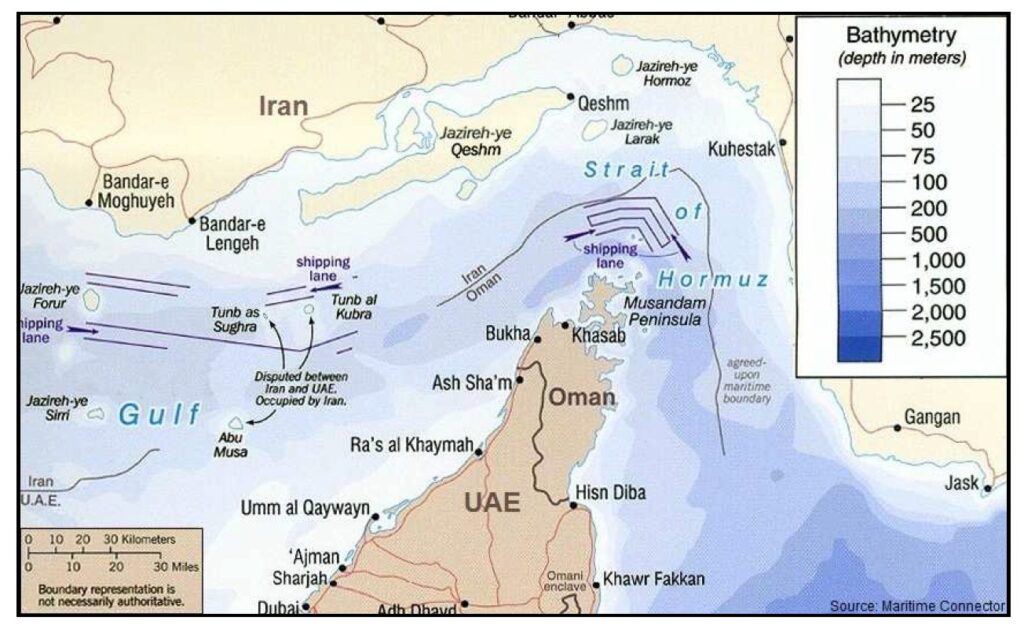
Closing the Strait of Hormuz does not mean physically blocking the entire area. It means making critical transit points risky, which is sufficient from a military and commercial perspective. For shipping insurance, shipowners, and energy companies, even a single confirmed mine incident could render the strait effectively unusable. Therefore, what is at stake here is not a blockade in the classical sense, but risk-based neutralization.
Iran’s maritime strategy is based on the Anti-Access/Area Denial (A2/AD) doctrine rather than the classic understanding of maritime superiority. The aim is not to completely prevent the opposing side from accessing the region, but to deter them by increasing military, economic, and psychological costs. Sea mines are at the heart of this doctrine due to their low cost and high potential impact.
The mines believed to be in Iran’s inventory can be grouped into three main effects in practice. Bottom mines are placed on the seabed and can be triggered by acoustic, magnetic, or pressure sensors . These types of mines are effective against large tankers sailing at depths of 40-60 meters and are relatively difficult to detect and clear. Moored mines are chained to the seabed and hang at a specific depth. They are effective at medium depths and can be detected with classic mine countermeasures, but still provide a high deterrent. Smart or effect-based mines, on the other hand, may have sensors that can distinguish between specific types of ships and can be programmed to target commercial tankers. Even if used in limited numbers, their psychological and economic impact is high.
According to assessments, even a single confirmed mine incident could create a perception of risk significant enough to effectively halt commercial traffic in the Strait of Hormuz. Therefore, a rational approach for Iran would be to target shallow and mandatory transit areas in a limited manner rather than mining the entire strait. Mining the entire strait requires much higher levels of planning, the use of secret platforms for ammunition and mines, and consequently, more time. Furthermore, as it implies long-term and overt activity, it increases the risk of early detection due to the air and sea surveillance capabilities of the US and its allies.
Balance of Power and Escalation Risks
Mine Countermeasures: US, UK, and Allied Capabilities
On the US side, mine countermeasures rely on a structure supported by modular MCM packages, helicopter elements, and unmanned maritime systems within the 5th Fleet’s area of responsibility. The USS Lewis B. Puller (ESB-3), serving as a surface base in the Persian Gulf, is used as a forward naval base for various tasks, including MCM. USV and UUV elements operated within the task force in the region are important for monitoring changes on the seabed and establishing situational awareness.
On the UK side, there are strong indications of a reduction in permanent ship deployments in the Persian Gulf, with HMS Middleton expected to return in 2026. If this trend continues, it is possible that the permanent MCM ship presence based in Bahrain will be limited or terminated by 2026. This situation could make it difficult for the UK to maintain a continuous MCM presence at sea in the event of a crisis in the short term and push the UK towards a model that relies more on US capabilities. The UK’s approach is shaping up to be a shift from traditional ship-based methods towards autonomous-based solutions, emphasizing the use of unmanned underwater vehicles and remotely operated platforms.
On the coalition side, Combined Task Force 152 (CTF 152), operating within the Combined Maritime Forces (CMF), is an important cooperation mechanism focused on maritime security, counter-smuggling, and joint patrols in the Persian Gulf. In the event of a mine threat, platforms from countries such as Saudi Arabia, the UAE, and Kuwait can provide support in terms of maritime security, escort, surveillance, and coordination. However, under the current concept, the United States has the highest and most sustainable mine countermeasure capabilities in the region.
The aircraft carriers and warships deployed by the US in the region seriously deter Iran from conducting large-scale and overt mine-laying operations. Continuous reconnaissance, surveillance, and air superiority make it difficult for Iran to carry out long-term activities. However, this presence cannot completely prevent short-term, limited, and covert mine-laying activities.
Timing Dimension: Who Can Do What in How Much Time?
Iran has the capacity to mine critical transit points in the Strait of Hormuz within hours to a maximum of 1-2 days using small, fast boats, logistics support vessels, and civilian-looking assets. This activity targets not the entire strait, but the narrow areas that commercial vessels are forced to use.
Although the US, UK, and some allied navies possess advanced MCM capabilities, mine clearance operations are inherently slow and risky. The initial goal here is not to clear the entire strait, but to gradually establish a safety corridor where commercial passage can be managed. If the mining has been focused on narrow passageways and remains limited, the opening of the first corridor could be assessed within a range of a few days to approximately one week. If the area is larger, there is a possibility of re-mining, or if there is simultaneous threat pressure, this period could extend to weeks, and a 100% guarantee of clearance is not practically possible.
An area declared “militarily clear” is not immediately considered safe from the perspective of commercial actors. Due to the cautious approach of insurance companies and shipowners, a short-term military action can have a longer-term economic impact. Therefore, even if controlled passage can begin within days, the significant restoration of commercial confidence should, in most cases, be assessed on a weekly scale.
Strategic Implications
Iran has repeatedly threatened to close the Strait of Hormuz in the past. During the Iran-Iraq War, mines were used and attacks were carried out against commercial vessels, but the strait was never completely and permanently closed. This pattern shows that, for Iran, Hormuz is not a route that will actually be closed, but rather a strategic card that is kept on the table and will be used as a last resort.
The closure of the Strait of Hormuz would negatively impact not only the US or the countries involved in the conflict, but also all Gulf oil and gas exporting countries and the global economy. It is clear that such a move would also cause serious economic damage to Iran. A sudden increase in energy prices, global inflationary pressure, and supply chain disruptions could turn a regional crisis into a global shock. This situation increases the risk of major actors such as China, the European Union, and Russia becoming involved in the process.
As of January and February 2026, Iran’s high military alertness and its planned exercises with Russia and China should be seen as a message aimed at increasing deterrence and bargaining power rather than direct conflict. These activities show that Iran is holding the Hormuz card as a strategic pressure tool rather than actually using it.
Possible Scenarios
Scenario 1: Limited Mining and Controlled Passage
If Iran limits its mining to a narrow strip, the aim would be to deter passage by raising the risk rather than physically closing the strait. In this case, the US and its allies would focus primarily on opening a limited security corridor and managing passage with escorts. Controlled passage could begin within days, but the return of commercial confidence would take longer.
Scenario 2: Repeated Mining and Extended Clearance
If mine laying is repeated, false contacts increase, or the area expands, clearance activities proceed in a more fragmented and cautious manner. In this case, the corridor opening period is extended, the economic impact grows due to insurance and shipowner behavior, and normalization is spread over weeks.
Scenario 3: Combined Crisis with A2/AD Pressure
If drone, missile, or speedboat pressure is added simultaneously to the mine threat, countermeasures against mines become riskier. The coalition’s priority becomes suppressing air and surface threats along with countering mines. In this scenario, the duration increases, uncertainty grows, and the return of commercial actors may be further delayed.
Conclusion
This study, when assessing the strategic importance of the Strait of Hormuz and Iran’s potential mine-laying capacity, reveals the following picture: Iran does not have the capacity to completely close the strait, but it can create a short-term and real risk by placing a limited number of mines in narrow and shallow passage points. While this situation provides Iran with a short-term advantage in terms of speed and pressure, the military presence of the US and its allies and their ability to counter mines could bring such an initiative under control in the medium term.
Under current geopolitical conditions, it is unlikely that Iran will resort to measures such as mining that could directly trigger war and an international crisis. If diplomacy and a military demonstration fail to yield the desired results, a large-scale US airstrike and special forces operation to achieve US objectives in Iran may become the most likely outcome. While amphibious and land operations against Iran seem improbable given the current geopolitical climate and operational risks, Iran retains the option to mine the Strait of Hormuz as a strategic move it can utilise in critical situations.
click HERE to download as PDF.