
Key Points:
- NATO’s central defense innovation challenge is conversion, not invention.
- Emerging and disruptive technology (EDT) adoption should be driven by operational demand, not technology fashion.
- Technology Readiness Level is insufficient for coalition defense adoption.
- Startups, SMEs and non-traditional suppliers need navigable transition pathways.
- Trusted data, interoperability, security and sustainment must become transition criteria.
- The purpose of defense innovation is deterrence, defense, resilience and the protection of Allied societies.
Executive Summary
NATO’s future technological edge will not be determined by how many emerging and disruptive technologies it identifies. It will be determined by how quickly the Alliance can convert them into trusted, interoperable and sustainable capability before adversaries adapt. NATO’s central innovation problem is that commercial technology is moving faster than Allied procurement, integration, doctrine and industrial processes can absorb it.
NATO already recognizes this pressure. NATO’s Rapid Adoption Action Plan states that technological development is outpacing the Alliance’s ability to procure, integrate and evolve doctrine around new technologies, and sets the ambition to move from identified need to adoption and integration generally within 24 months. In his recent defense industry and ministerial remarks, NATO Secretary General Mark Rutte framed the same challenge in practical terms, arguing that defense investment must become combat-ready capability, industry must be treated as part of deterrence and innovation must deliver operational effect rather than remain a separate activity.
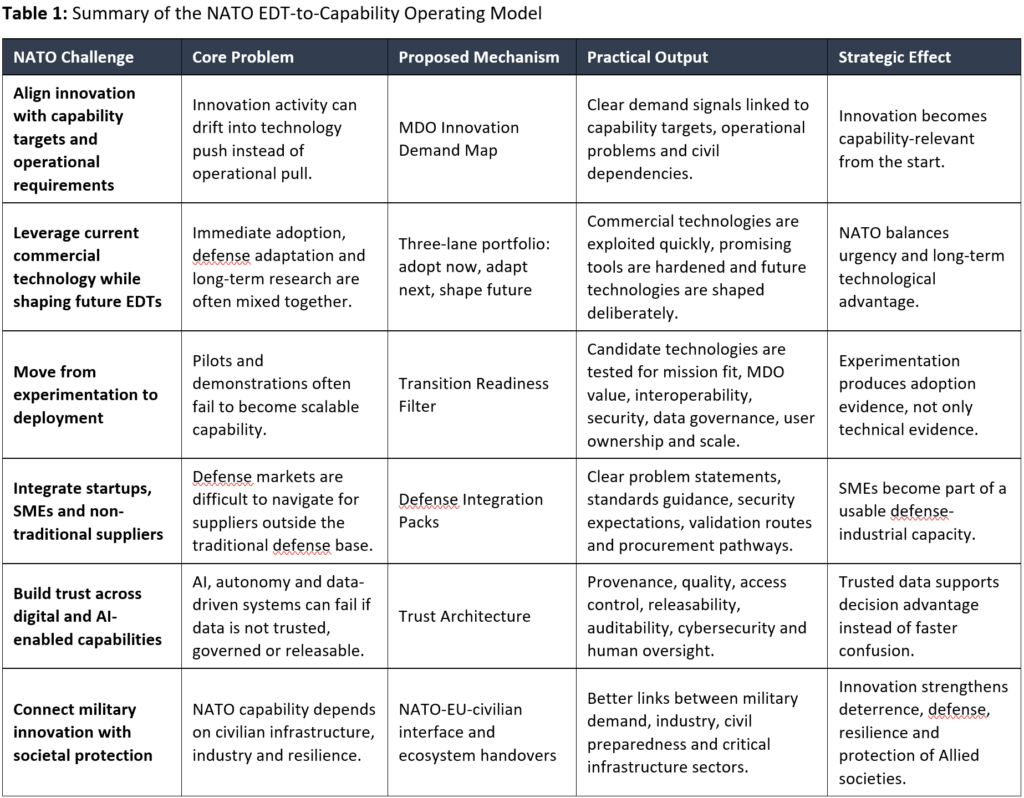
This white paper proposes a NATO EDT-to-Capability Operating Model. The model begins with strategic pressure, translates it into Multi-Domain Operations (MDO) problems, converts those problems into clear innovation demand signals, filters technologies through transition-readiness criteria and delivers trusted capability for deterrence, defense, resilience and protection.
The model responds directly to NATO’s three key challenges. It aligns innovation with capability targets and operational requirements through an MDO Innovation Demand Map. It accelerates transition from experimentation to deployment through a scale-or-stop Transition Readiness Filter that goes beyond Technology Readiness Level. It integrates startups, SMEs and non-traditional suppliers through defense Integration Packs, clearer problem statements, security onboarding and visible pathways from validation to adoption.
The purpose is not innovation for its own sake. defense innovation matters when it helps NATO see faster, decide better, protect data, sustain forces, defend infrastructure and shield societies from coercion.
click HERE to read full analysis.