

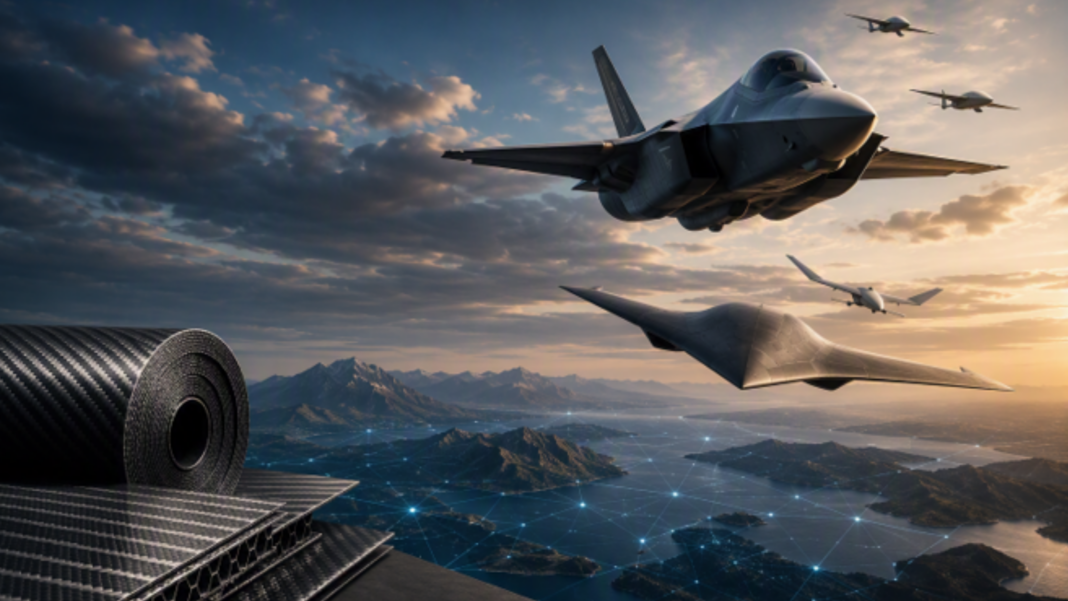
Key Points :
- Future air power increasingly relies on distributed, autonomous and networked operations.
- Collaborative Combat Aircraft and unmanned systems are redefining mass, capability and survivability.
- Ukraine demonstrates the operational value of scalable, rapidly adaptable air systems.
- Advanced materials increasingly enable endurance, survivability and operational effectiveness.
- Industrial capacity now rivals platform performance in determining military readiness.
- Future military aviation will depend on integrating platforms, autonomy, industrial capacity and enabling technologies.
The future of air power is no longer defined solely by faster aircraft or more advanced weapons. It is increasingly shaped by the ability to project force across vast distances, operate within contested environments and sustain a high operational tempo in an era of autonomous and networked warfare. As air forces around the world accelerate investments in unmanned systems, collaborative combat aircraft, advanced sensors and distributed operations, attention is often focused on artificial intelligence, propulsion and next-generation weapon systems. Yet beneath these highly visible technologies lies a less discussed but equally decisive factor: the materials that enable them.
Advanced materials are emerging as an important enabler of modern air power, providing the combination of lightweight performance, survivability, thermal resilience and manufacturing scalability required for the next generation of military aviation.
This broader transformation is consistent with RAND assessments that future conflicts against peer adversaries will challenge long-standing assumptions regarding secure air bases and reliable communications, reinforcing the need for more distributed and adaptable concepts of air operations.1
The transformation currently taking place within air forces is not simply a matter of replacing one generation of aircraft with another. Rather, it reflects a broader shift in operational doctrine. Future air operations are expected to rely on a combination of manned fighters, collaborative combat aircraft, long-endurance unmanned systems, distributed sensor networks and precision-guided effects operating simultaneously across contested environments.
This emerging model places unprecedented demands on range, endurance, adaptability and affordability. Military planners are therefore increasingly focused on how to field larger and more resilient force structures without incurring unsustainable costs. In this context, advanced materials are gaining strategic significance because they directly support many of the operational attributes that future air forces seek to achieve, including reduced weight, increased mission endurance, enhanced thermal performance and scalable production pathways for emerging defence platforms.
This trend is increasingly reflected in programmes such as the U.S. Air Force’s Collaborative Combat Aircraft (CCA), which are designed to operate alongside crewed aircraft and expand operational capacity through human-machine teaming in contested environments.2,3
Recent conflicts have further accelerated this shift. The war in Ukraine has demonstrated that air power is no longer measured solely by the performance of individual aircraft, but increasingly by the ability to deploy, sustain and replace large numbers of interconnected systems. Unmanned aerial vehicles, loitering munitions and networked reconnaissance assets have become an integral part of modern military operations, often operating alongside traditional combat aircraft.
This evolution is creating a demand for platforms that are not only capable and survivable, but also affordable, scalable and rapidly producible. As defence organisations seek to balance capability with mass, the materials used to construct future air systems are becoming a strategic consideration.
Observations from Ukraine further support this trend, with analysts highlighting the growing operational importance of unmanned systems, rapid adaptation cycles and the ability to continuously evolve capabilities in response to battlefield realities.4,5
While weight reduction remains one of the most commonly cited advantages of advanced materials, their importance extends far beyond lightweight structures. Modern air forces increasingly require platforms capable of operating in highly contested electromagnetic and thermal environments, where survivability depends not only on kinetic performance but also on signature management, sensor integration and mission endurance.
Advanced materials create opportunities to engineer structures with specific mechanical, thermal and electromagnetic characteristics, enabling capabilities that are difficult to achieve with conventional metallic solutions alone. As aircraft evolve into highly connected nodes within broader combat networks, material technologies are becoming an increasingly important component of operational effectiveness rather than merely an engineering consideration.
The increasing focus on lighter platforms and scalable production is also reflected in aerospace and defence manufacturing trends, where industry observers point to growing demand for advanced materials capable of meeting both operational performance requirements and emerging production challenges.6,7
Beyond operational performance, the growing importance of advanced materials carries significant implications for defence industrial capacity. The ability to design and manufacture next-generation military aircraft, unmanned systems and mission-critical components increasingly depends on access to advanced manufacturing capabilities, resilient supply chains and scalable production methods.
As defence spending rises across many countries, concerns regarding industrial readiness and production capacity are receiving greater attention from policymakers and military planners. In this environment, advanced materials should not be viewed solely as aerospace components but as enablers of defence capability.
This concern is increasingly visible at the policy level. NATO has repeatedly emphasised that increasing defence budgets alone is insufficient without the industrial capacity required to deliver military capabilities at scale.8,9
Looking ahead, the future of air power is likely to be defined less by individual platforms and more by the ability to integrate diverse capabilities into a coherent operational ecosystem. Crewed aircraft, autonomous systems, distributed sensors and precision effects will increasingly operate as interconnected elements of a larger combat network.
In such an environment, technological advantage will depend not only on aircraft performance or advanced software, but also on the industrial and material foundations that enable these capabilities. As defence planners seek to balance capability, mass and affordability, advanced materials are likely to play an increasingly important role in shaping the next generation of military aviation.
Similar thinking can be observed in current U.S. Air Force modernisation efforts, where collaborative and autonomous systems are expected to extend operational reach, survivability and mission effectiveness within future air combat ecosystems.2,3
The future of air power will not be determined solely by the platforms that dominate headlines, whether sixth-generation fighters, autonomous combat aircraft or advanced precision weapons. It will also be influenced by the technologies and industrial capabilities that make these systems possible.
As modern warfare increasingly demands greater endurance, scalability, resilience and adaptability, advanced materials are emerging as an important enabler of military capability. Their contribution extends beyond lightweight structures and improved performance; they support innovation, production capacity and operational readiness.
For defence planners, policymakers and industry leaders alike, understanding the role of advanced materials is therefore essential to understanding the future trajectory of air power. In an era defined by technological competition and evolving security challenges, the ability to develop, manufacture and sustain these enabling technologies may prove as important as the development of the platforms themselves.
- RAND Corporation. (2019). Distributed Operations in a Contested Environment: Implications for USAF Force Presentation. https://www.rand.org/pubs/research_reports/RR2959.html
- Congressional Research Service. (2025). U.S. Air Force Collaborative Combat Aircraft (CCA). https://www.congress.gov/crs_external_products/IF/PDF/IF12740/IF12740.5.pdf
- U.S. Air Force. (2026). Air Force Advances Future of Air Superiority with CCA Contracts. https://www.af.mil/News/Article-Display/Article/4520575/air-force-advances-future-of-air-superiority-with-cca-contracts/
- RUSI. (2025). Drones Win Battles, Components Win Wars. https://www.rusi.org/explore-our-research/publications/commentary/drones-win-battles-components-win-wars
- Irregular Warfare Center. (2026). Six Key Lessons from Ukraine’s Drone War. https://irregularwarfarecenter.org/publications/insights/six-key-lessons-from-ukraines-drone-war/
- CompositesWorld. (2026). JEC World 2026 Highlights Innovations in High-Rate Composite Manufacturing. https://www.compositesworld.com/articles/jec-world-2026-highlights-innovations-in-high-rate-composite-manufacturing-
- CompositesWorld. (2026). Aerospace- and Defense-Grade Carbon Fiber Composites Are Engineered for High Rate. https://www.compositesworld.com/products/aerospace–and-defense-grade-carbon-fiber-composites-are-engineered-for-high-rate
- NATO. (2026). Increasing Defence Industrial Production. https://www.nato.int/en/what-we-do/deterrence-and-defence/natos-role-in-defence-industry-production
- NATO. (2025). Updated Defence Production Action Plan. https://www.nato.int/en/about-us/official-texts-and-resources/official-texts/2025/02/13/updated-defence-production-action-plan
click HERE to download as PDF.


Great piece, Faik. It’s easy to focus on AI and sixth-gen fighters, but the point that materials and production capacity decide how much of that capability can actually be fielded is often overlooked. The Ukraine lesson, that mass and rapid replacement matter as much as individual performance, makes this even more relevant. Thanks for sharing.