

Key Points :
- Libya’s parliament endorsed the 2019 maritime memorandum on 20 October
- The vote reverses eastern Libya’s 2020 rejection of Ankara
- Endorsement shifts bargaining power, not maritime law
- Brussels, Athens and Cairo object; Ankara calls the deal lawful
- The next tests will come from survey ships, not courtrooms
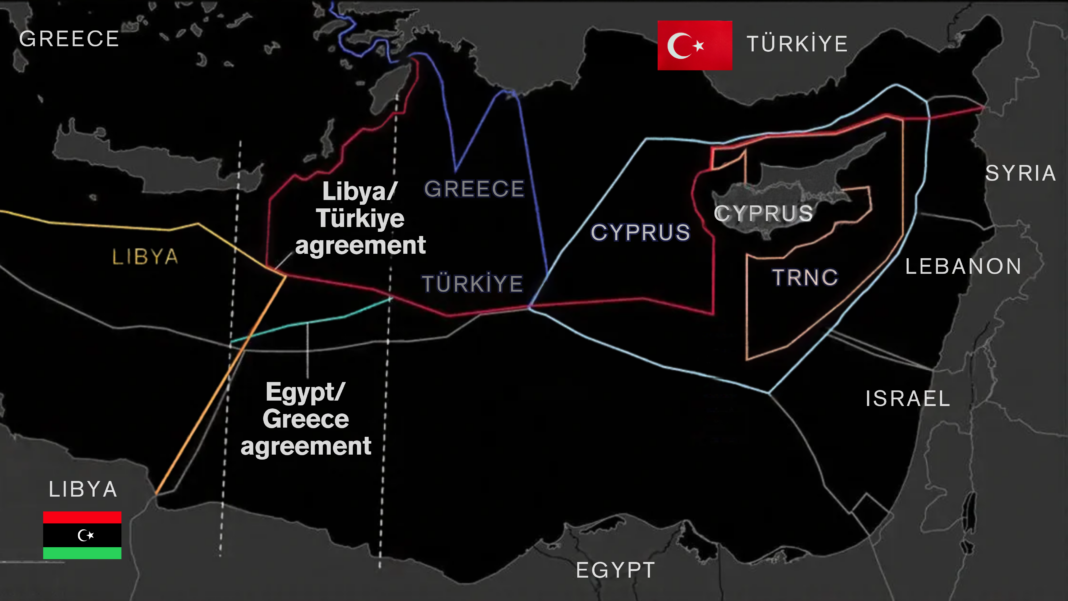
The next Eastern Mediterranean crisis is unlikely to announce itself in a courtroom. It is more likely to begin with a NAVTEX notice, a survey vessel and two frigates keeping station a mile apart. The Libyan House of Representatives’ endorsement of the 2019 Türkiye-Libya maritime memorandum on 20 October has made that scenario both more probable and more consequential, because it hands Ankara a political win inside the one Libyan institution that had rejected the arrangement for six years. What the vote cannot do is settle whose map is right. Its real products are leverage for Ankara, pressure on Athens and a larger surface for friction at sea.1-4
On 27 November 2019, Türkiye and Libya’s UN-recognized Government of National Accord signed a memorandum delimiting claimed maritime jurisdiction areas in the Mediterranean, anchored on a boundary segment of roughly 18.6 nautical miles between the two countries’ claimed continental shelves. It entered into force on 8
December 2019 and was later registered with the United Nations as treaty no. 56119. Registration records an agreement; it does not turn the line into a judicial boundary
binding on non-parties. The memorandum came wrapped in a broader security relationship that proved its weight during the 2019-2020 Libyan conflict, when Turkish military support helped prevent the collapse of the Tripoli government.1,5
The political problem was always Libya’s division. In January 2020 the eastern-based House of Representatives rejected the arrangements with Ankara and voted to sever political relations. The 20 October 2026 session reversed both decisions: it endorsed the maritime memorandum and rescinded the 2020 resolutions, with reporting from the
chamber describing the vote as unanimous among members present. Leading figures in eastern Libya responded favorably. Ankara’s own framing was deliberately modest,
stressing that the memorandum had been in force since Read properly, the event is an expansion of domestic political acceptance inside Libya rather than the creation of a new maritime border.2,3,6
For those who have followed Ankara’s Libya policy since 2019, the reversal completes an arc. A relationship that began as an emergency intervention to protect Tripoli has matured into engagement across Libya’s rival political centers, and it deprives Athens of a strategy that leaned on eastern Libya remaining a reliable institutional opponent of the deal. Caution is still in order. Libya’s executive and security structures remain divided, questions about the domestic treaty-approval chain remain open, and a parliamentary vote is not the same thing as national reconciliation.2,3,5
The sharpest dispute concerns the maritime effect of Greek islands lying between Anatolia and North Africa, above all Crete, Rhodes and Kastellorizo/Meis. Greece argues that these islands generate continental-shelf and exclusive economic zone (EEZ) entitlements, and that Türkiye and Libya cannot draw a line as if those entitlements did not exist. Türkiye argues that equitable delimitation must weigh relative coastal geography, and that islands should not disproportionately cut off the seaward projection of long mainland coasts. Türkiye is not a party to the UN Convention on the Law of the Sea (UNCLOS), though many delimitation principles bind it anyway through customary international law.4,7-9
Entitlement and delimitation effect are different questions, and most public commentary collapses them. UNCLOS Article 121 generally gives qualifying islands the capacity to generate maritime zones; Articles 74 and 83 require equitable solutions where claims overlap. The case law, from the 1977 Anglo-French arbitration through Libya/Malta (1985), Romania v. Ukraine (2009) and Bangladesh/Myanmar (2012), shows tribunals giving particular islands reduced weight in particular geographic settings. None of it establishes that Crete, a large inhabited island, lacks maritime entitlement, and none of it guarantees every Greek island full effect in every boundary segment. These outcomes are decided on the geography of each case.7-10
A second rule matters just as much: an agreement between two states cannot dispose of an absent state’s rights. The 2019 Türkiye-Libya memorandum cannot extinguish Greek claims by assertion, and the 2020 Greece-Egypt partial delimitation cannot erase Turkish or Libyan claims either. Competing maps are opening positions in a negotiation that has not yet happened. By the same logic, a maritime claim overlapping a proposed subsea cable route is a licensing and jurisdiction problem; it is not a blockade.1,4,7-9
Türkiye and Libya. Ankara characterizes the memorandum as lawful and equitable, raming it as protection for overlapping coastal entitlements, and welcomed the parliament’s decision as deepening bilateral cooperation. The Libyan calculus deserves more attention than it usually gets: a delimitation approach that discounts certain Greek islands also enlarges the maritime area Libya itself can claim, so endorsement carries a Libyan economic rationale that stands apart from alignment with Ankara. The hydrocarbon-cooperation memorandum of 2022 added a commercial layer, though exploration rights remain legally and operationally uncertain wherever claims overlap.2,6,11
Greece and the European Union. Athens rejects the memorandum as infringing maritime rights generated by Greek islands and disputes the premise of an unobstructed mainland-to-mainland delimitation. On the evening of 20 October, European Council President Antonio Costa and European Commission President Ursula von der Leyen issued a joint statement calling the memorandum “null and void” and reaffirming solidarity with Greece and the internationally recognized Republic of Cyprus, referred to in Turkish official usage as the Greek Cypriot Administration of Southern Cyprus (GCASC). The EU can state institutional and member-state legal positions; it is not a delimitation tribunal. Neither fact cancels the other.4,12
Egypt, the GCASC and the TRNC. Egypt’s 2020 maritime accord with Greece and its long-standing ties to eastern Libya make the parliamentary reversal diplomatically awkward for Cairo, which now watches its Libyan partners endorse a line it signed against. In the Cyprus context, Ankara and the Turkish Republic of Northern Cyprus (TRNC) maintain that Turkish Cypriots must share in decisions over offshore resources.3,11-13
United States and Israel. At the time of writing, no specific new US executive determination on the 20 October vote had been identified. Washington has, however, backed the Great Sea Interconnector linking Greece and Cyprus, with a potential extension to Israel, and generally favors regional energy connectivity. Israel publicly condemned the Libyan approval. These reactions signal competing security priorities; none of them amounts to a ruling on maritime coordinates.13,14
The immediate tests will come at sea. Offshore concession blocks, seismic surveys, drilling and seabed infrastructure are the mechanisms that convert a jurisdictional disagreement into an encounter between research ships, coast guards and naval escorts. The pattern is familiar from 2020, when the survey ship Oruc Reis operated south of Kastellorizo/Meis under escort for weeks, Greek and Turkish frigates shadowed one another daily, and two of them collided. Anyone who has stood bridge watch in a shadowing operation knows how little margin such routines leave: the professional seamanship on both sides held in 2020, and it is not a resource planners should budget as infinite.5,13
Infrastructure adds a newer pressure point. The EU-backed Great Sea Interconnector, a roughly 900-kilometer, 1,000 MW subsea electricity link between Crete and Cyprus laid at depths approaching 3,000 meters and supported by a 657 million euro EU grant, has already seen delays amid disagreement over seabed surveying, and its operator applied on 15 October to resume research. Projects of this kind expose investors and contractors to exactly the uncertainties an unresolved delimitation produces: licensing, insurance, security arrangements and schedule risk.13
Three trajectories cover most of the plausible space between now and the end of 2027.
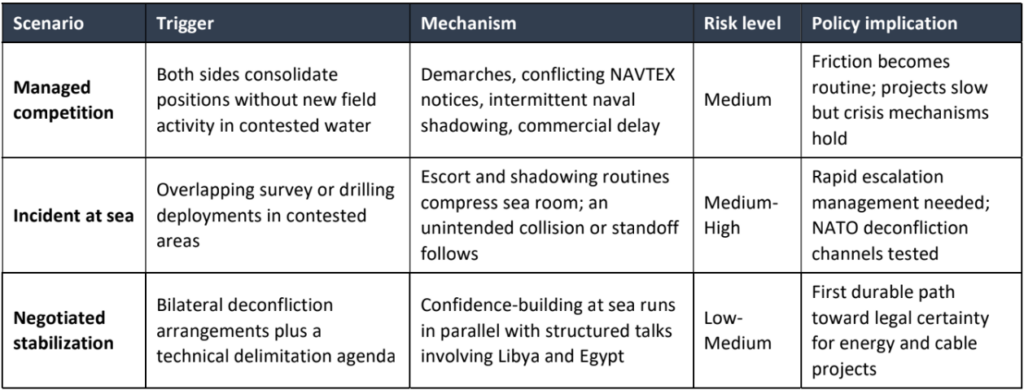
In text form: the baseline is managed competition, in which demarches, conflicting NAVTEX notices, intermittent shadowing and commercial delay substitute for confrontation. The higher-risk path runs through overlapping survey deployments or drilling in contested water, producing an incident neither Ankara nor Athens intended; the 2020 collision shows how little it takes. The stabilizing path pairs bilateral deconfliction arrangements with a technically defined negotiating agenda on delimitation, while broader engagement with Libya and Egypt lowers the temperature. Alliance ties do not remove the need for crisis-management mechanisms, and neither does the parliamentary endorsement.5,13
The October 2026 decision materially strengthens Türkiye’s diplomatic hand, because an eastern Libyan institution that once repudiated the memorandum has now embraced it,
and that closes off a channel through which the agreement was being contested. It is a genuine setback for Greek strategy. Claims circulating since the vote that Greece has somehow lost the legal capacity to assert an EEZ south of Crete or around Meis go far beyond what a parliamentary act can accomplish. What changed on 20 October is bargaining power. The maritime law of the region on 21 October was the same as it had been the week before.2-4,7-9
The strategic question now is what the actors do with the new balance. For Türkiye, the durable gain lies in converting broader acceptance in Libya into predictable commercial and maritime arrangements rather than fresh unilateral moves. For Greece, repeating that the memorandum is invalid is a position, and positions are not policies; Athens needs an agenda it can negotiate. For the EU, solidarity with member states will ring hollow without credible deconfliction options behind it. Libya arguably has the most to gain from keeping maritime competition out of its own fractured politics. Absent a negotiated framework, rising energy and infrastructure activity will keep the Eastern Mediterranean legally disputed and operationally unstable for years.2-5,13
- United Nations Treaty Collection, Turkiye-Libya Memorandum on Delimitation of Maritime Jurisdiction Areas (2019), registration no. 56119. https://treaties.un.org/Pages/showDetails.aspx?objid=080000028056605a. Accessed 21 October 2026.
- Reuters, “Eastern Libya parliament approves maritime deal with Turkey,” 20 October 2026. https://www.reuters.com/world/europe/eastern-libya-parliament-approves-maritime-deal-with-turkey-lifts-2020-boycott-2026-10-20/. Accessed 21 October 2026.
- Associated Press, “Libya approves contentious Turkey deal over Mediterranean waters,” 20 October 2026. https://apnews.com/article/c734515393b2eb9a9b66e69c21467831. Accessed 21 October 2026.
- Hellenic Republic Ministry of Foreign Affairs, Statement on the decision of the Libyan House of Representatives, 20 October 2026.
- International Crisis Group, Turkey Wades into Libya’s Troubled Waters, Report 257 (2020). https://www.crisisgroup.org/rpt/europe-central-asia/turkiye/257-turkey-wades-libyas-troubled-waters. Accessed 21 October 2026.
- Republic of Turkiye Ministry of Foreign Affairs, Statement No. 202 on the Turkiye-Libya maritime delimitation memorandum, 20 October 2026. https://www.mfa.gov.tr/no_-202_-turkiye-ile-libya-arasindaki-deniz-yetki-alanlarinin-sinirlandirilmasina-iliskin-mutabakat-muhtirasi-hk.en.mfa. Accessed 21 October 2026.
- United Nations Convention on the Law of the Sea (1982), arts. 74, 83, 121; 1833 UNTS 3.
- Anglo-French Continental Shelf Arbitration (1977), 18 RIAA 3; ICJ, Continental Shelf (Libyan Arab Jamahiriya/Malta), Judgment (1985).
- ICJ, Maritime Delimitation in the Black Sea (Romania v. Ukraine), Judgment (2009); ITLOS, Bangladesh/Myanmar, Judgment (2012).
- German Practice in International Law, “The Intricacies of Maritime Boundary Delimitation” (2020). https://gpil.jura.uni-bonn.de/2020/03/the-intricacies-of-maritime-boundary-delimitation-germanys-one-sided-response-to-the-turkey-libya-mou-on-delimitation-of-the-maritime-jurisdiction-areas-in-the-mediterranean/. Accessed 21 October 2026.
- Republic of Turkiye Ministry of Foreign Affairs, Spokesperson statement on hydrocarbon cooperation with Libya, 4 October 2022. https://www.mfa.gov.tr/sc_-28_-turkiye-ile-libya-arasinda-hidrokarbonlar-alaninda-isbirligine-iliskin-mutabakat-zapti-konusunda-ab-ve-yunanistan-tarafindan-yayimlanan-aciklamalar-hk-sc.en.mfa. Accessed 21 October 2026.
- European Council and European Commission, Joint statement by President Antonio Costa and President Ursula von der Leyen, 20 October 2026. https://www.consilium.europa.eu/en/press/press-releases/2026/10/20/joint-statement-by-the-president-of-the-european-council-and-the-president-of-the-european-commission/. Accessed 21 October 2026.
- Reuters, “EU-backed east Mediterranean undersea cable project applies to resume seabed research,” 15 October 2026. https://www.reuters.com/business/energy/eu-backed-east-mediterranean-undersea-cable-project-applies-resume-seabed-2026-10-15/. Accessed 21 October 2026.
- Reuters, “Israel strongly condemns Libyan approval of maritime deal with Turkey,” 21 October 2026. https://www.reuters.com/world/middle-east/israel-strongly-condemns-libyan-approval-maritime-deal-with-turkey-2026-10-21/. Accessed 21 October 2026.
click HERE to download as PDF.