

Key Points :
- Seven EU states plan a modular warship family for 2040
- Requirements released in January 2026 now await national endorsement
- A May 2026 industry workshop moved the program toward a Business Case
- France and Germany stay outside, narrowing the program’s market
- For Türkiye the ECV is competitor, benchmark and interoperability partner
The European Combat Vessel (ECV) is the first attempt to plan Europe’s surface fleet as one networked architecture rather than a queue of national purchases. Seven EU member states intend to field a family of modular combatants in three size classes from the 2040s, developed under the European Defence Agency. Momentum has been sustained through 2026: harmonized requirements were released in January, an industry workshop in San Fernando followed in May, and a Business Case is in preparation. The concept is sound and the institutional anchoring solid, but feasibility hinges on funding, governance and requirements discipline between now and 2028. The program also matters to navies outside it. For Türkiye, which is building its own laddered surface family a decade ahead of the ECV timeline, the initiative is at once a benchmark, a future competitor and an interoperability requirement.
Europe’s naval problem is arithmetic before it is strategic. EU member states operate a patchwork of surface combatant classes, most built in small series and few designed to be sustained together. The core frigate classes of several fleets reach the end of their service lives during the 2030s and 2040s, at precisely the moment when demand for presence at sea is rising. Successive Coordinated Annual Review on Defence (CARD) cycles and the EU Strategic Compass have flagged persistent shortfalls in maritime air and missile defense, anti-submarine depth, command platforms and the integration of unmanned systems., Russia’s war against Ukraine and a string of incidents around seabed infrastructure have moved those gaps from planning annexes to front pages.
The ECV grew out of that diagnosis. Following the 2024 CARD cycle and the November 2024 Ministerial Steering Board, Belgium, Greece, Italy, the Netherlands, Portugal, Spain and the Greek Cypriot Administration of Southern Cyprus (GCASC) signed a letter of intent in late 2024 to develop a new class of combat vessel for the 2040 horizon under the European Defence Agency (EDA).1,2 On 15 January 2026 the agency brought the seven navies together with Europe’s main shipbuilders in Brussels to detail the harmonized High-Level Requirements (HLR), which were released publicly and are now passing through national endorsement.3,4 The program is open to additional EU members, and its architects describe it as coherent with NATO targets rather than parallel to them.
The ECV should also be read against the programme it is often confused with. The European Patrol Corvette (EPC/MMPC), a PESCO project backed by the European Defence Fund, occupies the corvette segment below the ECV family and is already moving toward construction after Fincantieri and Navantia signed an MoU in February 2026 to form a joint venture, still pending final transaction documents.5,6 The two initiatives are layers of the same consolidation push rather than rivals: the EPC supplies the near-term test of whether multinational European shipbuilding can hold schedule and workshare discipline, and the ECV extends the same logic upward into first-rate combatants. In practice the corvette program functions as the ECV’s pathfinder, and its trajectory over the next three years will be watched as a leading indicator for the larger family.
Two absences shape the program’s politics. Germany is pursuing its national F127 air-defense frigate, displacing well above the ECV’s largest variant, and France has kept to national lines.7,8 Their industrial weight would transform the ECV’s market; their absence leaves it, for now, a coalition anchored on Italy, Spain and the Netherlands. Officials involved are frank about the logic of pooling. “It is not realistic to think that a single nation can develop this,” says Luis Calvino, the Spanish officer coordinating operational requirements.4 Jurgen Scraback, who heads the EDA’s maritime domain unit, argues the effort will fail unless industry is inside the room from the start.4
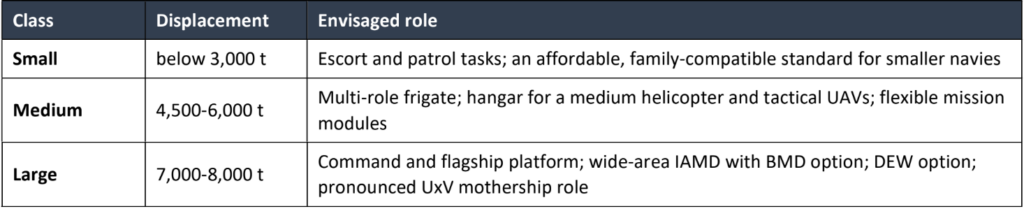
The ECV inverts Europe’s usual shipbuilding sequence. Instead of a national hull design in search of partners, a commonly defined capability profile comes first and the platform is drawn around it, an approach the EDA calls systems-to-hull.1 The output is a family rather than a class: a small variant below 3,000 tones for escort and patrol tasks, a medium variant of 4,500-6,000 tones as the workhorse multi-role frigate, and a large variant of 7,000-8,000 tones intended as a command platform with wide-area air defense and a ballistic missile defense option.7 All three share a 10,000-nautical-mile range at 15 knots, 30 days of endurance and operability up to sea state 6+.7
Table 1: The three ECV size classes. Source: Author’s compilation based on EDA High-Level Requirements documentation.1,7
The requirements read ambitiously even by high-end standards. Every variant is to carry an AI-enabled combat management system with multi-sensor data fusion, and command and control designed to keep a recognized maritime picture alive when satellite links and GNSS are jammed or gone. NATO-standard data links, cooperative engagement and, later, joint composite tracking are specified. The weapons annex lists 4D air-search radars and a full air-defense effector mix, anti-ship missiles reaching well beyond 75 nautical miles with hypersonic ambitions, a 76mm gun with a railgun option, and a layered anti-submarine suite of hull-mounted, towed and variable-depth sonars down to supercavitating torpedoes.7 Each ship is also conceived as a mothership for unmanned aircraft, surface craft and underwater vehicles, operating them in swarms. Directed-energy weapons and counter-hypersonic defence are written in on a fitted-for-but-not-with basis.1,7
What the family would change operationally is easiest to see from a small navy’s bridge. A Portuguese or Belgian escort built to the common standard would plug into the same data links, draw on the same spares pools and send its crews through the same schools as an Italian command ship, which lowers the cost of arriving at an EU or NATO task group with a credible unit. Larger navies gain something different: a framework in which future frigate and flagship replacements are planned once rather than seven times. The economies are not hypothetical. Joint procurement, shared training pipelines and common logistics chains are precisely where past European programs have found their savings, when they found any.
The command-and-control requirement deserves particular attention, because it is where the ECV most clearly imports the lessons of the past four years. Russia’s war against Ukraine and the run of seabed-infrastructure incidents in the Baltic have shown that satellite links, GNSS and shore connectivity are the first casualties of a serious confrontation, not the last. The ECV’s specification of distributed, redundant networks able to hold a recognised maritime picture, allocate targets and control a formation in degraded and denied environments is a direct response, and it quietly redefines what a small escort is for: in a jammed littoral, the smallest ECV variant is meant to keep fighting as a node of the family’s network rather than as an isolated hull. The same architecture raises an unresolved human question. An AI-enabled combat management system and unmanned teaming promise leaner crews, but seven navies with seven personnel systems, career structures and training traditions have yet to define what a common crewing model actually looks like, and the shared naval schools foreseen in the program will only matter if that definition comes early.
An honest capability audit is mixed. The modular architecture is genuinely retrofit-friendly and buys time for immature technologies, and the integrated logistics concept, with distributed maintenance, technology transfer, national certification centers and shared naval schools, addresses sustainment failures that have dogged past programmes.1 Against that stand hard gaps. Several headline technologies sit at low readiness levels, and no common development budget has yet been committed; the program currently leans on prospective European Defence Fund (EDF) and European Defence Industry Programme (EDIP) windows plus seven national budget cycles. Crewing plans, munitions stockpiles and yard capacity remain undefined. Managing one requirement set across seven capitals is itself a risk; the Eurofighter and A400M showed how requirement creep converts ambition into delay.
The first half of 2026 added substance on the industrial side. From 5 to 7 May the EDA, supported by SEA Europe, held a three-day industry workshop in San Fernando (Cadiz), Spain, bringing together the member states, maritime communities and Tier 1 and Tier 2 industry. A call for papers structured around thematic work packages derived from the HLR, including WP5 on hull and superstructure design and construction materials, drew written contributions due by 20 March 2026; selected contributors presented at the workshop.9 Participation reached beyond the system houses: even a Greek aluminum producer presented rolled-product solutions against WP5, a small but telling sign that mobilization now extends across the European Defence Technological and Industrial Base (EDTIB) down to material suppliers. The declared purpose of the exercise is to refine the concept and build the program’s Business Case, the next decisive document.
The deeper industrial stake is the value chain. Naval air and missile defense concentrates the most valuable links of the maritime chain, from sensors and effectors to fire-control software and system integration, and whoever defines that chain sets standards and shapes partner fleets for decades.8 Much of that stack currently arrives from across the Atlantic. The ECV’s designers make little secret of wanting the next technology generation developed inside EU structures, drawing on EDF and EDIP, without severing NATO interoperability. The parallel European Patrol Corvette (EPC), now backed by an MoU Fincantieri and Navantia signed in February 2026 to form a joint venture, is the near-term proof that the model can move from paper to steel.5
EDIP’s eligibility rules will shape the geometry of that supply chain. Under the regulation given final approval in December 2025, at least 65 percent of the component cost of a funded end product must originate in the EU or associated countries, and the design authority must in general sit inside the Union., For the ECV this hard-wires a European supply chain; for industries outside the EU and its associated circle, it raises the entry barrier considerably.
The program is explicitly designed to be coherent with NATO targets, and the aim is not to detach from transatlantic structures but to broaden Europe’s own capability base and thereby increase its weight and burden-sharing within the Alliance.1 The Alliance-level question is force allocation. The same European navies are being asked to sustain Baltic and Black Sea presence, contribute to Red Sea protection, watch undersea infrastructure and prepare for high-intensity contingencies. A common family that lets seven fleets share training, spares and upgrade paths is one of the few structural answers to that stretch; a family without France and Germany answers it only partially, and the risk of a two-standard European fleet, one built around the ECV architecture and one around F127 and French national lines, is real.
The two-standard risk is manageable, but only if the interoperability floor is set at the Alliance level rather than inside the program. The ECV requirements already point that way: NATO-standard data links, cooperative engagement and joint composite tracking are Alliance mechanisms, not EU ones, and they are precisely the layer at which an F127, a French frigate, a Turkish task group and an ECV escort can be made to work as one force even though their hulls, combat systems and supply chains differ. The test of the program’s NATO coherence will be whether those interface standards are frozen early and shared openly, or allowed to drift into a proprietary European stack that recreates the fragmentation problem one level higher.
For the EU the exposure is systemic rather than operational. Sea lines of communication, LNG terminals and submarine cables have become the transmission channels of European insecurity, and CARD’s naval shortfall findings are the capability translation of that exposure. The ECV is the fund-and-build answer: it routes the response through EDF and EDIP structures, which is why the funding milestones matter more than any design review. The Business Case now in preparation will be the first hard evidence of affordability, and the first ECV-specific funding windows will be the first hard evidence of commitment. Neither exists yet.
Türkiye operates one of NATO’s largest fleets and runs the closest thing Europe has to a working, laddered surface family, which makes it a natural reference point for what the ECV is trying to do. The national MILGEM line climbs from the Ada-class corvettes through the eight-ship Istanbul (Istif) class, whose sixth unit, TCG Karadeniz, was launched in July 2026, to the TF-2000 (Tepe) class air-defense destroyer of roughly 8,300 tones, under construction since January 2025 with the first ship planned to be launched around 2027.13,14,15 In tonnage terms that ladder brackets the ECV’s three classes almost exactly, and it is being delivered a decade ahead of the ECV’s 2040 horizon. The comparison cuts both ways: it validates the family-of-ships logic the ECV is adopting, and it shows that a determined national program can move faster than a seven-nation one.
The industrial relationship is more constrained. As a candidate country that is not an EDIP-associated state, Türkiye falls on the wrong side of the 65 percent component rule and the EU design-authority requirement, so Turkish industry has no funded route into the ECV supply chain as matters stand.11,12 Access would require bilateral industrial arrangements, a change in association status or a political decision by the participating states. In export markets the effect is competitive: a subsidized European standard family, once real, would compress the space in which Turkish designs have been winning orders, from Pakistan’s Babur-class program to Ukraine’s Ada-derived corvettes, precisely in the corvette and light frigate segments the ECV small and medium classes will occupy.
The operational layer pulls in the opposite direction. Every ECV participant is a NATO ally, and the program’s NATO-coherent design means Turkish task groups will plan, train and fight alongside ECVs in Allied formations. Interface-level compatibility, in data links, cooperative engagement and eventually joint composite tracking, is therefore a Turkish interest regardless of industrial access. For Ankara the practical agenda is threefold: track the HLR-derived standards as they harden, press for interoperability floors to be set at NATO rather than EU level, and use the speed advantage of its own programs to anchor positions in markets and mission areas before the European family arrives in the water.
Three trajectories look plausible between now and the end of the decade, each with a distinct trigger and policy meaning.
Table 2: Possible programme trajectories to 2030. Source: Author’s qualitative assessment based on the cited programme documentation and reporting.
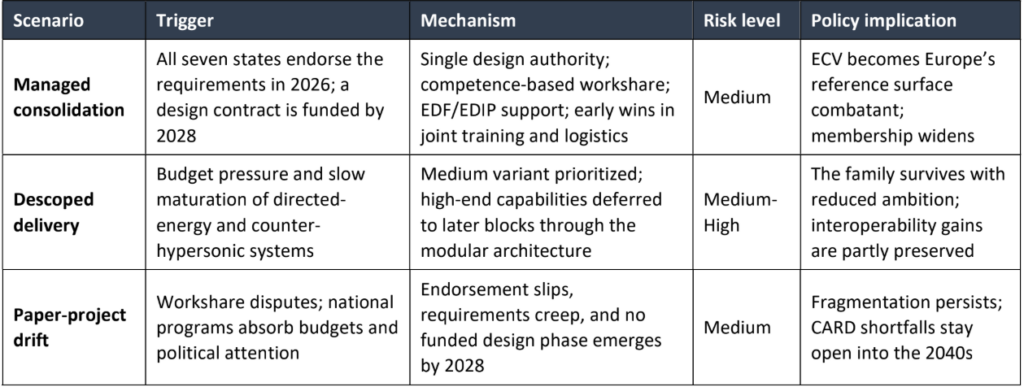
In text form: under managed consolidation, endorsement in 2026 flows into a funded design phase by 2028, with a single design authority and workshare allocated by competence; the risk is moderate and the ECV becomes the reference European combatant. Under descoped delivery, fiscal pressure and slow technology maturation push the program toward the medium variant first, deferring the high end to later blocks; ambition shrinks but the interoperability dividend largely survives. Under paper-project drift, industrial disputes and competing national programs stall endorsement and funding, and the ECV joins the long list of well-argued European studies that never cut steel.
The ECV matters conceptually before it matters materially. For the first time, a group of European states is planning its surface fleet as one networked architecture, from escort hull to command platform, rather than as a queue of national purchases. Concepts do not float, though. What will decide this program is executional discipline: freezing requirements once endorsed, phasing exotic technologies into later blocks, locking multi-year funding early and distributing work by competence rather than by flag. Those choices harden between 2026 and 2028, from national endorsement through the Business Case to a funded design phase. Used well, that window makes the ECV the standard European combatant of the 2040s, and a fixture in the planning of every navy, Turkish included, that will operate beside it. Wasted, it leaves Europe’s fleets as they are today, only older.
- European Defence Agency. (2026). European Combat Vessel: Europe’s Next-Generation Multi-Modular Naval Platform. Factsheet 01/2026. Accessed 10 July 2026. https://eda.europa.eu/docs/default-source/eda-factsheets/ecv-hlr-factsheet-1.pdf
- Defense News. (2024). Europeans Start Work on Next-Generation Combat Ship for the 2040s. 5 November 2024. Accessed 10 July 2026. https://www.defensenews.com/global/europe/2024/11/05/europeans-start-work-on-next-generation-combat-ship-for-the-2040s/
- European Defence Agency. (2026). EDA Hosts Shipbuilders, Signatory Countries for New Family of Warships. 15 January 2026. Accessed 10 July 2026. https://www.eda.europa.eu/news-and-events/news/2026/01/15/eda-hosts-shipbuilders–signatory-countries-for-new-family-of-warships
- Defence Industry Europe. (2026). EDA Brings Seven EU States and Shipbuilders Together to Shape Future European Combat Vessel Frigates. 17 January 2026. Accessed 10 July 2026. https://defence-industry.eu/eda-brings-seven-eu-states-and-shipbuilders-together-to-shape-future-european-combat-vessel-frigates/
- Naval News. (2026). Navantia and Fincantieri Strengthen Their Cooperation to Advance the European Patrol Corvette (EPC) Programme. February 2026. Accessed 10 July 2026. https://www.navalnews.com/naval-news/2026/02/navantia-and-fincantieri-strengthen-their-cooperation-to-advance-the-european-patrol-corvette-epc-programme/
- PESCO. European Patrol Corvette (EPC). Accessed 10 July 2026. https://www.pesco.europa.eu/project/european-patrol-corvette-epc/
- MarineForum. (2026). European Combat Vessel: Europe’s Naval Project Takes Shape. Accessed 10 July 2026. https://marineforum.online/en/european-combat-vessel-europes-naval-project-takes-shape/
- Mergener, H.U. (2026). European Combat Vessel: Flottenarchitektur statt Ruestungsmosaik. ESUT, 17 February 2026. Accessed 10 July 2026. https://esut.de/2026/02/meldungen/68095/european-combat-vessel-flottenarchitektur-statt-ruestungsmosaik/
- European Defence Agency. (2026). European Combat Vessel – Industry Workshop. Event notice, 9 February 2026. Accessed 10 July 2026. https://eda.europa.eu/news-and-events/events/2026/05/05/default-calendar/european-combat-vessel—industry-workshop
- ElvalHalcor. (2026). Elval Participated in the Industry Workshop for the European Combat Vessel (ECV). 19 May 2026. Accessed 10 July 2026. https://www.elvalhalcor.com/articles/elval-participated-in-the-industry-workshop-for-the-european-combat-vessel-ecv/
- Council of the European Union. (2025). European Defence Industry Programme: Council Gives Final Approval. 8 December 2025. Accessed 15 September 2026. https://www.consilium.europa.eu/en/press/press-releases/2025/12/08/european-defence-industry-programme-council-gives-final-approval/
- CMS Law. (2026). The 35% Rule and Design Authority: How EDIP’s Third-Country Restrictions Reshape Defence Supply Chains. CMS Global Radar 2026. Accessed 15 September 2026. https://cms.law/en/int/publication/cms-global-radar-2026-third-edition/the-35-rule-and-design-authority-how-edip-s-third-country-restrictions-reshape-defence-supply-chains
- Army Recognition. (2026). Türkiye Launches Sixth Istanbul-Class Frigate TCG Karadeniz at Sedef Shipyard. Accessed 15 September 2026. https://www.armyrecognition.com/news/navy-news/2026/tcg-karadeniz-f520-istif-class-frigate-launch-turkey-milgem
- Army Recognition. (2026). Türkiye to Receive Its First National TF-2000 Air Defense Destroyer by 2027 for Carrier Protection. Accessed 15 September 2026. https://www.armyrecognition.com/news/navy-news/2026/tuerkiye-to-receive-its-first-national-tf-2000-air-defense-destroyer-by-2027-for-carrier-protection
- Naval News. (2025). Turkish Navy Starts Construction of 3 Major Projects: MUGEM Aircraft Carrier, TF-2000 Destroyer, and MILDEN Submarine. 14 January 2025. Accessed 24 September 2026. https://www.navalnews.com/naval-news/2025/01/turkish-navy-starts-construction-of-3-major-projects-mugem-aircraft-carrier-tf-2000-destroyer-and-milden/
click HERE to download as PDF.