Key Points :
- Türkiye must control every mission accepted under the pact.
- Intelligence support can create exposure without combat deployment.
- Defending Saudi territory must not determine Yemen’s settlement.
- Iranian stability remains a Turkish and Pakistani interest.
- The next attack will test consent, reciprocity and restraint.
The Mecca pact’s real test will not be whether Türkiye responds when Saudi Arabia requests assistance. It will be whether Ankara can keep that response within a mission it has deliberately accepted. Recent attacks have exposed the distance between a collective defense promise and agreement on what each member should do. Türkiye and Pakistan may initially provide intelligence, air defense, logistics or other limited support, but repeated attacks could gradually expand those contributions into responsibility for a wider campaign. A credible pact must protect Saudi Arabia while preserving each member’s authority over the purpose, scope and duration of its involvement.
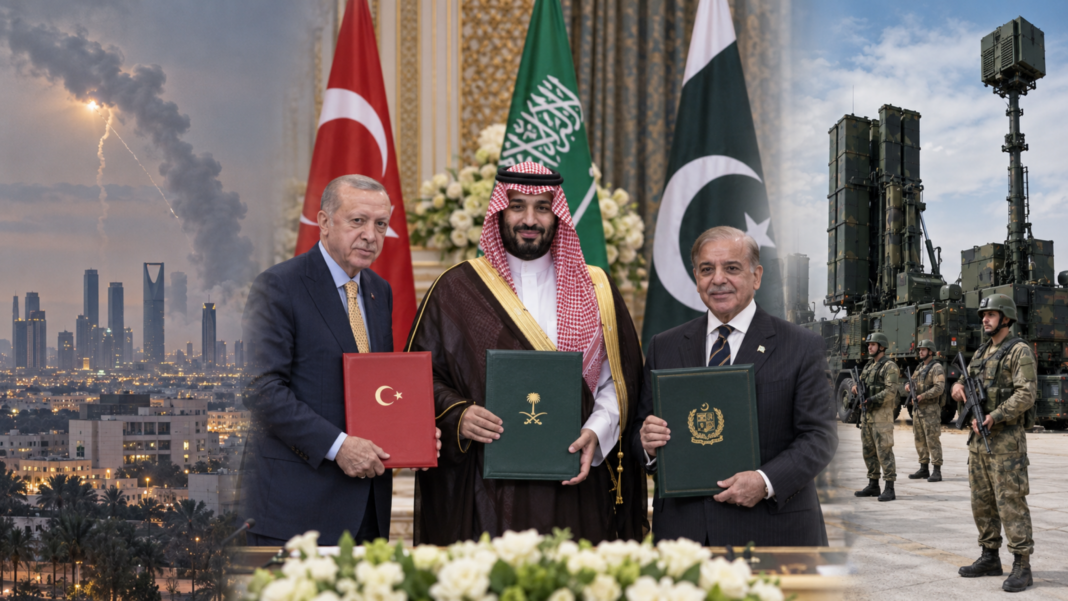
The Mecca pact’s operational test has begun. On 25 September, the Turkish, Saudi and Pakistani foreign ministers-initiated arrangements for an urgent meeting of their chiefs of staff to consider how Saudi Arabia should be supported. Türkiye’s Chief of General Staff travelled to Saudi Arabia for consultations with his Saudi and Pakistani counterparts.1 The issue is no longer whether Riyadh will seek practical support. It is what missions the three governments will approve, under whose authority and with what limits.
The earlier Defense Domain paper, “The Mecca Pact Connects Two Wars”, examined how a Gulf commitment could carry escalation towards Turkish territory and the North Atlantic Treaty Organization (NATO). The question now is who can interrupt that sequence before limited support becomes participation in a wider campaign.2
On 31 August, the three governments agreed to deepen defense-industrial cooperation and establish a secretariat in Saudi Arabia, initially headed by a Pakistani secretary general. Their joint statement also endorsed restraint.3 On 10 September, Pakistan said a military response to Houthi attacks was not under discussion.4 Türkiye’s 12 September statement condemned attacks launched from Iraqi territory while praising Saudi restraint and welcoming Baghdad’s investigation.5
The agreement’s legal and operational status nevertheless remains incomplete. On 25 September, Turkish Parliament Speaker Numan Kurtulmuş said that the pact still required parliamentary approval and described the current meetings as preparatory. Immediate Turkish assistance would therefore remain largely bilateral until ratification.6 This is not a procedural detail. Political solidarity, bilateral military cooperation and formal collective-defense action currently overlap without being legally identical. Ankara retains substantial discretion over each contribution made during this interim period.
Bounded assistance is now moving from diplomatic signaling towards military planning. On 19 September, Foreign Minister Hakan Fidan said that Türkiye was prepared to meet Saudi military needs, particularly technical requirements, while arguing that Saudi Arabia should not be drawn into the wider US-Iran war.7 On 22 September, Türkiye, Pakistan, Saudi Arabia and Egypt affirmed Riyadh’s right to defend itself under international law while maintaining that dialogue and diplomacy remained the only sustainable solution.8 These positions define Ankara’s emerging approach: provide credible defensive assistance while resisting a mission that converts support for Saudi security into participation in the wider conflict.
Türkiye’s authority to refuse a particular mission derives from its sovereign control over national forces and contributions. It should not be interpreted as evidence that the agreement contains an unrestricted legal opt-out. The public commitments leave important operational questions unanswered. Their absence from public statements does not prove that private arrangements do not exist. It does mean that declarations alone cannot establish how far Ankara has agreed to go.
The political cost of restraint has also increased. Türkiye formally condemned the 16 September Houthi drone attack targeting Mecca and reaffirmed its support for Saudi sovereignty, territorial integrity and security.9 An attack associated with Islam’s holiest city creates a stronger public and symbolic claim for solidarity than an attack on remote infrastructure. It does not, however, determine whether Turkish support should remain defensive or extend to operations outside Saudi territory.
Alliance research identifies an enduring tension between abandonment and entrapment. Michael Bosack shows that efforts to reassure an ally can increase exposure to its actions, particularly in ambiguous or grey-zone conflicts. Tongfi Kim demonstrates that alliance commitments create risks of entanglement, but states retain political and institutional mechanisms for preventing entanglement from becoming involuntary participation in war.10,11 The Mecca pact will therefore be judged not only by the strength of its collective-defense promise but also by whether its procedures allow members to limit the scope, form and duration of their involvement.
Multinational operations have faced this problem before. Research on NATO’s Afghanistan mission shows that contributing states used national caveats to restrict where, when and how their forces could be employed. These restrictions sometimes reduced coalition effectiveness, but they also preserved national authority over delegated military power. The Mecca pact will require a comparable method for distinguishing an accepted collective commitment from automatic participation in every operation undertaken under its name.12
Protecting Saudi cities and infrastructure is a comprehensible military purpose. Deciding Yemen’s political future or joining a wider campaign against Iran requires a different decision. The distinction becomes harder to maintain when attacks continue and the immediate demand is to stop them by whatever means appear effective.
A government providing assistance must know the political outcome its contribution is intended to support. Intercepting an incoming threat does not require agreement on every aspect of Saudi regional policy. A prolonged campaign to suppress that threat at its source demands a much closer understanding of objectives, acceptable costs and the conditions under which operations end.
Geographical restrictions provide only part of that answer. Personnel can remain inside Saudi Arabia while their work supports activities beyond its borders. Conversely, a well-defined defensive contribution can protect civilians and reduce the pressure for retaliation. Its strategic meaning depends on what it enables and the decisions governing its use.
This creates an uncomfortable possibility. Turkish or Pakistani protection could free Saudi capabilities for operations elsewhere without giving either supporting government equivalent influence over those operations. That would not establish Saudi bad faith. It would expose a foreseeable mismatch between the burden of providing security and the authority to shape the campaign. Yasuki Kudo’s research offers an analogy rather than a direct model. Asymmetric alliances can distribute protection, influence and autonomy unevenly. The Mecca pact does not establish a single hierarchy across every issue: financial dependence, military capability and access to defense technology may distribute leverage differently. The relevant question is therefore not which member is categorically stronger, but whether a member accepting a specific burden receives corresponding authority over what that burden enables.13
Yemen illustrates how a defensive mission can expand into support for a preferred political settlement. Iraq presents a more immediate Turkish exposure. An attack launched from Iraqi territory could lead Saudi Arabia to request Turkish intelligence or operational support against an Iran-aligned group.5 If that group retaliated against Turkish forces or facilities in Iraq, Ankara could face casualties outside Turkish territory, where NATO’s collective-defense geography would not apply automatically.14 The pact could therefore widen Türkiye’s military exposure without producing the clear territorial attack assumed in the original escalation pathway.
Intelligence support is often presented as a limited alternative to direct military action. The phrase covers activities with very different consequences. A general threat assessment, warning of an incoming attack and information supporting a particular operation are distinct commitments. Grouping them together obscures the decisions that matter.
The first decision concerns the assessment itself. Evidence that a weapon originated in Iraq does not establish who authorised its use. Identifying an Iran-aligned organisation does not, without further evidence, prove that Tehran directed a particular attack. Technical findings, analytical confidence and political responsibility must remain distinguishable.
Support relationships do not necessarily establish operational control. Karlén and colleagues show that external support, proxy warfare and conflict delegation cover different relationships, with varying degrees of hierarchy, dependence and sponsor control.15 A state and an armed group may share interests without the state directing every operation. Attribution should therefore distinguish material support, strategic alignment, hierarchical control and direction of the particular attack under examination.
A partner under attack has an understandable need for quick answers. That urgency can create pressure to accept its attribution and preferred response together. Türkiye must retain the capacity to examine the evidence independently and record disagreement. Consultation becomes little more than endorsement if the decision to retaliate precedes consideration of the assessment.
The next decision concerns use. Ankara needs clarity on whether information is released for warning, territorial protection or support to a specified operation. The recipient’s ability to pass it onward also matters because shared intelligence can produce consequences beyond the purpose for which it was originally provided. Şeniz Bilgi’s research on European intelligence cooperation shows that formal institutions and technical mechanisms cannot by themselves overcome differences in national interests, intelligence cultures and levels of trust between partners.16 For the Mecca pact, this implies a need for agreed restrictions on purpose, onward disclosure and operational use.
An effective arrangement therefore needs agreed limits and a practical way to suspend or narrow a contribution when its purpose changes. These are requirements for responsible cooperation, not allegations about an existing misuse of Turkish intelligence. Nothing in the public evidence establishes that Turkish information is being transferred to Israel or used in operations Ankara has rejected.
The underlying problem is political. Supplying an important part of a decision does not necessarily give the supplier control over the decision itself. Türkiye could retain command of its personnel while losing influence over the consequences of their work. Counting deployments would miss that form of exposure.
Türkiye can oppose Iranian coercion while rejecting severe destabilisation in Iran as a desirable outcome. Those positions are compatible. Before the current phase of the conflict, Foreign Minister Hakan Fidan warned that widespread Iranian instability would exceed the region’s capacity to withstand it. His January statement provides a clear indication of Ankara’s underlying concern.17
Geography gives that concern lasting weight. Türkiye would have to live with the consequences of disorder across its eastern border after other actors reduced their military involvement. Displacement, disrupted commerce and opportunities for armed groups would become problems of Turkish national security. Research on Türkiye-Iran relations describes a durable pattern of competition and cooperation shaped by regional security effects and geographical proximity.18 These are risks to assess, not predictions that Iranian fragmentation is inevitable.
Pakistan has a comparable reason to avoid an open-ended confrontation with its neighbour, alongside its own distinct security priorities. Its relationship with Riyadh does not remove the costs of deteriorating relations with Tehran. The pact brings these interests into the same consultation; it does not make them identical.
Ankara also continues to resist defining the pact as an anti-Iran bloc. On 25 September, Kurtulmuş raised eventual Iranian participation as part of a possible broader arrangement for the Muslim world.6 This should be read as political signaling rather than an agreed initiative. It nevertheless reinforces Türkiye’s interest in preventing defensive cooperation with Saudi Arabia from hardening into a permanent anti-Iran alignment.
The hard question is the intended end of the war. Saudi Arabia may seek relief from attacks. Other participants may seek more extensive changes in Iranian capabilities or behaviour. Ankara can support the former without accepting every means proposed in pursuit of the latter. Agreement on the need to stop an attack is insufficient evidence of agreement on victory.
This also places an obligation on Iran. Turkish opposition to destabilisation cannot be treated as permission to impose unlimited costs on Türkiye’s partners. Repeated attacks could narrow Ankara’s room for restraint and strengthen arguments for deeper involvement. Preserving a diplomatic channel is useful only if it can influence conduct, not simply explain it after the damage.
Reciprocity becomes meaningful when a member incurs costs. If Turkish personnel are attacked while helping defend Saudi Arabia, the resulting support should not have to be invented under pressure. If Ankara then faces additional exposure elsewhere, it needs a realistic understanding of what its partners are prepared to contribute.
Equal commitment does not require identical forces. Financing, replenishment and diplomatic support can have substantial value. The relevant test is whether the contribution addresses the risk being accepted. A promise that is politically impressive at signature can prove poorly matched to the needs of the member carrying the immediate burden.
Defense-industrial cooperation adds another consideration. Contracts and joint production can strengthen capability and relationships. They cannot substitute for deciding whether a particular operation serves the national interest. An export opportunity, an alliance obligation and consent to a military mission are separate decisions, even when they arise within the same partnership.
Riyadh has a legitimate objection to unlimited partner hesitation. If assistance is always postponed until risk disappears, the pact offers little protection when it is needed. Türkiye and Pakistan cannot claim a consequential regional role while treating every meaningful contribution as somebody else’s responsibility.
The practical bargain must therefore work in both directions. The supporting member should deliver the protection it has accepted. The recipient should recognise the agreed purpose and the authority needed to prevent that contribution from expanding without renewed consent. Neither blank commitments nor habitual refusal will sustain the agreement.
The United States remains part of this calculation. On 12 September, reporting indicated that Washington had offered intelligence support while declining immediate direct intervention against the Houthis.19 Saudi Arabia’s additional partnerships have therefore not removed the distinction between what Washington supports and what it is prepared to fight for.
Britain’s response demonstrates how mission limitation can operate in practice. London accepted Saudi Arabia’s request for defensive air-to-air refueling support while avoiding direct entry into the conflict.20 Yet even a contribution described as defensive can extend aircraft endurance and release Saudi capabilities for other missions. The case reinforces the need to define not only what a supporting platform does, but what operations its support ultimately enables.
A regional defense arrangement can increase local autonomy. It can also absorb costs generated by decisions taken elsewhere. If regional partners make a continuing pressure campaign easier to sustain, they need to understand whether they have influence over its objectives and duration. That is a question of consequences; it does not require a claim that Washington secretly designed the pact to outsource a war.
Israel’s interests must be examined with the same precision. Reduced Iranian capacity could improve Israel’s position in one theatre while stronger Turkish influence constrains it in another. The August dispute following Israeli strikes on Syria’s Abu al-Duhur airbase illustrates that Turkish and Israeli security priorities remain capable of direct collision.21
The pact’s members should consequently be wary of accepting a single regional threat picture as a common strategy. States may cooperate against one danger while competing over the political order that follows. Sharing information or protecting the same infrastructure does not establish agreement on Syria, Lebanon or Iran’s future.
NATO cannot resolve those differences in advance. Its collective-defense provisions have their own geographical scope and decision process. An attack on Turkish interests abroad is not automatically equivalent to an attack on Turkish territory. Ankara’s obligations under a separate agreement do not confer NATO authority over that agreement’s missions or pre-commit Allies to the resulting campaign.14
The boundary should be defined by changes in operational effect rather than by the formal name of the mission. Renewed Turkish authorisation would become necessary if assistance moved from warning to targeting, from interception to attacks on launch sites, from Saudi territorial defense to operations outside Saudi Arabia or from controlled intelligence release to onward disclosure. A deployment can retain its original label while its strategic purpose changes. That is the point at which continued support must become a new national decision.
Consider the decision now approaching. Attacks have already extended from energy infrastructure and military facilities to Riyadh and the approaches to Mecca.1 The three chiefs of staff agree on limited Turkish and Pakistani technical assistance. That contribution becomes recurrent as the attacks continue. A subsequent strike causes casualties among supporting personnel or creates pressure to attack launch infrastructure outside Saudi territory. Riyadh then requests an operation beyond the original defensive purpose.
At that point, the pressure changes. Refusing the expanded request can be presented as abandoning an ally or failing to protect one’s own people. Continuing the original mission can look inadequate. Withdrawal becomes politically costly because forces are already committed and expectations have formed around their presence.
Domestic politics would reinforce that pressure differently in each member state. In Türkiye, casualties among deployed personnel could create simultaneous demands for retaliation and questions about why a limited mission had expanded. Pakistan would face a different tension between its security relationship with Saudi Arabia and the costs of confrontation with neighboring Iran. These pressures would not determine the outcome, but they could narrow the political space for keeping the mission limited.
The initial decision need not have been careless. Each government may have accepted a reasonable task with a limited objective. The danger develops when protecting the existing commitment becomes the justification for accepting another. The need for force protection is real, but it should not settle the political question of what campaign the country is now supporting.
There are alternatives to that progression. Effective defense can reduce Saudi losses and create room for negotiations. Members can agree to narrower responsibilities or insist on renewed authorization before mission expansion. The pact could also weaken through disagreement without producing a wider war. The evidence available on 25 September does not justify treating offensive escalation as inevitable.
The decisive indicators will be changes in approved missions and the use of assistance, rather than declarations of unity alone. A shift from protecting agreed assets to supporting a broader campaign would matter more than another committee meeting. So, would an inability to withdraw consent without threatening the entire relationship.
A capable staff should make those decisions visible before they become urgent. The public need not receive operational details, but the government should be able to explain the purpose of the commitment and the authority for changing it. Secrecy can protect a mission. It cannot replace a defined national interest.
The Mecca pact now confronts the practical problem behind its collective promise. Saudi Arabia needs protection that has military value. Türkiye and Pakistan need control over the missions through which they provide it. Both requirements are legitimate and neither can be deferred indefinitely.
For Ankara, the central risk is accepting responsibility for a campaign while retaining too little influence over its direction. That exposure can develop through intelligence and continuing support well before any decision to enter a wider war. Türkiye should fulfil clearly defined defensive commitments but refuse an expanded operation whose purpose it has not accepted. Such a refusal would require explanation and could carry real political costs, yet the ability to disagree must remain usable when the mission changes.
The previous paper warned that the pact could bring regional escalation to Türkiye. The next test is whether Ankara can help protect its partners while keeping authority over how far it follows them. The commitment must remain a Turkish decision after the first deployment, after the first loss and after the next request for more.
- Reuters. (2026, September 25). Allies Unite behind Saudi Arabia as Houthis Step Up Attacks. https://www.reuters.com/world/middle-east/allies-unite-behind-saudi-arabia-houthis-step-up-attacks-2026-09-25/
- Büker, E. (2026, August 12). The Mecca Pact Connects Two Wars. Defense Domain. https://defensedomain.com/the-mecca-pact-connects-two-wars/
- Republic of Türkiye Ministry of Foreign Affairs. (2026, August 31). Strategic Political and Defense Committee of the Makkah Agreement for Joint Defense: Joint Statement. https://www.mfa.gov.tr/strategic-political-and-defense-committee-of-the-makkah-agreement-for-joint-defense–joint-statement–31-august-2026.en.mfa
- Reuters. (2026, September 10). Pakistan Says No Military Response Discussed Under Mecca Pact over Houthi Attacks on Saudi Arabia. https://www.reuters.com/world/middle-east/pakistan-says-no-military-response-discussed-under-mecca-pact-over-houthi-2026-09-10/
- Republic of Türkiye Ministry of Foreign Affairs. (2026, September 12). No. 176: Regarding the Drone Attacks Targeting Saudi Arabia. https://www.mfa.gov.tr/no_-176_-suudi-arabistan-a-yonelik-gerceklestirilen-iha-saldirilari-hk.en.mfa
- Reuters. (2026, September 25). Pact with Saudi and Pakistan Could Expand to Muslim World, Iran, Turkish Speaker Says. https://www. reuters.com/world/middle-east/pact-with-saudi-pakistan-could-expand-muslim-world-iran-turkish-speaker-says-2026-09-25/
- Reuters. (2026, September 19). Turkey Says It Could Help Meet Saudi Military Needs under Defense Pact. https://www.reuters.com/ business/aerospace-defense/turkey-says-it-could-help-meet-saudi-military-needs-under-defense-pact-2026-09-19/
- Reuters. (2026, September 22). Turkey, Saudi Arabia, Pakistan, Egypt Affirm Riyadh’s Right to Defend Itself. https://www.reuters.com/world/asia-pacific/turkey-saudi-arabia-pakistan-egypt-affirm-riyadhs-right-defend-itself-2026-09-22/
- Republic of Türkiye Ministry of Foreign Affairs. (2026, September 16). No. 181: Regarding the Drone Attack by the Houthis Targeting Saudi Arabia. https://www.mfa.gov.tr/no_-181_-husilerin-suudi-arabistan-a-yonelik-saldirisi-hk.en.mfa
- Bosack, M. M. (2020). Ameliorating the Alliance Dilemma in an Age of Gray-Zone Conflict: Lessons Learned from the U.S.-Japan Alliance. Naval War College Review, 73(4), Article 5. https://digital-commons.usnwc.edu/nwc-review/vol73/iss4/5/
- Kim, T. (2011). Why Alliances Entangle but Seldom Entrap States. Security Studies, 20(3), 350–377. https://doi.org/10.1080/09636412.2011.599201
- Saideman, S. M., & Auerswald, D. P. (2012). Comparing Caveats: Understanding the Sources of National Restrictions upon NATO’s Mission in Afghanistan. International Studies Quarterly, 56(1), 67–84. https://doi.org/10.1111/j.1468-2478.2011.00700.x
- Kudo, Y. (2025). Rewarding Loyalty: Selective Reassurance and Enforcement of Asymmetric Alliances. Journal of Peace Research, 62(6), 1938–1950. https://doi.org/10.1177/00223433241292270
- North Atlantic Treaty Organization. (1949, April 4). The North Atlantic Treaty (as amended, Arts. 4–6). https://www.nato.int/en/about-us/official-texts-and-resources/official-texts/1949/04/04/the-north-atlantic-treaty
- Karlén, N., Rauta, V., Salehyan, I., Mumford, A., San-Akca, B., Stark, A., Wyss, M., Moghadam, A., Duursma, A., Tamm, H., Jenne, E. K., Popovic, M., Siroky, D. S., Meier, V., Chinchilla, A., Rickard, K., & Spatafora, G. (2021). Forum: Conflict Delegation in Civil Wars. International Studies Review, 23(4), 2048–2078. https://doi.org/10.1093/isr/viab053
- Bilgi, Ş. (2016). Intelligence Cooperation in the European Union: An Impossible Dream? All Azimuth, 5(1), 57–67. https://doi.org/10.20991/allazimuth.167342
- Republic of Türkiye Ministry of Foreign Affairs. (2026, January 15). Press Conference by Foreign Minister H. E. Hakan Fidan with Representatives of National and International Media Organizations. https://www.mfa.gov.tr/disisleri-bakani-sayin-hakan-fidan-in-ulusal-ve-uluslararasi-medya-kuruluslarinin-temsilcileriyle-gerceklestirdigi-basin-toplantisi-15-01-2026.en.mfa
- Savaş, Z. F. (2026). Forever the Frenemies of the Middle East? Türkiye’s Regional Relations with Iran, 2002 to 2023. All Azimuth, 15(1), 113–138. https://doi.org/10.20991/allazimuth.1726446
- Reuters. (2026, September 12). Houthi Advance in Yemen Puts U.S. in a New Bind. https://www.reuters.com/world/middle-east/houthi-advance-yemen-puts-us-new-bind-2026-09-12/
- Reuters. (2026, September 21). UK’s Burnham Agrees to Saudi Request for Refuelling Support. https://www.reuters.com/business/aerospace-defense/uks-burnham-agrees-saudi-request-refuelling-support-2026-09-21/
- Reuters. (2026, August 20). Israel and Turkey Step Up Warnings over Syria after Airbase Strikes. https://www.reuters.com/world/middle-east/syria-says-no-turkish-military-build-up-planned-airbase-struck-by-israel-2026-08-20/
click HERE to download as PDF.