

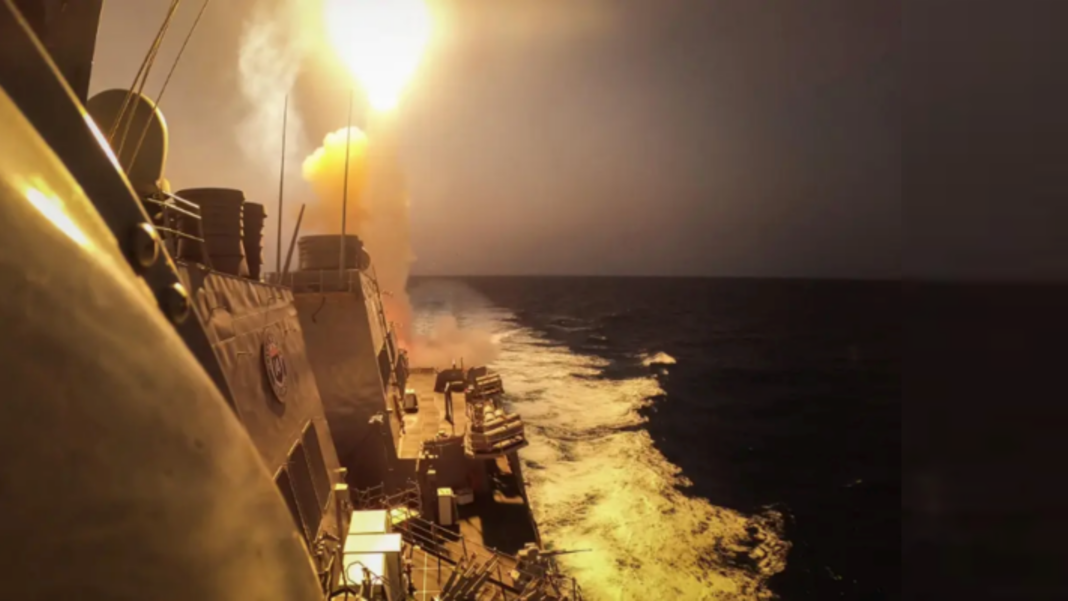
Key Points :
- Cheap threats impose costs far beyond their purchase price.
- Mass attacks strain detection, identification and engagement capacity.
- Uncrewed systems make sea denial cheaper and more accessible.
- Magazine depth now limits how long warships can fight.
- Forward and rear logistics hubs are now targets in their own right.
- European navies must integrate layered defense, weapon choice and logistics.
Europe’s most capable warships take years and close to or more than a billion euros to build, yet the drones and missiles fired at them cost a fraction of that. The imbalance
matters less for the damage a single cheap weapon can cause than for what repeated attacks demand: scarce interceptors, constant attention from sensors and crew and
eventually a long transit to rearm. Since 2022, the Black Sea, the Red Sea and the Gulf have made this an operational record. For European navies, which can neither replace warships nor replenish missile stocks quickly, the question is how long their most valuable platforms can sustain operations under repeated attack. The challenge is no longer confined to defending the warship; it extends to the bases, ammunition stocks and industrial capacity that keep it in the fight.
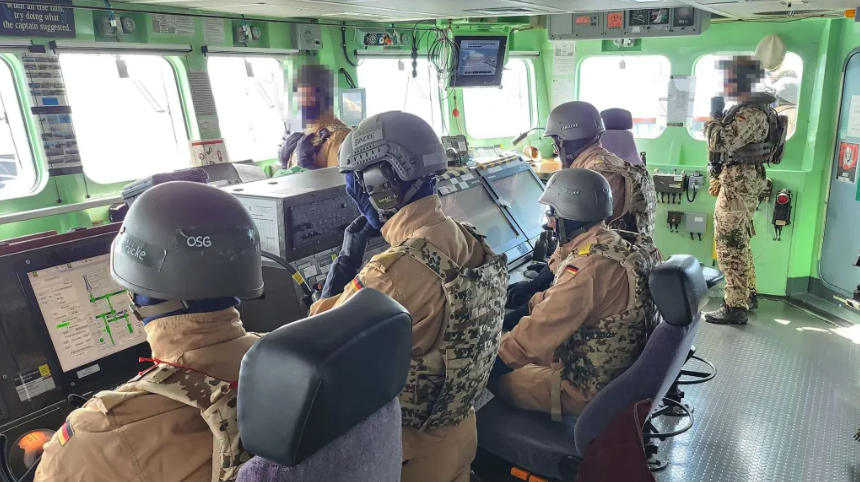
In February 2024, the German frigate Hessen entered the Red Sea under the EU’s Aspides mission. Over 58 days in the operation area, it escorted 27 merchant ships and repelled four attacks.1 It also had to rearm in Djiboutifour attacks.2 Within days of arriving, it fired two SM-2 missiles at an unidentified drone that turned out to be a U.S. MQ-9 Reaper. Both missed. The drone had reportedly been flying without its identification transponder switched on,3 raising questions about allied identification procedures and information exchange.4
Picture 1: The bridge of the German frigate Hessen during an Air Warning Red, issued when an air threat has been identified.
On 9 March 2024, the Danish frigate Iver Huitfeldt, serving in the U.S.-led Prosperity Guardian coalition, faced around fifteen Houthi drones in an engagement lasting about an hour. According to reports, its ESSM missiles could not be fired for roughly 30 minutes, while up to half of the 76 mm rounds it fired detonated early, close to the ship. It shot down four drones; other ships dealt with the rest.5,6 The French frigate Alsace faced both drone and ballistic missile attacks during 71 days in the region. Its commander said the Aster missile had been “pushed to its limits”.7
Together, these cases reveal three vulnerabilities that advanced weapons alone cannot solve: limited ammunition, system reliability under sustained pressure and positive identification in crowded waters.
Pressure now comes from several directions, each testing a different limit of naval defense.
In the air, each contact imposes a sequence of tasks: detection, tracking, identification, sharing with allied units, engagement and assessment of the result. When threats arrive close together, these steps compete for the same combat system. A failed engagement may require another weapon. More radar power alone does not remove the bottleneck.
At the waterline, uncrewed surface vessels exploit a different gap. Their small profiles can complicate detection and engagement, especially near cluttered coasts. In June 2024, a Houthi uncrewed boat struck the bulk carrier Tutor, which was later reported sunk, the second merchant ship lost in the campaign.8,9 Ukrainian military intelligence claimed that Magura V7 boats armed with adapted air-to-air missiles shot down two Russian Su-30 aircraft on 2 May Russian Telegram channels appeared to corroborate the first loss, but Russia has not officially confirmed either.10 If independently confirmed, the incident would show uncrewed surface platforms taking on limited air-defense roles.
Below the surface, the evidence is thinner. In December 2025, Ukraine’s security service said underwater drones had disabled a Russian submarine at a pier in Novorossiysk; Russia’s Black Sea Fleet denied that any vessel had been damaged.11
A warship must therefore coordinate timely responses to threats from the air, the surface and below the sea, often tracked through different systems. That requirement shapes who can deny the sea and at what cost.
Ukraine’s Black Sea campaign shows how much a weaker naval power can achieve through sea denial. Improvised uncrewed surface vessels, with missiles and other capabilities, pushed Russia’s Black Sea Fleet into a defensive posture and helped restore seaborne grain exports by mid-2023. CSBA calls this a “minimum viable” approach: effective enough to avert strategic failure, yet never immune to countermeasures.12
Russia adapted by moving major naval assets to Novorossiysk, sheltering them behind boom defenses and minimising patrols.13 These measures reduced exposure but restricted where and how its warships could operate. Ukraine has constrained a stronger opponent without making its own use of the sea assured. Shelter has not meant sanctuary. On 12 August 2026, Ukraine struck Novorossiysk with Neptune missiles, jet-powered strike drones and uncrewed surface vessels. Its General Staff said four warships had been damaged, including the frigates Admiral Essen and Admiral Makarov. Commercial satellite imagery analysed by Naval News indicated possible damage near the forward missile launch cells of two Russian frigates, although Russia has not published a damage assessment.14,15 The attack combined several weapon types rather than relying on uncrewed boats alone, suggesting that effective sea denial increasingly works across domains.
Sea denial has never depended exclusively on large fleets; uncrewed systems extend the reach of established methods, particularly when combined with coastal weapons and persistent surveillance. Sea control remains far more demanding. It requires the ability to escort shipping, protect forces in port, sustain operations and accept risk over time. A navy can possess powerful warships and still be unable to use a contested sea when and for as long as it needs to.
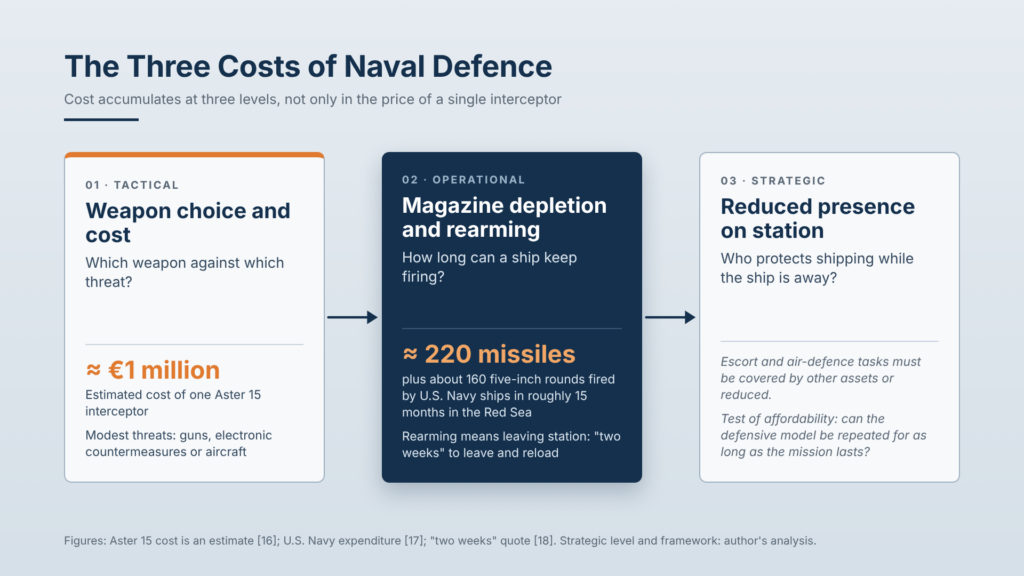
Naval defense costs are often reduced to a cheap drone against an expensive missile. That is only the first of three levels at which cost accumulates. At the tactical level, the question is which weapon to use against which threat. An Aster 15 is estimated to cost around €1 million.16 French Vice Admiral Emmanuel Slaars defended the expense: “The cost is not that of the missile we use, but the cost of what we protect”.16 The commander of U.S. Naval Surface Forces has described handling more modest threats with guns, electronic countermeasures and aircraft instead.17 At the operational level, repeated engagements consume finite magazines. Over roughly 15 months of Red Sea operations, U.S. Navy ships fired around 220 missiles and 160 five-inch rounds.17 In January 2025, Navy Secretary Carlos Del Toro said the service could not afford “to give up two weeks” for warships to leave and reload.18 Hessen, too, rearmed in port.2
Figure 1: The Three Costs of Naval Defense. Cost accumulates at the tactical, operational and strategic levels, not only in the price of a single interceptor.
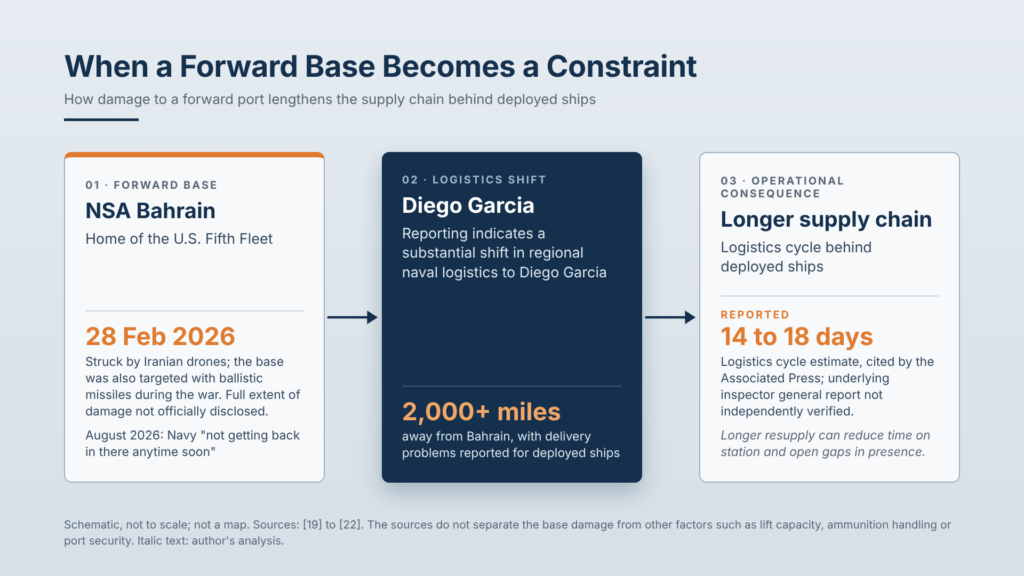
The war with Iran added a further constraint: the security of the ports themselves. On 28 February 2026, Iranian drones struck Naval Support Activity Bahrain, home of the U.S. Fifth Fleet.19 The full extent of the damage has not been officially disclosed, but in August the Chief of Naval Operations said the Navy was “not getting back in there anytime soon”.20 Press reporting and the Congressional Research Service link the damage to a shift of much of the Navy’s regional logistics to Diego Garcia, more than 2,000 miles away, causing delivery problems for deployed ships.20,21 According to the Associated Press, the Pentagon’s inspector general said in its first report on the war that NSA Bahrain had been targeted with drones and ballistic missiles and described 14 to 18 day logistics cycles,22 although the reporting does not show how far lift capacity, ammunition handling or port security also contributed. Hessen’s resupply took place in a port that was not itself under attack; in the Gulf, the forward port became a target. Moving logistics further away did not remove the threat. On 20 March 2026, Iran fired two medium-range ballistic missiles at Diego Garcia; one fell short and a U.S. warship intercepted the other. Reporting has suggested that the attack may be linked to the island’s new role as the Navy’s main shipment point.23
Figure 2: When a Forward Base Becomes a Constraint. Reporting links damage to NSA Bahrain to a shift of regional logistics to Diego Garcia and longer resupply cycles. Schematic, not to scale.
Surviving at sea and sustaining a mission are different tests. A warship can defeat every attack against it and still lose operational value if the port that rearms and repairs it can no longer be used. The loss of access to a forward base can reduce naval presence without the loss of a single warship. For European navies, the same logic applies to their own forward facilities in Djibouti, the Gulf and the Indian Ocean. At the strategic level, these costs become gaps in protection. When a warship leaves to rearm, its escort and air-defense role must be covered by other assets or reduced. The real measure of affordability is whether the defensive model can be repeated for as long as the mission
lasts.
For European navies, three changes stand out. The first is to make defense more sustainable. Defense in depth combines complementary defensive layers, while cost-exchange discipline matches each threat with the least costly effective response without compromising protection. The United Kingdom has contracted MBDA to deliver the DragonFire laser for Type 45 destroyers, starting with one ship by 2027.
The Ministry of Defense puts the cost of a shot at about £10, against missiles costing hundreds of thousands of pounds or more.24 It is not a complete answer. Lasers depend on weather, line of sight and target characteristics. Cheaper layers also multiply the decisions a crew must make. Hessen’s near-engagement of an allied drone shows why identification procedures must grow with every new defensive option.3,4
Other navies are moving in the same direction. The U.S. Navy has begun fitting destroyers with launchers for Coyote interceptors and plans to add Roadrunner-M; both cost a fraction of a Standard Missile.25 In Europe, the Netherlands has contracted Destinus to develop a naval version of the Hornet B2 interceptor drone for several warships, with completion targeted for 2027. Ukraine already uses low-cost interceptor drones against one-way attack drones.26 Such systems add capacity at lower cost, but each must still be integrated into sensors, command arrangements and identification procedures.
The second is to recognise that readiness depends on two things that must be replenished: ammunition and available ships.
On ammunition, MBDA’s chief executive said the company delivered five times more Aster missiles in 2025 than initially planned without disclosing the baseline. MBDA now plans to
double Aster production in 2026.27,28 Planned increases do not show whether existing stocks are sufficient; absolute production and inventory figures are not public. The war with Iran shows why time matters as much as money. CSIS estimates, which are not official data, put U.S. use at 130 to 250 SM-3 and 190 to 370 SM-6 interceptors. CSIS also notes that ships in theatre could not reload at sea and had to return to port.29 According to press reporting of a later CSIS analysis, SM-3 stocks would not return to prewar levels before early 2029 and SM-6 stocks would take about two years.30 CSIS judged U.S. stocks sufficient for the campaign up to the ceasefire, locating the risk in future contingencies.29 In September 2026, the Pentagon’s inspector general said, as quoted by the Associated Press, that munitions expenditure in the war had caused strategic inventory shortfalls and exposed bottlenecks in resupply.22 Washington has responded with multi-year contracts. In October, the Navy awarded Raytheon an SM-6 contract worth up to $24.4 billion, supporting a target of more than 500 missiles a year.31,32 The figure is a contract ceiling rather than appropriated funding; rebuilding stocks will take years rather than months.
Rearming at sea is one way to narrow that gap. The U.S. Navy has demonstrated reloading vertical launch cells while underway and is preparing further trials.33 For European navies operating far from home ports, a comparable capability would reduce the time ships spend away from station.
The problem is not only American. The United States approved a possible sale to Germany of up to 173 SM-6 and 577 SM-2 Block IIIC missiles for its future F127 frigates.34 European naval air defense therefore draws on both European Aster production and, for certain programs, the U.S. Standard Missile industrial base. Their production capacities and timelines should be assessed separately. In May 2026, France’s air and space force chief, whose Rafales had used MICA air-to-air missiles against drones in the Middle East, also said that stockpiles “naturally remain a concern”.35
On ships, the constraint is availability. When Aspides was extended in early 2026, it was operating with three naval vessels and had supported more than 1,570 ships in 23 months.36 Demand has since grown. In July, the Houthis declared a blockade of Saudi-linked shipping.37 In September, Yemeni government sources reported that Houthi forces had captured additional stretches of the Red Sea coast, including positions near the Bab al-Mandab Strait.38,39 In September 2026, the EU’s foreign policy chief recalled that the mission had been judged to need at least ten ships when it was established and said it now needed more.40 The response has been modest. Beyond an additional French frigate, only the Netherlands and Belgium had offered one more vessel each by mid-October; the Dutch ship in an associate, information-gathering role and the Belgian frigate not before next year.41,42 A confidential EU readiness assessment reportedly found that critical maritime capability gaps would be filled only after 2030.42 Such snapshots do not show whether a force is sufficient, but they show why availability, rotation and timely resupply
are central to maritime protection.
The third is to extend protection beyond the ship. Distributed systems that can deny an area to a larger fleet create two requirements for European navies: integrating uncrewed systems into coastal surveillance and sea denial, while protecting ships and harbours against similar threats. The August strike on Novorossiysk shows why harbour protection must account for threats that persist even after warships withdraw from exposed areas.11,12
Between November 2026 and October 2027, the most likely course is incremental adaptation. Navies will more likely add cheaper layers around high-end interceptors than abandon them. In Europe, indicators to watch are DragonFire’s planned fitting, whether MBDA’s Aster increase translates into deliveries, whether member states close the gap in Aspides and how quickly low-cost interceptors such as the Dutch Hornet B2 program reach ships.24,26,27,42 Base security and logistics continuity are likely to become as central to adaptation as new weapons. The disruption at Bahrain and the attempted strike on Diego Garcia illustrate how quickly access to logistics hubs, forward and rear, can be constrained.
Two conditions could change that trajectory. If mixed attacks intensify where European navies operate or resupply is delayed, pressure on ship availability could grow faster than new layers can be fielded. In crowded waters, a misidentified contact or poorly coordinated engagement could also trigger an unintended confrontation. If cheaper defenses are integrated successfully and replenishment improves, that pressure could ease. The clearest sign of progress will be warships that remain on task longer under repeated attack.
Cheap and distributed threats have not made expensive warships obsolete. They have changed what it takes to keep them useful. In the Red Sea, the Black Sea and the Gulf, the decisive pressures fell on interceptor stocks, system reliability, identification and the ability to remain on station. For European navies, the response lies in managing several elements together: layered and affordable defense, disciplined weapon choice, reliable identification among allies, ammunition that can be produced and replenished and protection that extends to ports. Warships will remain central to sea control. Whether they can exercise it will depend on how long they can sustain the fight.
- Bundeswehr. (2024, April 22). Fregatte Hessen beendet nach 58 Tagen im Krisengebiet ersten scharfen Einsatz.
- Bundeswehr. (2024, April 5). Neue Munition für die Fregatte Hessen im Aspides-Einsatz. https://www.bundeswehr.de/de/auftrag/einsaetze/neue-munition-fregatte-hessen-einstatz-aspides-5767436.
- Sprenger, S. (2024, February 29). Allies probe accidental targeting of US drone by German Navy frigate. Defense News. https://www.navytimes.com/global/europe/2024/02/29/allies-probe-accidental-targeting-of-us-drone-by-german-navy-frigate/
- Stenzel, J., & Posey, M. (2024, May 7). Analyzing the German Frigate Hessen’s Near-Miss of a U.S. Drone in the Red Sea. CIMSEC. https://cimsec.org/analyzing-the-german-frigate-hessens-near-miss-of-a-u-s-drone-in-the-red-sea/
- Naval News. (2024, April 4). Danish Frigate Cuts Red Sea Mission Short After Technical Issues. https://www.navalnews.com/naval-news/2024/04/danish-frigate-cuts-red-sea-mission-short-after-technical-issues/
- USNI News. (2024, April 4). Danish Defense Chief Removed After Warship Malfunction in Red Sea. https://news.usni.org/2024/04/04/danish-defense-chief-removed-after-warship-malfunction-in-red-sea
- The War Zone. (2024, April 12). French Frigate Captain Describes Frenetic Red Sea Combat. https://www.twz.com/sea/french-frigate-captain-describes-frenetic-red-sea-combat.
- U.S. Central Command. (2024, June). Update on M/V Tutor and M/V Verbena. https://www.centcom.mil/MEDIA/PUBLIC-RELEASES/Article/3808372/update-on-mv-tutor-and-mv-verbena/
- Associated Press. (2024, June 19). Ship attacked by Yemen’s Houthi rebels in fatal assault sinks in Red Sea in second such sinking. https://www.clickondetroit.com/news/world/2024/06/19/ship-attacked-by-yemens-houthi-rebels-in-fatal-assault-sinks-in-red-sea-in-second-such-sinking/
- Janes. (2025, May). Update: Ukrainian unmanned surface vessels down Russian fast jets. https://www.janes.com/osint-insights/defence-news/sea/update-ukrainian-unmanned-surface-vessels-down-russian-fast-jets.
- Reuters. (2025, December 15). Ukraine says underwater drones hit submarine but Moscow denies damage. Republished by gCaptain. https://gcaptain.com/ukraine-says-underwater-drones-hit-submarine-but-moscow-denies-damage/
- Clare, T. A Navy of Necessity: Ukraine’s Unmanned Surface Vessels at War. Center for Strategic and Budgetary Assessments. https://csbaonline.org/research/publications/a-navy-of-necessity-ukraines-unmanned-surface-vessels-at-war.
- Sutton, H. I. (2024, August 20). Uncrewed Platforms Have Been Critical to Ukraine’s Success in the Black Sea. RUSI Commentary. https://www.rusi.org/explore-our-research/publications/commentary/uncrewed-platforms-have-been-critical-ukraines-success-black-sea.
- The Maritime Executive. (2026, August). Ukraine Confirms Hits on Four Russian Warships at Novorossiysk. https://maritime-executive.com/article/ukraine-confirms-hits-on-four-russian-warships-at-novorossiysk.
- Naval News. (2026, August). Ukrainian Drone Strike Damages Russian Frigates in Novorossiysk. https://navalnews.com/naval-news/2026/08/ukrainian-drone-strike-russian-frigates-novorossiysk/
- Defense News. (2024, January 11). French Navy defends use of million-euro missiles to down Houthi drones. https://www.defensenews.com/global/europe/2024/01/11/french-navy-defends-use-of-million-euro-missiles-to-down-houthi-drones/
- Stars and Stripes. (2025, January 16). Navy has fired hundreds of missiles at Houthi threats in Red Sea. Remarks by Vice Adm. Brendan McLane. https://www.stripes.com/branches/navy/2025-01-16/houthis-navy-red-sea-missiles-drones-16500246.html.
- The War Zone. (2025, January 16). Navy Warships Have to Leave the Red Sea Fight for Weeks to Reload Their Missiles, Navy Secretary Says. https://www.twz.com/news-features/navy-warships-have-to-leave-the-red-sea-fight-for-weeks-to-reload-their-missiles-navy-secretary-says.
- Defense One. (2026, February 28). Americans evacuate after Iranian drones damage US Navy base in Bahrain. https://www.defenseone.com/threats/2026/02/iranian-drones-damage-us-navy-base-bahrain/411786/
- Slayton, N. (2026, September 13). Iran ‘blew the hell out of’ base in Bahrain, acting Navy Secretary admits. Task & Purpose. https://taskandpurpose.com/news/navy-base-bahrain-iran-damage/
- Congressional Research Service. (2026, September 18). U.S. Conflict with Iran. R48887. https://www.congress.gov/crs-product/R48887.
- Associated Press. (2026, September 14). US watchdog tallies Iran war’s hit to weapons stockpiles, military bases and more. https://www.local10.com/news/politics/2026/09/14/us-watchdog-tallies-iran-wars-hit-to-weapons-stockpiles-military-bases-and-more/
- Ismay, J. (2026, August 15). Navy carrier’s problems are tied to attacks on US base early in war. The New York Times. Republished by Hawaii Tribune-Herald. https://www.hawaiitribune-herald.com/2026/08/15/nation-world-news/navy-carriers-problems-are-tied-to-attacks-on-us-base-early-in-war/
- UK Defence Equipment and Support. (2025, November 20). Boost for Armed Forces as new laser weapon takes down high-speed drones. https://des.mod.uk/boost-for-armed-forces-as-new-laser-weapon-takes-down-high-speed-drones
- The War Zone. (2025, August). Coyote Loitering Drone Interceptors Have Arrived on US Navy Destroyers. https://www.twz.com/sea/coyote-loitering-drone-interceptors-have-arrived-on-us-navy-destroyers
- Defense News. (2026, August 25). Dutch navy to equip fleet with Destinus C-UAS interceptor drones. https://www.defensenews.com/global/europe/2026/08/25/dutch-navy-to-equip-fleet-with-destinus-c-uas-interceptor-drones.
- Defense News. (2026, March 26). MBDA to double Aster air defense missile output in 2026. https://www.defensenews.com/global/europe/2026/03/26/mbda-to-double-aster-air-defense-missile-output-in-2026/
- Breaking Defense. (2026, March 27). MBDA plans $5.8B investment in missile production as demand soars. https://breakingdefense.com/2026/03/mbda-plans-5-8b-investment-in-missile-production-as-demand-soars.
- Cancian, M. F., & Park, C. H. (2026, April). Last Rounds? Status of Key Munitions at the Iran War Ceasefire. Center for Strategic and International Studies. https://csis-website-prod.s3.amazonaws.com/s3fs-public/2026-04/260424_Cancian_Park_Last_Rounds.pdf
- The War Zone. (2026, May 28). Severity of America’s Depleted Advanced Weapons Stockpiles Detailed in New Report. https://www.twz.com/news-features/severity-of-americas-depleted-advanced-weapons-stockpiles-detailed-in-new-report.
- Manufacturing Dive. (2026, October 13). Raytheon secures 2 Pentagon contracts worth $30.7B combined. https://www.manufacturingdive.com/news/rtx-raytheon-dod-defense-war-sm3-ib-sm-6-missile-interceptors/832760/
- RTX. (2026, October 1). RTX’s Raytheon awarded $24.4 billion multi-year contract for SM-6 interceptors. https://www.rtx.com/news/news-center/2026/10/01/rtxs-raytheon-awarded-24-4-billion-multi-year-contract-for-sm-6-interceptors.
- The War Zone. (2026, May 5). Navy’s Unwanted Sea Base Ship Will Test At-Sea Rearming Of Warships. https://www.twz.com/sea/navys-unwanted-sea-base-ship-will-test-at-sea-rearming-of-destroyer.
- U.S. Defense Security Cooperation Agency. (2025, November 14). Germany: Standard Missile-6 Block I and Standard Missile-2 Block IIIC. Transmittal No. 25-74. https://www.dsca.mil/Press-Media/Major-Arms-Sales/Article-Display/Article/4332014/germany-standard-missile-6-block-i-and-standard-missile-2-block-iiic.
- The Defense Post. (2026, May 4). France Steps Up Missile Output After Middle East Ops Drain Stockpiles. https://thedefensepost.com/2026/05/04/france-missile-stockpile/
- The Maritime Executive. (2026, February 23). EU Extends Red Sea Protection Effort Until 2027. https://maritime-executive.com/article/eu-extends-red-sea-protection-effort-until-2027.
- Reuters. (2026, July 29). Saudi Arabia seeks international coalition to protect Red Sea shipping from Houthis. Via Graphic Online. https://graphiconline.com/international/international-news/saudi-arabia-seeks-international-coalition-to-protect-red-sea-shipping-from-houthis.html.
- AFP. (2026, October 8). EU sending extra ships to Red Sea naval mission. Via Arab News. https://www.arabnews.pk/middle-east/eu-sending-extra-ships-to-red-sea-naval-mission-3003608
- Al Jazeera. (2026, September 11). Houthis control key shipping route after gains along Yemen’s Red Sea coast. https://www.aljazeera.com/news/2026/9/11/houthis-take-control-of-yemens-red-sea-coast-key-shipping-route
- Reuters. (2026, September 21). EU’s Kallas says Red Sea mission needs more than 10 warships. Via Al-Monitor. https://www.al-monitor.com/originals/2026/09/eus-kallas-says-red-sea-mission-needs-more-10-warships.
- Marine Insight. (2026, September 29). EU Seeks More Warships For Red Sea As Hormuz Mission Remains On Hold. https://www.marineinsight.com/eu-seeks-more-warships-for-red-sea-as-hormuz-mission-remains-on-hold/
- Euronews. (2026, October 12). EU struggles to ramp up Red Sea mission as Houthis escalate attacks. https://www.euronews.com/2026/10/12/eu-struggles-to-ramp-up-red-sea-mission-as-houthis-escalate-attacks.
click HERE to download as PDF.