

Key points :
• European navies are too small to win
• Buying off-the-shelf unmanned vessels is a dead end
• EUROGUARD can serve as the standardized blueprint for Europe’s robotic fleet
The maritime security environment is changing rapidly, and European navies are facing a critical challenge: defending vast waters with shrinking fleets and highly expensive ships. To maintain a credible defense, defense planners are looking toward unmanned surface vessels (USVs) to add mass and numbers back to their fleets. However, simply buying robots off the shelf creates new problems with logistics and communication. This article explores the current concern in European naval architecture, the technical traps of uncoordinated procurement, and how the EU’s EUROGUARD project offers a standardized, practical path forward.
In 1990, the Royal Navy operated roughly 50 frigates and destroyers. Today, that number hovers around 17. Similar contractions apply to the fleets of other European navies. Over the last three decades, European navies have bet everything on multi-billion-euro platforms. Consequently, in a high-intensity conflict, whether facing the missile threats of the Black Sea or the drone swarms of the Red Sea, losing just one of these advanced ships is a national tragedy and a strategic disaster. European navies risk becoming too risk-averse to fight.
The financial asymmetry of modern naval warfare makes this posture unsustainable. Today, an attacker can deploy a €50,000 drone or a €200,000 loitering munition. In response, a defending naval ship must fire an Aster-30 or SM-2 interceptor for about €1 million. Even ignoring the very real risk of saturated anti-air warfare systems, this math is economically impossible to maintain. It is the equivalent of firing silver bullets at a swarm of locusts. If an attacker launches a swarm of 100 cheap drones, defense budgets will be drained long before the incoming threats stop.
Beyond the financial drain, there is a fundamental geographic problem. If opposing forces threaten the Strait of Hormuz and disrupt Baltic subsea cables simultaneously, for instance, Europe simply lacks the hulls to project a presence in both areas. Technology, no matter how advanced the radar or interceptors, cannot replace physics. A ship can only be in one place at a time. To cover more water, navies need more hulls. Yet, the hard truth remains: the budgets required to build 50 more traditional frigates simply do not exist.
The solution lies in mass and low-cost platforms; vessels cheap enough that their loss is treated as a tactical annoyance rather than a strategic failure. European fleets need hulls that can carry extra missiles and sensors, absorb risk, and cost less than the weapons used to sink them.
So, what does this “ideal ship” look like? It certainly doesn’t resemble a traditional frigate. Instead, it must be modular, a standardized “truck” that any EU nation can load with mission-specific weapon or sensor containers. Adding these low-cost, modular ships is the only realistic way to regain the necessary numbers.
Accepting the need to invest in maritime robotics is only the first step; European nations must also address a glaring issue with current procurement strategies. If Germany buys a Saab Unmanned Surface Vessel (USV), Italy buys one from Leonardo, and France opts for Thales, the EU has not built a cohesive fleet. It has built a “zoo.” None of these systems share data, spare parts, or command protocols.
Historically, defence contractors build proprietary software that prevents navies from seamlessly upgrading or mixing equipment from different companies. In a distributed robotic fleet, this fragmentation turns logistics into a nightmare. Imagine a deployed task group attempting to repair four entirely different types of USV engines in the middle of the Atlantic. It is operationally impossible.
Looking at the latest developments in major European Navies, they are all currently building highly capable but distinctly different national systems. German submarine tech leader Gabler partnered with FLANQ in late 2025 to develop “Ranger” (ISR) and “Raider” (Strike) USVs. In January 2026, France launched the DANAE program (Naval Autonomous Surface Drone with Onboard Weapon Capability). In February 2026, Intermarine officially began development of a brand new, highly advanced modular USV specifically for the Italian Navy.
To understand the tactical penalty of this fragmentation, consider a realistic operational scenario in the Eastern Mediterranean. A joint European naval task force is escorting a high-value commercial convoy when intelligence detects hostile submarine activity ahead. Under the current, fragmented procurement model, the task force might possess three different USVs from three different nations. However, only the French-built USV is equipped with the necessary Anti-Submarine Warfare (ASW) towed sonar array. Suddenly, the French USV suffers a mechanical engine failure. The German USV floating right next to it has a perfectly functioning engine, but its deck is permanently welded to a mine-hunting payload. Because the systems are proprietary and physically incompatible, the task force is left completely blind to the submarine threat, despite having functioning robotic vessels in the water.
To break this cycle, the hull and the payload must be decoupled. The hull should be viewed merely as a delivery vehicle; the true tactical value lies in the “container” (the specific mission payload, such as radar or sonar). To achieve this, European navies need the maritime equivalent of a “Universal USB Standard” for warships, a shared digital architecture where any sensor can plug into any hull.
This raises a critical question: Is there a project that combines a shared hull design with a modular, open-standard software architecture to solve this fragmentation? Fortunately, the EU recognized this gap and has funded a project designed specifically to address these operational and technical shortfalls: EUROGUARD.
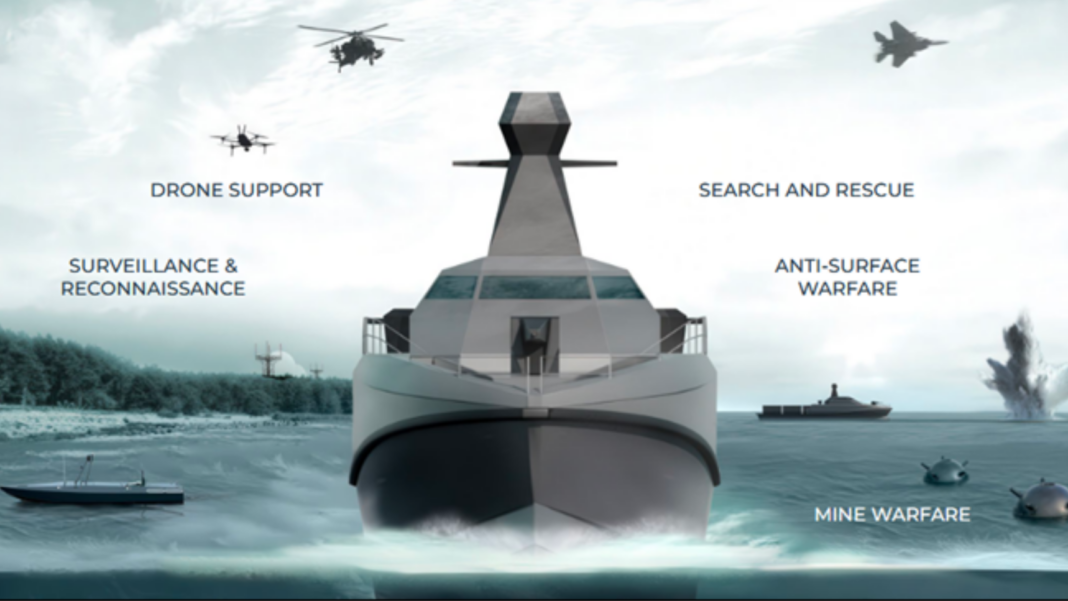
The Medium-Sized Semi-Autonomous Surface Vessel (M-SASV) project, officially known as EUROGUARD, represents a fundamental shift in European naval design. Supported by the European Defence Fund (EDF) and led by a consortium of nations including Estonia, France, and Spain, EUROGUARD is not just a theoretical whitepaper. It is a physical, 45-meter vessel currently under construction, engineered to serve as the standardized “truck” for Europe’s future robotic fleet.

EUROGUARD directly solves the interoperability trap outlined earlier by completely decoupling the hull from the payload. Physically, the vessel utilizes a modular deck system based on standard ISO shipping container footprints. Digitally, it runs on the Generic European Naval System Architecture (GENSA). This open-architecture software acts as the universal digital handshake. If a mission requires mine hunting, a standardized sonar container from one nation can be craned onto the deck, plugged in, and instantly recognized by the ship’s systems, which is much like plugging a USB drive into a computer.
Furthermore, EUROGUARD addresses the strategic shortfall of fleet numbers discussed previously. At 45 meters long, the vessel hits a critical design “sweet spot.” It is large enough to survive the rough sea conditions (Douglas Sea State 5) common in the Baltic and North Seas, yet simple enough to be mass-produced at a fraction of the cost of a traditional manned corvette. By shifting to this attritable design, European navies can afford to build the volume of ships required to cover multiple geographic choke points simultaneously.
As of early 2026, the project has moved steadily from digital modeling to physical assembly. The keel for the prototype was laid in 2025 at the Baltic Workboats shipyard in Estonia. With the hull launch scheduled for spring 2026 and active sea trials targeted for autumn, the project is rapidly approaching operational reality.
Looking ahead, the success of EUROGUARD has the potential to redefine the future of EU maritime robotics. If the upcoming sea trials validate the modular concept, it paves the way for a new, highly efficient industrial model. Smaller, commercial shipyards across Europe could be utilized to mass-produce the standardized steel hulls, while major defense contractors focus purely on building advanced, containerized sensor and weapon payloads. By establishing this shared standard today, EUROGUARD ensures that the European fleets of the 2030s will be affordable, fully interoperable, and numerous enough to maintain a credible maritime defense.
Ultimately, the era of the “all-big-gun” navy is over. In a maritime environment increasingly defined by cheap, asymmetric threats, the future belongs to the swarm. While transitioning a continent of independent navies to a unified robotic architecture will undoubtedly present significant political and logistical challenges, EUROGUARD offers a highly credible, pragmatic solution. Crucially, it is no longer just an academic paper project; it is a physical reality taking shape in the shipyard today. By embracing this standardized approach to mass, European navies can ensure they remain a resilient, effective force in the decades to come.
- European Defence Fund (EDF) Official Factsheet: EUROGUARD Project Factsheet (PDF). Images from https://bwb.ee/
- UK House of Commons Library: UK defence in 2025: Warships and the surface fleet
- Gabler & FLANQ Partnership (Germany): New defense partnership to develop submarine-launched USVs – Naval Today
- The DANAE Program (France): France Launches Armed Surface Drone Program to Protect Naval Bases and Escort Warships – Army Recognition
- Intermarine Modular USV (Italy): Development of modular USV for Italian Navy begins – Baird Maritime
click HERE to download as PDF.