

Key Points :
- Electronic warfare threatens the core functionality of maritime robotics by actively targeting maritime drones’ ability to navigate and communicate.
- Next-generation navigation depends on secure satellite signals and Alt-PNT.
- Resilient robotic fleet communication is moving from traditional radios to software-defined networks, optical sensors, and swarm intelligence.
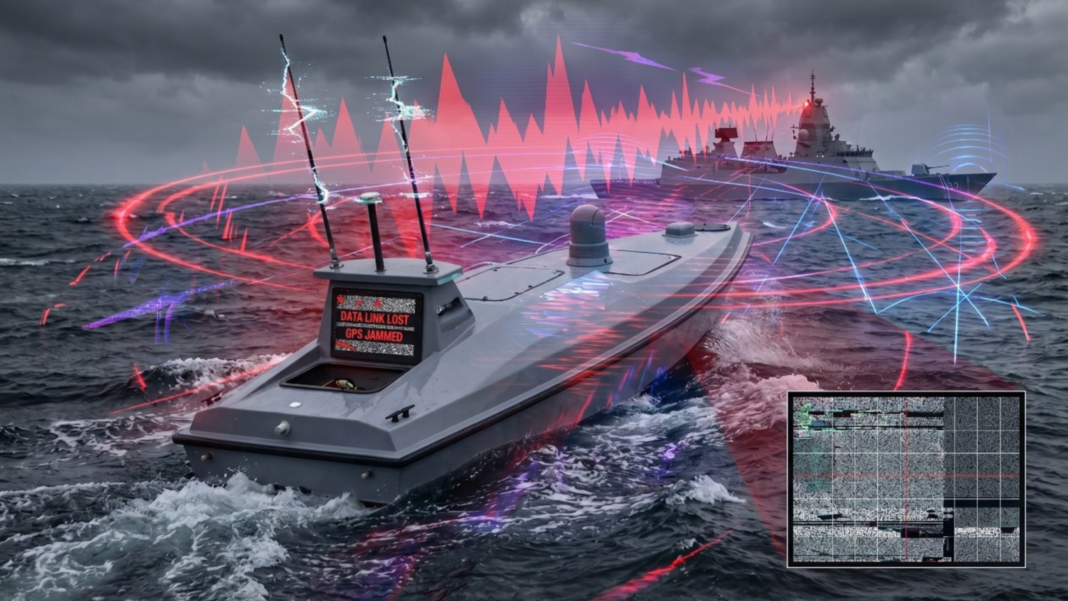
European navies face a critical challenge: defending vast waters with shrinking fleets and highly expensive ships. To rebuild fleet numbers, defense planners intend to deploy Unmanned Vessels as a standardized robotic fleet, using platforms like the EUROGUARD project. However, deploying hundreds of modular drones introduces a completely new operational vulnerability. Modern maritime drones rely heavily on space-based satellite signals to determine their global location and on standard radio waves to receive mission commands. In a modern conflict, opposing forces attack the electromagnetic spectrum directly. By utilizing powerful electronic warfare transmitters, adversaries flood these frequencies with noise. This tactic creates an invisible electromagnetic wall. If a drone cannot survive and fight under these conditions, the tactical advantage of deploying a robotic fleet completely dissolves. To ensure maritime drones penetrate this wall, defense engineers must fundamentally rewrite how these platforms navigate and communicate.
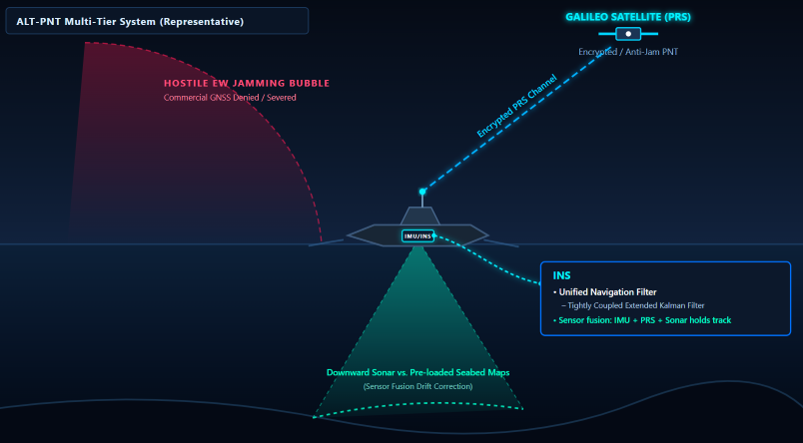
The most immediate danger to a maritime drone in a contested environment comes from losing its geographic anchor. When a traditional manned frigate enters a zone where electronic warfare blocks satellite navigation, the crew switches to backup methods immediately. Navigators pull out paper charts or utilize visual dead-reckoning to keep the ship moving safely. A standard commercial drone lacks this capability. If it loses its satellite link, the machine goes blind. Historically, engineers programmed basic fail-safes for this scenario: the drone cuts its engines and drifts helplessly, or it blindly attempts to retrace its path back to base. Neither response suits a combat zone. To overcome this limitation, European defense planners completely abandoned the expectation of continuous satellite coverage. Instead, they started to focus on Alternative Positioning, Navigation, and Timing (Alt-PNT).
The physical backbone of Alt-PNT relies on the Inertial Measurement Unit (IMU). Rather than looking outward for a signal from space, an IMU looks inward. It functions as a highly sophisticated hardware cluster containing accelerometers and fiber-optic gyroscopes. As the drone moves, the gyroscopes use lasers to measure the exact rotation and pitch of the hull. Simultaneously, the accelerometers track every shift in speed. The onboard computer uses an Inertial Navigation System (INS) to translate this raw physical motion into exact global coordinates, starting from the last known point before the jamming began. Because an IMU measures physical motion rather than receiving an external radio wave, electronic jammers cannot disrupt it.
However, INS technology suffers from minor flaws. Over hours of operation, minuscule measurement errors compound, which causes the system’s calculated position to slowly drift away from its actual physical location on the globe. To correct this drift without relying on commercial satellites, engineers employ sensor fusion. The drone’s computer combines the INS data with input from other onboard sensors. For example, underwater drones utilize downward-facing sonars to scan the ocean floor. The drone’s software continuously matches this acoustic terrain against highly detailed seabed charts pre-loaded on its hard drive. By cross-referencing its physical movement with its visual environment, the drone maintains absolute accuracy entirely independent of the surface spectrum.
For European defense platforms, the ultimate layer of navigational resilience resides in space, but on a highly secure, militarized channel. The European Union’s Galileo satellite network provides a specialized capability called the Public Regulated Service (PRS). Unlike standard open-access GPS, the Galileo PRS provides position and timing restricted strictly to government-authorized users for sensitive applications. The service incorporates heavy encryption and robust anti-jamming mechanisms to increase resistance against malicious interference and spoofing attacks.
To harness this capability, the European Union established the EU Radio Navigation Solution (EURAS) project under the Permanent Structured Cooperation (PESCO) framework. The project aims to promote the development of EU military PNT capabilities by drafting the EU military PNT Navigation Warfare (NAVWAR) doctrine and taking advantage of Galileo, particularly the PRS. NAVWAR is a military operational concept focused on protecting friendly PNT information while denying or degrading the enemy’s access to identical data. It is executed across space, cyber, and electronic warfare domains to secure a tactical advantage. For modern drones, the key to survival depends on tight coupling the onboard INS directly with Galileo PRS receivers, fusing raw inertial data with encrypted satellite signals in a unified navigation filter (Extended Kalman Filter). Under this architecture, if an incredibly powerful enemy jammer momentarily breaks the encrypted PRS lock, the IMU and sensor fusion instantly take over. The systems carry the vessel along its precise track. The moment the drone exits the jamming bubble, it immediately reacquires the encrypted European satellite signal, corrects any minor INS drift, and continues the mission. Although EURAS itself is not a dedicated project for naval robotics, its main objective, the EU NAVWAR doctrine, aims to provide the secure navigation backbone utilized by European unmanned/autonomous naval drones.
Figure 1: A Representative ALT-PNT Multi-Tier System (Image generated with AI assistance
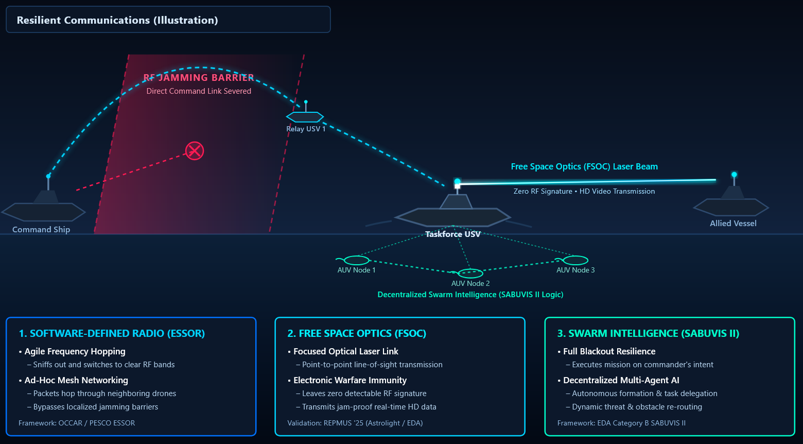
Knowing precisely where to sail offers little value if a drone cannot receive its mission parameters. Traditional maritime drones rely on standard military radio frequencies to talk to command ships. Because radio waves obey the inverse-square law of physics, a powerful electronic jammer placed relatively close to a drone easily overpowers the weaker radio signals broadcast by a distant command center.
To prevent robotic fleets from becoming isolated, European navies transition away from rigid hardware radios to secure, highly adaptable software networks. A primary initiative enabling this shift operates under the European Secure Software-defined Radio (ESSOR) project. Software-defined radio (SDR) is a radio communication system where components that conventionally have been implemented in analog hardware are instead implemented by means of software on a computer or embedded system. Managed by the Organisation for Joint Armament Cooperation (OCCAR), ESSOR’s objective focuses on providing Europe with a military SDR capability. Instead of broadcasting on a single, easily targeted frequency, an ESSOR-compliant SDR rapidly and automatically hops across the electromagnetic spectrum. It intelligently sniffs out clear bands of communication. Furthermore, these SDRs create secure ad-hoc mesh networks. If the command ship cannot penetrate the jamming wall to reach a specific drone directly, the ESSOR network allows the data packet to securely hop through a chain of other nearby drones until it successfully reaches its intended target.
When extreme electronic warfare saturates the entire radio spectrum, defense planners turn to light. Free Space Optical Communications (FSOC) utilize focused lasers to transmit data. The maritime environment suits laser communications particularly well; compared to operating over land, the ocean usually provides excellent line-of-sight conditions. By utilizing optical lasers, drones securely exchange massive amounts of tactical information across the fleet. Although rough seas and atmospheric conditions can cause beam mis alignment, this method generate zero RF signature for opposing forces to intercept. In September 2025, FSOC were successfully tested during REPMUS’25 (Robotic Experimentation and Prototyping using Maritime Unmanned Systems). During this exercise, which was co-organized by the European Defense Agency (EDA), NATO, and the Portuguese Navy, Lithuanian defense tech company Astrolight tested its POLARIS laser communication terminal. The terminals maintained a stable, jam-proof, horizon-limited laser link between two Portuguese Navy vessels while transmitting real-time HD video through rain and fog without being detected by other sensors.
Finally, defense engineers must account for the worst-case scenario: losing all radio and laser communication links completely. The solution removes the human from the immediate operational loop through autonomous collaboration. Instead of requiring a human commander to pilot the drone constantly via remote control, modern robotic fleets operate on a commander’s general intent. They rely on swarm intelligence to execute the details. Swarm Intelligence (SI) describes the collective behaviour of decentralized, self-organized systems (both natural and artificial) that interact locally to solve complex problems without centralized control. The European Defense Agency (EDA) achieved vital progress in this area through the Swarm of Biomimetic Underwater Vehicles (SABUVIS II) project, which concluded its formal R&D cycle in 2025. The project sought to create a coordinated swarm of Autonomous Underwater Vehicles (AUVs) operating as one coherent system, moving away from deploying separate drones loosely connected to one another. SABUVIS II focused on addressing fundamental challenges of underwater autonomy, including the lack of satellite-based tracking and limited communication bandwidth. During field demonstrations in REPMUS 2025, the project successfully tested mixed swarms of drones in real-life settings. These trials enabled the coordination of swarm movement, reliable data exchange, formation control, and adaptive mission execution. Applying the SABUVIS II swarm logic to future surface platforms can ensure that if an electromagnetic wall cuts off all communication with the base, the fleet does not shut down. The onboard artificial intelligence automatically delegates tasks and dynamically routes around threats while continuing to execute the tactical mission collaboratively.
Figure 2: Resilient Communications (Image generated with AI assistance)
Deploying maritime robotics has become essential for modern naval warfare. However, physical hulls alone cannot win conflicts. When navies deploy unmanned vessels that rely solely on standard commercial satellite positioning and open radio frequencies, the enemy can quickly neutralize these vulnerable platforms using intensive electronic attack. By comprehensively redesigning the digital architecture of these vessels, defense planners aim to reduce or completely eliminate this risk. Europe already demonstrated its commitment on this intention by supporting the initiatives on developing the EU NAVWAR doctrine which can facilitate tightly coupled INS navigation alongside the EURAS Galileo PRS framework, leveraging adaptable mesh networks via ESSOR, utilizing optical communications, and deploying swarm intelligence. By aligning modular hardware, secure positioning, adaptable communications, and autonomous software standards, NATO and European navies can establish a practical path toward maintaining credible maritime operations in heavily contested electromagnetic environments.
- Defense Domain. European Naval Dilemma: Modular Mass. https://defensedomain.com/european-naval-dilemma-modular-mass/
- PESCO. (2025). EU Radionavigation Solution (EURAS). https://www.pesco.europa.eu/wp-content/uploads/2025/10/2025-FR-EU-Radionavigation-Solution-EURAS-Website-leaflet.pdf
- NATO StandardizaƟon Office. ANP-4621, EdiƟon A, Version 1. https://jedi-sec.us/downloads/MISC_PDF/ANP-4621%20EDA%20V1%20E.pdf
- A4ESSOR. A4ESSOR. https://a4essor.com/
- OCCAR. OrganisaƟon for Joint Armament CooperaƟon (OCCAR). https://occar.int/
- Seapower Magazine. NATO’s Biggest Naval Exercise Proves Undetectable Ship-to-Ship Laser CommunicaƟon. https://seapowermagazine.org/natos-biggest-naval-exercise-proves-undetectable-ship-to-ship-laser-communicaƟon/
- Beni, G., & Wang, J. (1989). Swarm Intelligence in Cellular RoboƟc Systems. Proceedings of NATO Advanced Workshop on Robots and Biological Systems, Tuscany, Italy.
- European Defence Agency. (2026). EDA Project Develops Technology for Underwater Drones to Move in Swarms. https://eda.europa.eu/news-and-events/news/2026/02/17/eda-project-develops-technology-for-underwater-drones-to-move-in-swarms
click HERE to download as PDF.