

Key Points:
- Gallipoli demonstrates the enduring risks of amphibious assaults against defended coastlines.
- Kharg Island is strategically valuable but operationally vulnerable.
- Iran’s mainland capabilities would remain intact even if Kharg were seized.
- Occupying Kharg could prolong the war rather than shorten it.
A century ago, in March 1915, the world’s greatest naval power launched a bold amphibious assault to seize a strategic strait from a weakened adversary. It became one of the worst military disasters in modern history. Washington should take lessons from this disaster before ordering Marines ashore at Kharg Island.
Summary:
With the USS Tripoli carrying thousands of Marines heading toward the Persian Gulf and President Trump threatening to seize Kharg Island, Washington appears to be contemplating a ground operation that military history suggests is far harder than it looks on a map. This piece draws a direct parallel to the 1915 Gallipoli campaign, where the world’s greatest naval power launched an amphibious assault against a weakened Ottoman Empire to open a strategic strait, and paid for that miscalculation in blood for eight catastrophic months.
The Illusion of an Easy Victory
On March 18th, 1915, Allied troops began the campaign toward the beaches of the Gallipoli peninsula. The British Empire had the most powerful navy in the world. The Ottoman Empire was widely considered its weakest adversary. The objective, forcing open the Dardanelles Strait to knock Turkey out of the war, seemed achievable, even obvious. Eight months later, the Allies withdrew in defeat, having suffered 285,000 casualties, their commanders disgraced, Winston Churchill forced from office, the campaign branded a byword for catastrophic military overconfidence. More than a century later, Washington appears to be contemplating a remarkably similar move in a remarkably similar body of water. The question is whether the decision-makers in Washington are aware of this historical file.
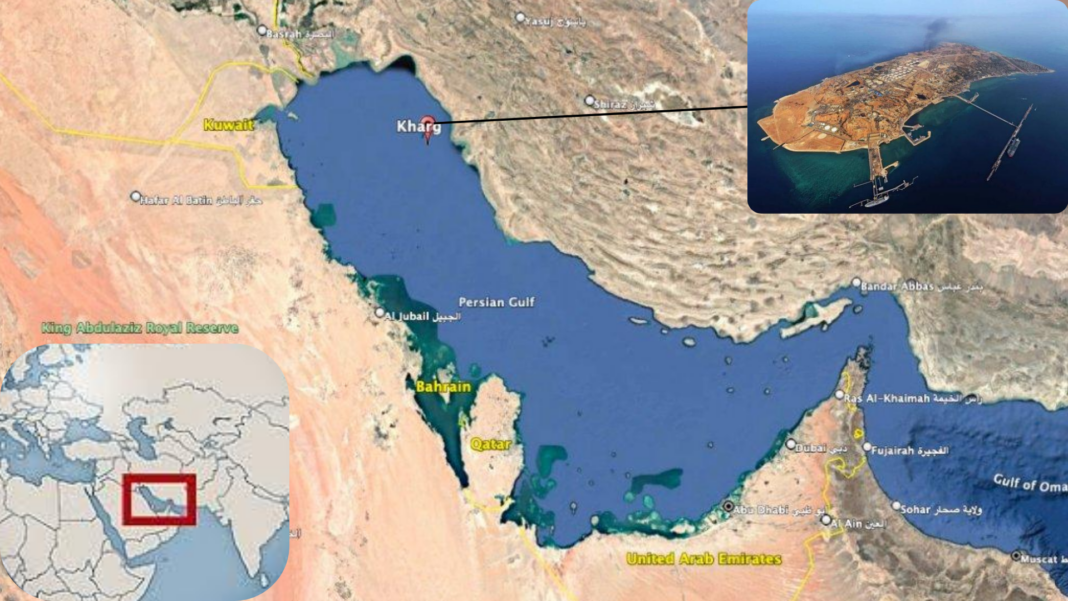
The target under discussion is Kharg Island, the vital island for Iran that is roughly one-third the size of Manhattan, sitting 15 miles off the Iranian coast in the northern Persian Gulf. Its strategic value is almost impossible to overstate. Around 90 percent of Iran’s crude oil exports leave the country through its terminals, making it the most vital facility in Iran’s oil system. Iran earned $53 billion in net oil export revenues in 2025, roughly 11 percent of its GDP. Kharg is the valve on that pipeline. If the US and Israel close it, and Tehran’s ability to fund its military, its proxies, and its government begins to suffocate.
The temptation is therefore obvious, and the Trump administration has made no secret of it. The reports show that USS Tripoli, an amphibious assault ship carrying approximately 2,000 Marines, was spotted transiting the Malacca Strait toward the region, fueling widespread speculation about a seizure operation. Republican Senator Lindsey Graham argued publicly that controlling Kharg could shorten the conflict. The logic is seductive. The execution is where history intervenes.
The Sick Man Trap
The parallel to Gallipoli is not a rhetorical flourish. It is structural. In 1915, British planners looked at the Ottomans and saw a crumbling empire with outdated fortifications and demoralized troops. What they underestimated was the combination of terrain, mines, and the willingness of a defending force to fight with far greater ferocity when defending its own soil than expected. The Allied fleet applied overwhelming naval firepower but failed to force the Dardanelles. When the amphibious landings came, the Ottomans were waiting. The beaches became killing grounds. The Imperial War Museum’s assessment is blunt: The soldiers fighting in the war were badly disappointed by their commanders and by the senior politicians who pushed for this campaign.
Iran in 2026 is not the Ottoman Empire of 1915. It is better armed, better organized, and fighting on terrain it has spent decades preparing for exactly this kind of assault. Kharg sits just 15 miles from the Iranian mainland. As former US Army Major Harrison Mann wrote in Responsible Statecraft, the operation would be a “suicide mission” and require crossing open water in slow landing craft through what amounts to an Iranian kill zone: speedboats, explosive drones, shore-based anti-ship missiles, and minefields that Iranian forces would have ample time to deploy with the USS Tripoli’s approach visible on satellite imagery for days. A classic amphibious assault doctrine requires four to six times more attackers than defenders at the moment of landing. The Marine battalion landing team numbers roughly 1,200. Iran’s IRGC Navy has been preparing coastal defenses against exactly this scenario for years.
Even If It Works, It Doesn’t Work
The deeper problem is that seizing Kharg may not accomplish what its proponents believe. Amir Handjani of the Quincy Institute put it plainly: “An invasion of Kharg would precipitate Iranian retaliation on Kharg. It’s close to the Iranian mainland and much easier for Iranian drones and missiles to strike than American bases in the Gulf.” A US Marine garrison on a flat coral island 15 miles from Iran’s coast, under sustained drone and missile fire from the mainland, is not a strategic asset. It is a hostage. The garrison would require constant resupply, air defense coverage, and protection from fast-attack boat swarms, all while the oil infrastructure it was sent to protect would be the first thing Iranian forces targeted in retaliation.
The Strait of Hormuz problem is even more intractable. About 20 percent of the world’s oil trade normally passes through the strait, and it has been effectively closed since the war began, driving oil prices past $100 a barrel. Reopening it by military force would require not just seizing Kharg but clearing mines, neutralizing Iranian shore batteries on both sides of the strait, suppressing drone swarms, and maintaining a continuous naval presence in one of the most contested bodies of water on earth, all while Iran retaliates against Saudi Arabia, UAE, and Kuwaiti oil infrastructure across the region. Edward Fishman, senior fellow at the Council on Foreign Relations, said that “Tehran would escalate by attacking more energy infrastructure in the region, for instance, Abqaiq in Saudi Arabia”. And that possibility is not unreal: the 2019 Houthi drone strike on Saudi Aramco’s Abqaiq facility, carried out with Iranian-supplied weapons, briefly knocked out five percent of the world’s oil supply. Iran has far more capability now than it did then.
The Lesson That Keeps Not Being Learned
The Gallipoli campaign is one of the most studied military failures in the English-speaking world precisely because its logic was so compelling and its execution so catastrophic. Historians at the US Naval Institute have analyzed it for over a century, extracting the same fundamental lesson: naval supremacy does not translate automatically into the ability to seize and hold defended coastal terrain, and a defender fighting on home ground with short supply lines will almost always punish an attacker crossing open water in ways that pre-operation planning fails to anticipate. The Ottomans in 1915 were described as weak, demoralized, and on the verge of collapse. But they fought far stronger than expected when Allied troops came ashore.
Iran’s new supreme leader, Mojtaba Khamenei, has publicly insisted the Strait of Hormuz must remain closed as a tool to pressure the enemy. Defense Secretary Pete Hegseth has refused to rule out ground forces while insisting the US will not “get bogged down” in Iran, but a formulation that defies military logic: you cannot seize an island 15 miles from an enemy’s coast and not get bogged down. The question of whether 2,500 Marines can take Kharg is almost beside the point. The question is what happens the morning after they do, when Iranian missiles start landing on the oil terminal the operation was designed to protect, when Gulf energy infrastructure starts burning, and when the operation that was supposed to end the war extends it indefinitely instead.
Senator Graham is right that Kharg Island is a singular prize. But seizing it would not shorten this war. The beaches of Gallipoli were also a singular prize. The boldness of the plan was never the problem. The problem was what the plan looked like on the second day, and the third, and the eighth month. Washington needs to ask that question now, while there is still time to answer it honestly, before the USS Tripoli drops anchor in the Persian Gulf and the question answers itself.
Conclusion
The Gallipoli campaign reminds us that operational logic can become strategic failure when geography, logistics, and defender resolve are underestimated. Kharg Island presents many of the same characteristics. Even if an amphibious assault succeeded tactically, Iran’s ability to escalate from the mainland would remain largely intact. Rather than ending the conflict, a seizure of Kharg could transform a limited campaign into a prolonged regional war.
Sources
- World History Encyclopedia. “Gallipoli Campaign: Churchill’s Folly in World War I.” Updated November 2025. https://www.worldhistory.org/Gallipoli_Campaign/
- CNN. “What to Know About Kharg Island, the Tiny Coral Outcrop at the Heart of Iran’s Oil Industry.” March 14, 2026. https://www.cnn.com/2026/03/14/middleeast/iran-kharg-island-explainer-intl-hnk
- TIME. “What To Know About Kharg Island, the Oil Hub at the Center of the Iran War.” March 14, 2026. https://time.com/article/2026/03/14/kharg-island-trump-oil/
- TIME. Ibid. (Lindsey Graham quote and amphibious deployment details.) https://time.com/article/2026/03/14/kharg-island-trump-oil/
- US Naval History and Heritage Command. “Strait Comparison: Lessons Learned from the 1915 Dardanelles Campaign.” https://www.history.navy.mil/research/library/online-reading-room/title-list-alphabetically/s/strait-comparison-lessons-learned-from-1915-dardanelles-campaign.html
- Imperial War Museums. “What Went Wrong at Gallipoli?” https://www.iwm.org.uk/history/what-went-wrong-at-gallipoli
- Mann, Harrison. “Seizing Iran’s ‘Crown Jewel’ Would Be a Suicide Mission.” Responsible Statecraft, March 19, 2026. https://responsiblestatecraft.org/kharg-island-iran/
- TIME. Ibid. (Handjani quote on invasion precipitating retaliation.) https://time.com/article/2026/03/14/kharg-island-trump-oil/
- Euronews. “Explainer: Why Kharg Island Is Vital to Iran and the Global Economy.” March 16, 2026. https://www.euronews.com/business/2026/03/16/explainer-why-kharg-island-is-vital-to-iran-and-the-global-economy
- CNBC. “Trump’s Warning over Kharg Island Raises the Stakes for Iran’s Oil Exports.” March 16, 2026. https://www.cnbc.com/2026/03/16/trump-iran-kharg-island-strikes-oil-exports.html
- USNI Naval History. “Decision and Disaster at the Dardanelles.” April 2025. https://www.usni.org/magazines/naval-history/2025/april/decision-and-disaster-dardanelles
- CNBC. “Iran War: What Happens If Trump Pushes to Seize Kharg Island.” March 13, 2026. https://www.cnbc.com/2026/03/13/iran-war-oil-kharg-island-trump-us-israel-middle-east-crisis.html
click HERE to download as PDF.