

Key Points :
- Europe replaced one gas dependency with a new coastal one.
- LNG terminals now act as strategic chokepoints in Europe’s energy system.
- Their vulnerability extends beyond the terminal to maritime, digital and grid-linked networks.
- Pressure can range from soft kill disruption to hard kill damage.
- Europe’s real safeguard is resilience, not equal protection for every terminal.
Following the war in Ukraine, Europe’s energy system underwent a structural transformation. This shift was driven not only by the need to replace lost volumes, but also by the recognition that dependence on Russian pipeline gas had created a strategic exposure to energy coercion. As the European Union moved away from the old balance reliant on Russian pipeline gas, it positioned LNG not merely as a short-term substitute but as one of the key components of the new energy architecture. This transition shifted the geography of energy supply from land to sea. In other words, European energy security is now defined not only through pipelines and land-based transmission hubs, but also through ports, LNG terminals, Floating Storage and Regasification Unit(s) (FSRUs) and the maritime transport routes connected to them.1
The clearest sign of this transformation was the rapid expansion of LNG capacity after 2022. European states not only relied more heavily on existing terminals but also added new LNG terminals, FSRUs and network connections. While this improved supply flexibility, it also created new fixed coastal nodes, linking energy security more directly to maritime and port security.2
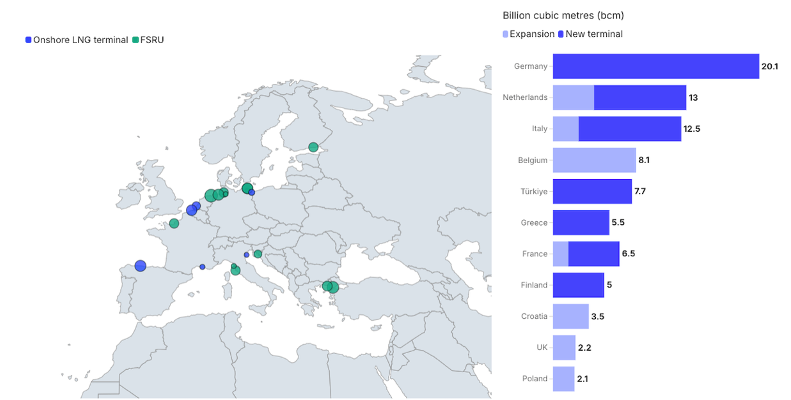
Note: Spain is not included in the bar chart because El Musel was an existing onshore LNG terminal that was reactivated after being mothballed, rather than a newly built facility.
The EU’s import of more than 140 bcm of LNG in 2025 and the operation of 33 large-scale LNG terminals across Europe underline the scale of this shift. LNG has become a core component of Europe’s energy system, increasing the strategic weight of the coastal terminals through which much of this supply now enters.1,3
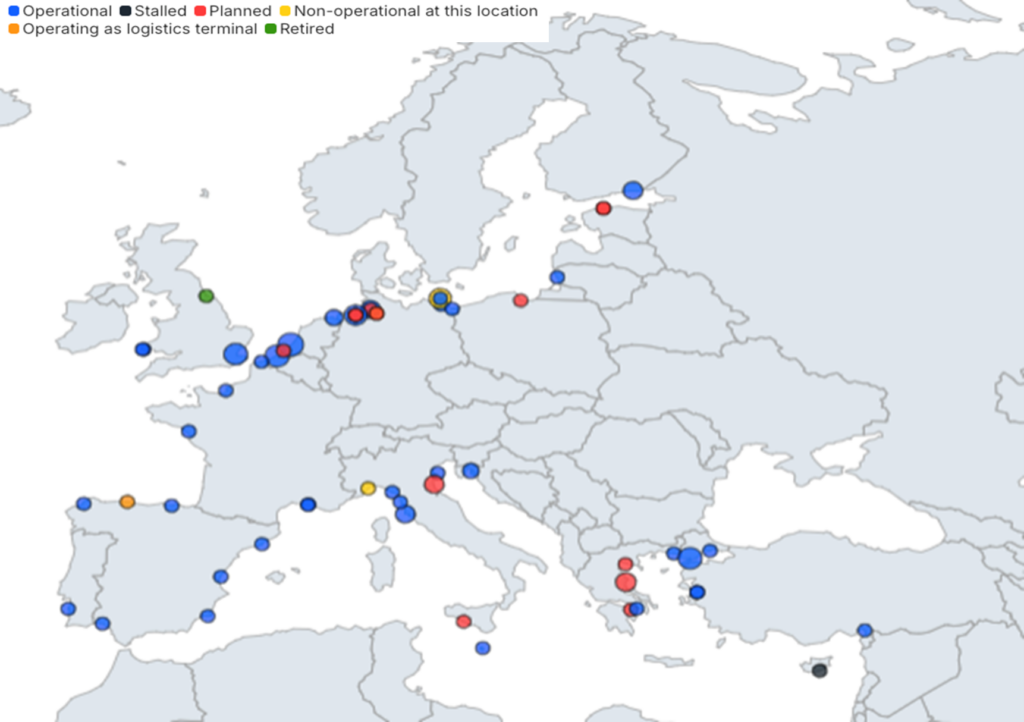
Key Takeaway:As Europe shifted away from pipeline gas, LNG terminals became strategic gateways linking energy security to coastal infrastructure, maritime access and resilience during crises.
As Europe expanded its LNG network, many terminals evolved from simple import sites into regional transit nodes. Regasified gas now feeds not only national grids but also neighboring markets through interconnectors, which means a disruption at one coastal terminal can affect supply beyond the host country.
These terminals should therefore be understood not merely as import infrastructure, but as strategic energy chokepoints. Their importance lies in the convergence of maritime access, regasification capacity and inland transmission links. The shutdown of a major terminal may no longer be a local technical problem. In some cases, it can disrupt gas flows across a wider subregion. More terminals can increase flexibility, but where substitution capacity remains limited, they can also create a larger number of critical nodes.
This pattern is visible across several clusters. In the Baltic and North Sea, LNG terminals support northern and northwestern European flows. Atlantic terminals such as Dunkirk and Montoir connect overseas LNG, including U.S. and (partial) Qatari supply, to major demand centers. Iberia has substantial regasification capacity, but limited onward connectivity across the Pyrenees reduces its wider balancing role. In southeastern Europe, Greece-centered and Türkiye-linked infrastructure shapes flexibility into the Balkans.1,4,5
Where maritime exposure overlaps with pipeline convergence and limited alternatives, LNG terminals become high-impact nodes. Their strategic importance lies not only in the volume they handle, but in their function as the points where sea-based supply enters Europe’s internal energy system.
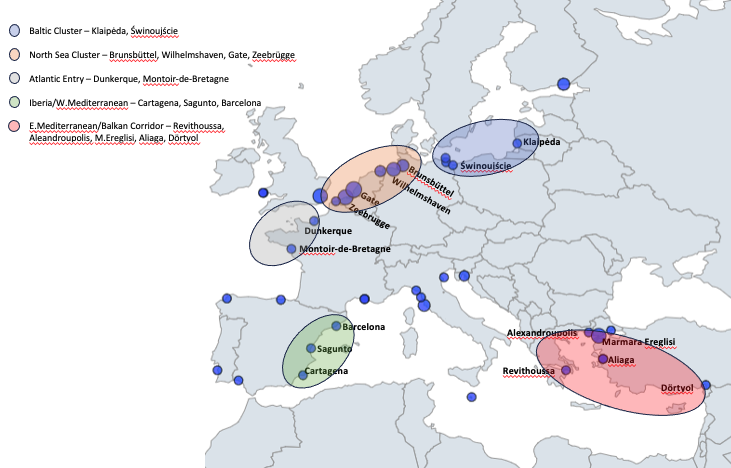
Note: The maps are not to scale; they have been prepared to schematically illustrate strategic nodes.
Key takeaway:Europe’s LNG terminals are no longer just import sites. They are critical points in the gas network and a disruption at one terminal can affect other countries as well.
As Europe’s energy system has become more dependent on LNG, terminals have evolved beyond commercial infrastructure into multi-layered operational hubs. Their function depends on the uninterrupted interaction of maritime access, berthing arrangements, storage, regasification, control systems, power supply and connections to the national grid. This means that a terminal’s vulnerability does not lie in a single asset, but in the need for all parts of the chain to work together. Pressure on any one link can disrupt the wider flow.
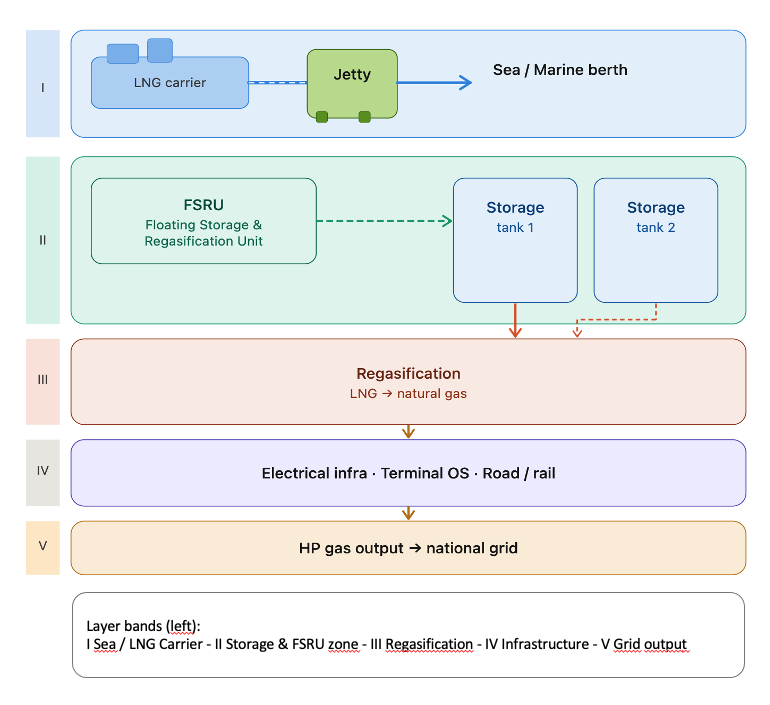
This makes LNG terminals vulnerable across both physical and digital domains. On the maritime side, vessel approaches, pier operations and offshore safety are critical. Within the terminal, Operational Technology / Industrial Control Systems (OT/ICS), sensors and process safety shape operational continuity. Onshore, power supply, terminal software and grid connections are equally important. LNG terminal security should therefore be assessed not as the protection of a single facility, but as the protection of an interconnected system exposed to cascading effects.
Recent incidents in the Baltic Sea highlighted this broader risk. Damage to undersea cables did not directly strike LNG terminals, but it showed how exposed Europe’s connected energy and communication infrastructure remains beneath the sea and along port approaches. For LNG terminals, security depends not only on the terminal site itself, but also on the protection of cables, pipelines, data links and power connections that support operations.6,7
Cyber incidents have reinforced the same lesson. Disruptions such as NotPetya, the ransomware attack at the Port of Nagoya and the DP World Australia incident showed that maritime and port operations can be slowed or suspended without any physical strike. In the LNG sector, this risk is even more acute because operators may halt operations when safety or data integrity becomes uncertain.8,9,10
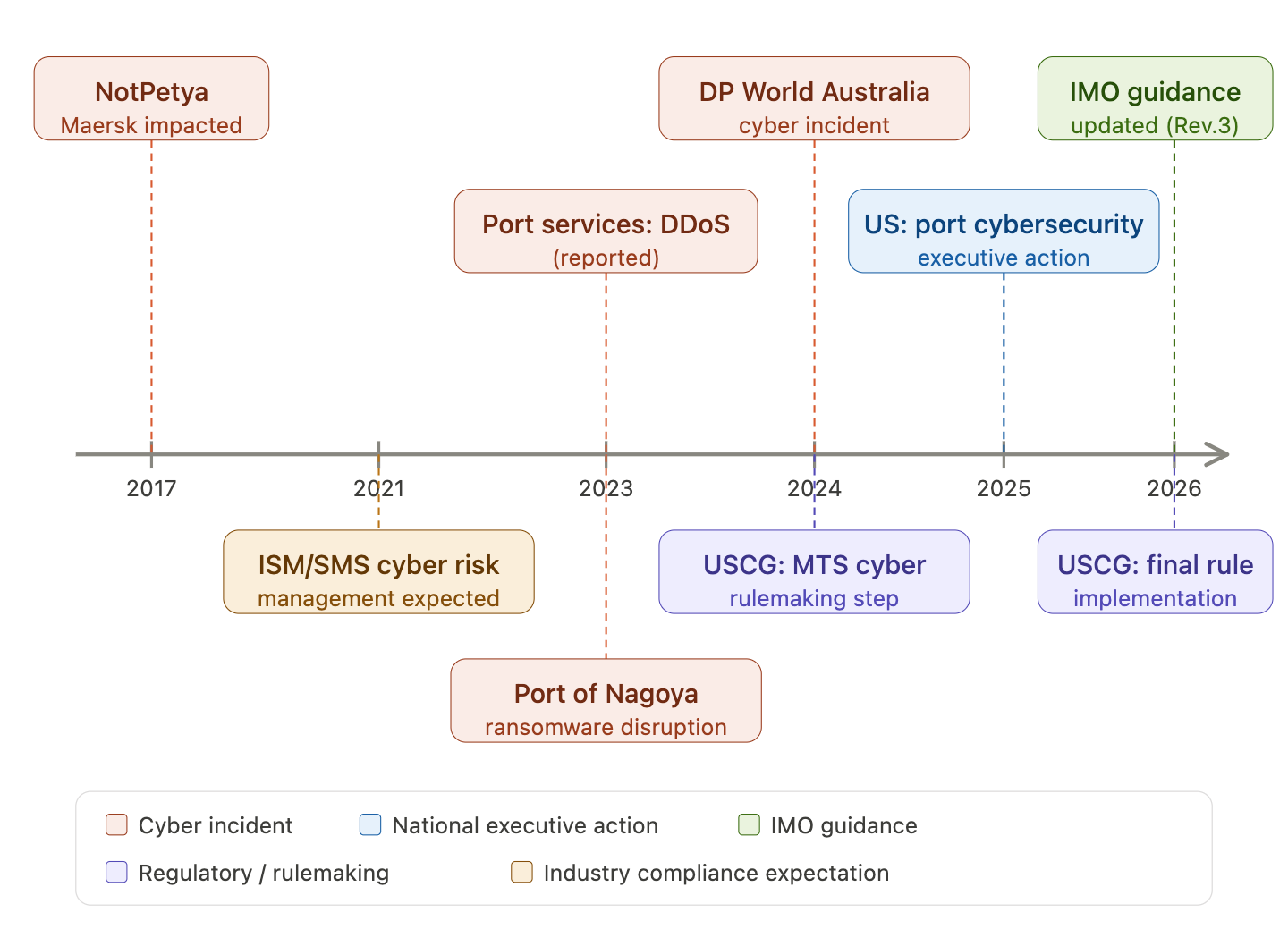
Taken together, these examples show that LNG terminals are no longer just critical energy facilities. They are multi-domain targets where maritime, subsea, digital and grid-linked vulnerabilities intersect. A cable incident, cyber disruption, Global Navigation Satellite System (GNSS) interference, pier security concern or drone-related threat may differ in form, but each can create the same strategic effect: slowing or interrupting the flow on which Europe’s maritime energy system depends.
Key Takeaway: LNG terminals have become more vulnerable because they are no longer isolated facilities, but interconnected operational systems. Recent subsea and cyber incidents show that pressure on any one part of this system can disrupt the wider energy flow.
The wars in the Middle East over the past two years showed that fixed energy infrastructure is no longer merely exposed to pressure, but can become a direct operational target. For Europe, the lesson is not that LNG terminals are identical to gas fields or refineries, but that they share the same strategic logic: they are fixed, visible and high-impact nodes whose disruption can affect wider energy flows.11,12,13,14,15,16
What is becoming visible is not only a broader willingness to strike energy infrastructure, but also a weakening of the legal and political restraint that once raised the threshold for such attacks. Recent U.S. and Israeli threats and strikes against Iranian energy-related sites, as well as Iranian attacks on Arab Gulf energy facilities, suggest that critical energy infrastructure is increasingly being treated as an operational pressure point rather than as an asset shielded by strong legal caution. This does not make international humanitarian law irrelevant. It shows, rather, that its restraining effect is being tested more openly in practice.
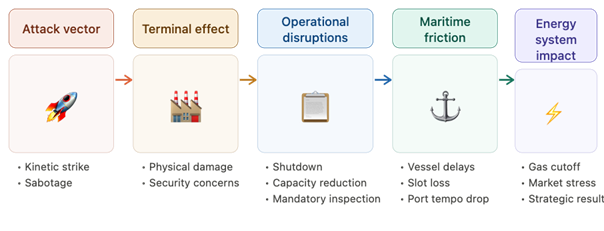
The events of 2025 made this shift visible. Reuters reported that Israeli strikes affected Iran’s South Pars field, while Iranian attacks hit energy infrastructure in Haifa and led Israel to suspend part of its own gas production for security reasons. These developments showed that energy infrastructure was no longer a secondary target, but part of the core operational logic of the conflict. Reuters also highlighted the growing role of low-cost drones in this environment, underscoring how relatively cheap systems can be used to pressure far more valuable energy assets and flows.
The 2026 U.S.-Israel-Iran war pushed this logic further. Reuters reported strikes on South Pars and the nearby Asaluyeh processing centre, while gas prices in Europe jumped sharply amid fears of broader disruption. Further reporting pointed to damage at Israeli refining infrastructure and shipping-related adjustments by Abu Dhabi National Oil Company (ADNOC Gas) near the Strait of Hormuz.17 Together, these incidents showed that the target was no longer only infrastructure itself, but the wider flow of energy, shipping and market confidence connected to it.
For Europe, the main implication is clear. LNG terminals may differ in form from Middle Eastern gas fields or refineries, but they are still fixed, networked and strategically visible assets. The threat to them should therefore not be viewed as a simple choice between cyber pressure and physical attack. What matters is a broader pressure logic in which different tools can be used to disrupt the same energy flow.
Key takeaway: The 2025 and 2026 wars in the Middle East showed that energy infrastructure is now a direct operational target. For Europe, this means LNG terminals should be understood as exposed strategic nodes that may face different forms of pressure aimed at disrupting the same flow.
The threat to LNG terminals does not fall into a single category. These facilities face a spectrum of pressure ranging from soft kill to hard kill and the difference lies less in the method used than in the depth of the disruption and the time needed for recovery.
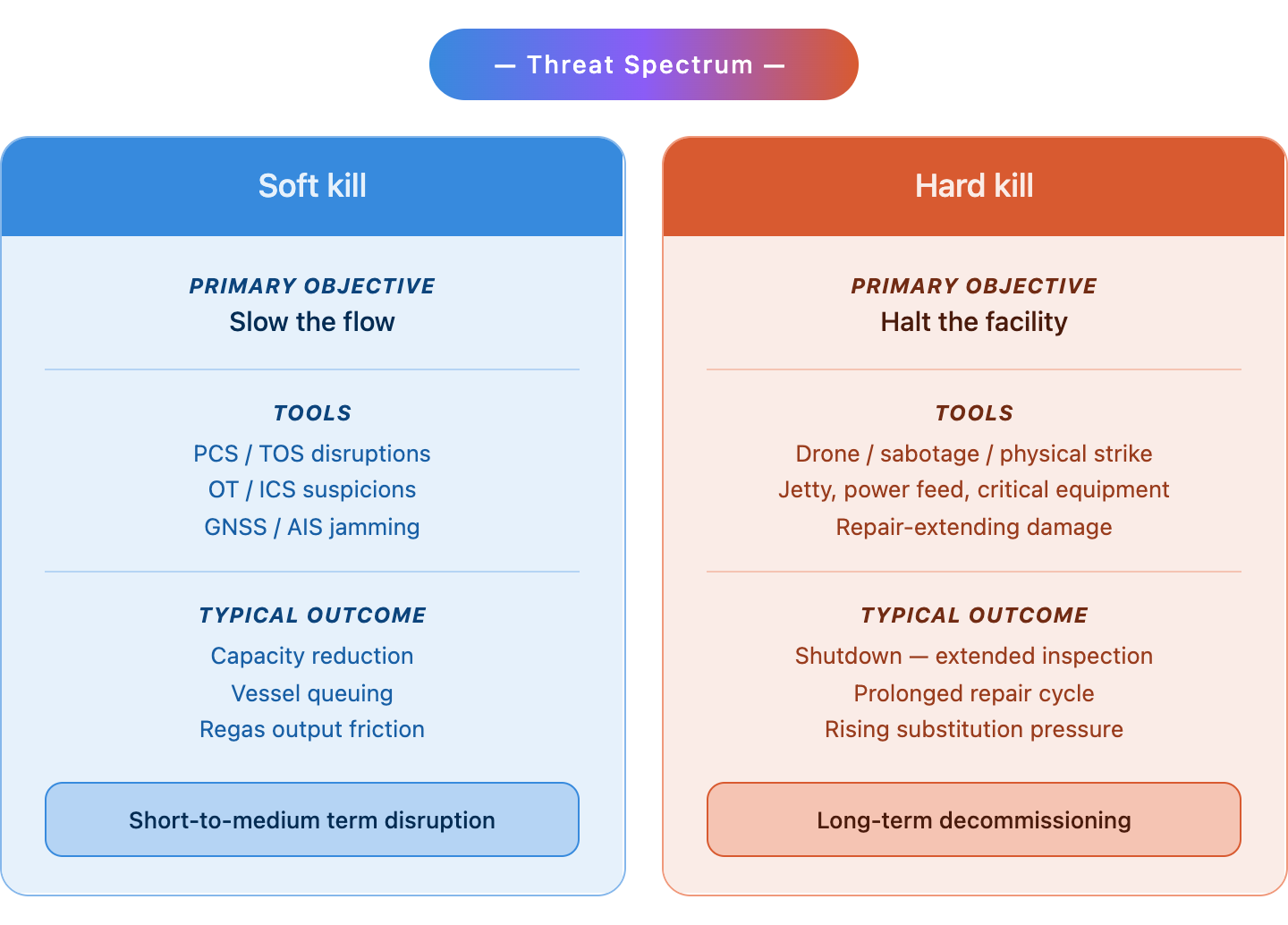
A soft kill does not aim to destroy the terminal physically. Its purpose is to slow operations, create uncertainty and force the operator into a more defensive posture. The likely result is lower throughput, vessel delays and friction in the gas flow.
A hard kill aims at longer disruption by damaging critical components and making recovery more difficult. Its effect is not just interruption, but prolonged loss of function and reduced replacement capacity.
The strategic logic, however, is the same in both cases. Whether the pressure comes through cyber disruption, navigational interference, sabotage, drones or direct physical attack, the objective is to put pressure on the maritime energy supply chain by slowing or halting the flow at a critical node. In practice, soft-kill methods are more likely to be used in peacetime competition and crisis settings, where the aim is to create pressure without crossing the political and military threshold associated with direct physical destruction. Hard-kill options become more likely as escalation deepens and confrontation moves closer to open warfare, since their purpose is not merely to disrupt the flow, but to disable a critical node for a longer period. This should not be treated as a strict rule, however, but as a pattern of escalation.
Key takeaway: The difference between soft kill and hard kill is not the tool, but the scale and duration of the disruption. Both aim at the same result: putting pressure on energy flow by degrading or stopping operations at LNG terminals.
LNG terminals are not fixed targets that can be secured through perimeter protection alone. They operate across wide port areas and depend on maritime access, power supply, digital systems, pipeline connections and surrounding transport infrastructure. This makes them difficult to protect as single sites and means that their vulnerability extends well beyond the terminal fence.
The problem is also one of scale. Providing continuous, high-level protection for every LNG terminal is not realistic given the number of sites, the spread of supporting infrastructure and the variety of threats, from low-altitude drones to sabotage and seaborne access. Some parts of a terminal can be better protected than others, but maintaining the same level of security across piers, seabed connections, power supply and digital networks is far more difficult.
This is why the real issue is not only how to defend each terminal, but how much weight each terminal carries in the wider system. Where a single terminal is closely tied to transmission hubs, interconnectors or regional storage, its disruption can have effects far beyond the port itself. In such cases, the terminal becomes not just infrastructure, but a choke point with disproportionate systemic importance.
For Europe, the more durable answer lies not in trying to protect every node perfectly, but in reducing the consequences of losing one. In practice, energy security will depend less on the absolute protection of individual terminals and more on building a system with greater substitution capacity, alternative flow routes, storage buffers and more distributed entry points.
Key takeaway: The real question is not how to protect every LNG terminal equally, but how to ensure that the loss of one terminal does not undermine wider energy security.
Once the threat is understood, the issue is no longer only how LNG terminals can be targeted, but how their disruption can be prevented from destabilising the wider system. If LNG terminals form Europe’s new coastal entry layer, the answer lies not in trying to secure each site absolutely, but in building an energy architecture that is more distributed, more flexible and less dependent on a small number of critical nodes.
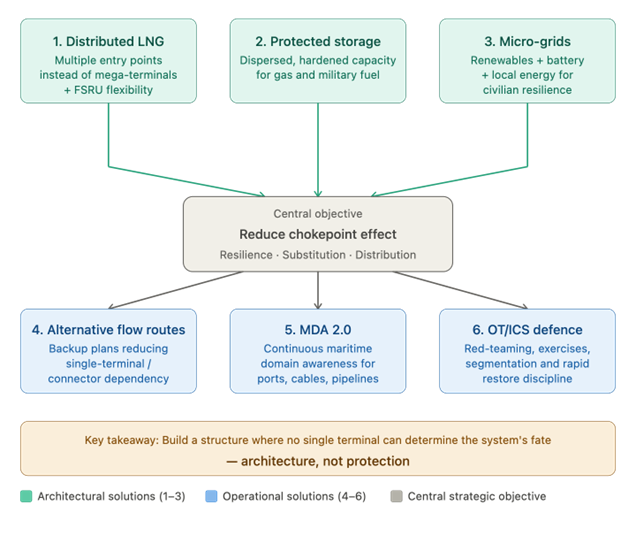
A more resilient model would rely on a wider spread of entry points, including smaller terminals and FSRUs, rather than placing excessive weight on a few major facilities. Resilience also depends on storage, but not all storage serves the same purpose. While storage buffers in civilian energy systems help absorb supply shocks and balance market fluctuations, military fuel continuity requires a different standard of protection. In wartime, storage must be deeper, more secure and more resistant to blast effects and physical attack. Storage should therefore be viewed not merely as an economic buffer, but as part of the infrastructure needed to sustain continuity during crises and war. The same logic applies to redundancy: alternative routes, reverse-flow options and pre-planned backup arrangements reduce the risk that the disruption of one node will paralyse a wider region.
Resilience also depends on what happens beyond the terminal itself. Microgrids and local backup power can help sustain essential services during wartime or major outages, easing pressure on central infrastructure. At the same time, maritime domain awareness must extend across port approaches, seabed infrastructure and surrounding traffic patterns, while OT/ICS defence, segmentation and regular exercises remain critical to protecting the digital layer of terminal operations.
Key takeaway: The real answer is not to protect a few LNG terminals more heavily, but to build an energy security architecture in which the disruption of one node does not destabilise the whole system.
Europe’s shift to LNG has made its energy system more flexible, but it has also created a new form of vulnerability. LNG terminals are no longer just commercial facilities. They have become strategic coastal nodes through which energy supply, maritime access and infrastructure resilience now intersect. As a result, Europe’s energy security depends not only on how much gas it can import, but also on whether these nodes can continue to function under pressure.
Recent experience has shown that the threat to energy infrastructure is no longer limited to market disruption or technical failure. Across both the physical and digital domains, pressure can now be applied in ways that slow, interrupt or disable the same flow. For Europe, this means LNG terminals should be understood not only as part of energy policy, but as part of a wider maritime and strategic security problem.
The central challenge, however, is not simply how to defend each terminal more heavily. A system built around a small number of critical coastal nodes will remain vulnerable even if those nodes are better protected. The more durable answer lies in a more distributed energy architecture with greater redundancy, storage, alternative routes and operational resilience.
The key question for Europe is no longer only how to secure supply, but how to keep the maritime energy system functioning when disruption occurs. The answer lies in treating LNG terminals not as isolated facilities, but as part of a broader system whose stability depends on resilience as much as protection.
- Council of the European Union. “Where does the EU’s gas come from?” 2025.
- Institute for Energy Economics and Financial Analysis (IEEFA). “European LNG Tracker.” 2026.
- ACER. “Capacity Use and Booking Trends in European Natural Gas Infrastructure.” October 30, 2025.
- QatarEnergy LNG. “RasGas Delivers First LNG Cargo to France’s Dunkerque LNG Regasification Terminal.” November 23, 2016.
- Elengy. “Qatar Petroleum Secures Nearly 3 MTA Throughput Capacity at the Montoir-de-Bretagne LNG Terminal in France for a Term Extending to 2035.” February 20, 2020.
- Reuters. “NATO to Boost Baltic Sea Presence after Cables Broken.” December 27, 2024.
- Reuters. “Finland Finds Drag Marks on Baltic Seabed after Cable Damage.” December 29, 2024.
- Reuters. “Maersk Says Cyber Attack Caused Computer System Breakdown.” June 27, 2017.
- Reuters. “Japan’s Largest Port Plans to Resume Operations Thursday Following Cyberattack.” July 6, 2023.
- DP World Australia. “Media Statement: Update on Cybersecurity Incident.” November 28, 2023.
- Reuters. “Iranian and Israeli Energy Sites Impacted by Conflict.” June 17, 2025.
- Reuters. “Cheap Drones Are Reshaping the War in the Sky.” March 16, 2026.
- Reuters. “US Shoots Down Iranian Drone Approaching Aircraft Carrier, Official Says.” February 4, 2026.
- Reuters. “Iran’s Giant South Pars Gas Field at the Centre of Gulf War Escalation.” March 19, 2026.
- Reuters. “Natural Gas Prices Soar as Iran, Israel Strike Middle East Energy Infrastructure.” March 19, 2026.
- Reuters. “Israeli Refinery Owner Says Essential Infrastructure Damaged in Iranian Strike.” March 20, 2026.
- Reuters. “UAE’s ADNOC Gas Adjusts LNG Output in Response to Shipping Disruption.” March 23, 2026.
click HERE to download as PDF.