This Week at a Glance:
- US shifts from diplomacy to blockade and coercive pressure on Iran
- Israel and Lebanon agree to a temporary ceasefire linked to wider Iran diplomacy
- Europe begins planning post-conflict Hormuz security mission
- Russia and Ukraine expand strikes on ports and energy infrastructure
- Ukraine deepens drone warfare as Europe expands defense-industrial support
- North Korea advances missile and nuclear capabilities
- Indo-Pacific military drills expand among US and allies
Strategic Overview
The breakdown of US-Iran negotiations has shifted conflict management from diplomacy toward coercive enforcement. Washington has implemented a naval blockade alongside financial pressure targeting Iranian-linked trade, while Iran has signaled a conditional reopening of the Strait of Hormuz under its own regulatory framework. This has created a contested operating environment in which restriction and access coexist, increasing uncertainty for global shipping and drawing third-party actors into the escalation dynamic.
At the regional level, the Israel-Lebanon ceasefire reflects the use of temporary de-escalation as a tool to contain spillover from the wider Iran conflict. While active hostilities have paused, core issues such as Hezbollah’s role and Israeli force posture remain unresolved. The arrangement functions as a stabilization mechanism linked to broader diplomatic efforts rather than a pathway to conflict resolution, leaving escalation risks structurally embedded.
Beyond the Middle East, the war in Ukraine continues to shape both the operational and industrial dimensions of modern conflict. Reciprocal strikes on energy, port, and logistics infrastructure highlight the expansion of economic warfare, while European states are institutionalizing defense-industrial integration through battlefield data sharing and joint production. This reflects a longer-term shift in which active conflict environments are directly feeding into military innovation, alliance adaptation, and the evolving structure of strategic competition.
Research Field Analysis
Regional Conflict & Stability
Iran War – Operational Assessment (Weeks 1–7)
Key Indicators
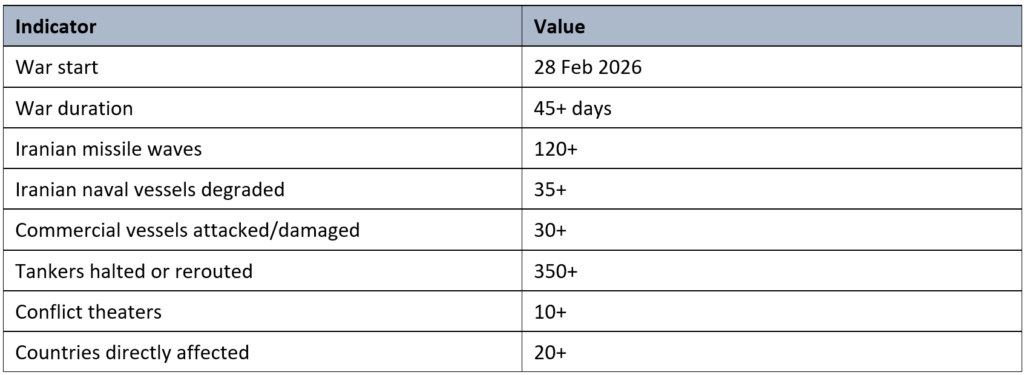
Operational Snapshot
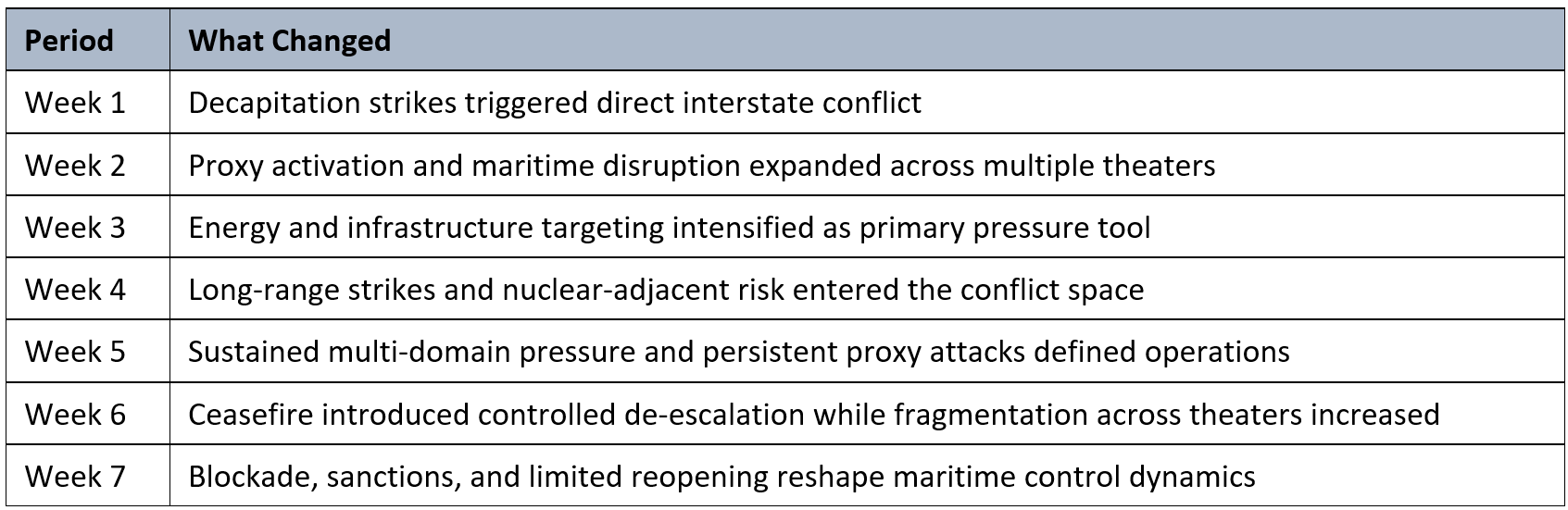
Conflict Evolution
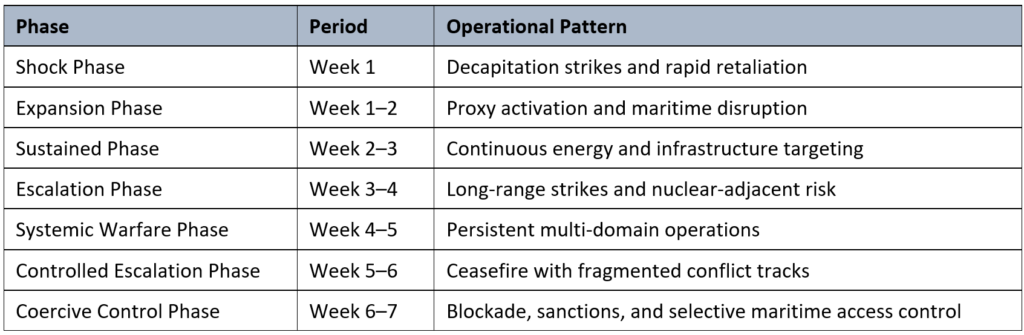
Operational Dynamics
The conflict has evolved into a structured coercion system combining military, economic, and maritime pressure tools.
- Maritime domain has transitioned into a controlled coercion space
Blockade enforcement, selective transit permissions, and interdictions define a managed but contested environment. - Economic warfare has been integrated with military operations
Secondary sanctions and financial pressure reinforce physical blockade mechanisms. - Proxy warfare remains active but relatively secondary in this phase
While still operational, proxy activity is no longer the primary driver of escalation dynamics. - Energy systems continue to function as the central pressure node
Disruption, rerouting, and controlled reopening of energy flows shape global economic impact. - Diplomatic channels have re-emerged without resolving core conflicts
Ceasefires and negotiations remain active but fragile and conditional.
Weekly Strategic Shift
- Maritime domain shifts into coercive control architecture
- US pressure expands from naval blockade to financial sanctions
- Iran responds with selective reopening and controlled access proposals
- Conflict transitions from escalation to managed pressure competition
- Diplomatic activity increases without producing structural resolution
- Energy and shipping systems remain under sustained stress
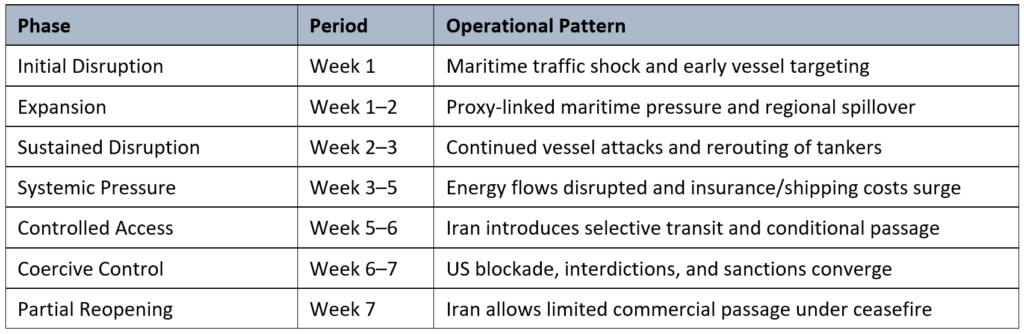
Hormuz Maritime Dynamics
Phase Evolution
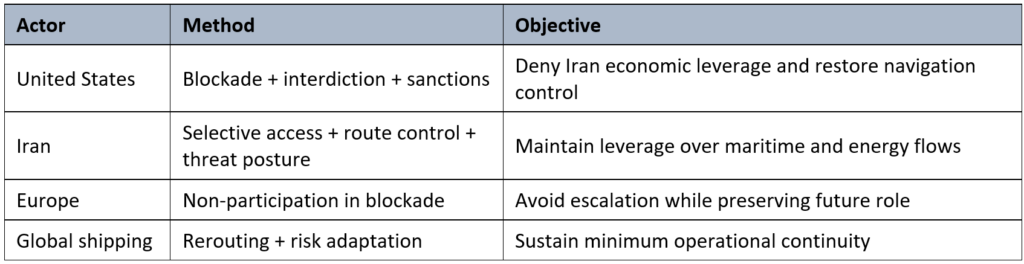
Control Competition Model
Strategic Note
The Strait of Hormuz is no longer operating as a normal transit corridor, but as a managed pressure zone shaped by competing coercive tools.
US blockade enforcement and financial pressure are increasing the cost of Iranian-linked shipping, while Iran preserves leverage through selective access and route coordination.
Traffic has resumed only partially and under constraint, leaving commercial flows exposed to persistent uncertainty.
What has emerged is not maritime normalization, but a controlled form of instability.
Coercive Pressure Architecture
The collapse of US–Iran negotiations in Islamabad has shifted the conflict from diplomacy to coordinated coercive pressure, as Washington combines naval blockade enforcement with secondary sanctions to extend pressure from the maritime domain into global financial networks. Iran, in response, maintains leverage through selective access to the Strait of Hormuz, allowing conditional reopening while preserving its ability to restrict flows. The result is not a move toward resolution, but the emergence of a managed coercion framework in which pressure and access operate simultaneously, shaping trade, access, and escalation dynamics.
Israel-Lebanon Ceasefire as Conditional De-Escalation
A US-brokered 10-day ceasefire between Israel and Lebanon has paused a secondary conflict theater linked to the wider Iran war. Core issues, including Hezbollah’s military role and Israeli force posture, remain unresolved. The ceasefire functions as a containment tool to prevent horizontal escalation while maintaining diplomatic channels, with escalation risks still embedded beneath the pause.
Reciprocal Infrastructure Targeting Expands in Ukraine War
Russia and Ukraine have intensified strikes on critical infrastructure, including ports, logistics nodes, and energy facilities. Ukrainian drone strikes on Black Sea assets aim to disrupt fuel storage and export capacity, while Russian attacks on Danube port infrastructure target alternative trade routes. Sustained, multi-day strike patterns indicate a shift toward systematic economic warfare, with both sides targeting sustainment capabilities rather than frontline positions.
Drone-Centric Warfare Reshapes Tactical Balance
Ukraine’s integration of aerial and ground unmanned systems with infantry operations is contributing to localized gains, while Russia maintains large-scale drone and missile pressure across multiple axes. Drones are no longer a supporting asset but a central component of battlefield execution, shaping both offensive and defensive dynamics.
Energy & Maritime Security
Hormuz Enters Controlled Access Phase Under Dual Pressure
The US naval blockade targeting Iranian-linked shipping has introduced active enforcement into the maritime domain, while Iran has simultaneously signaled controlled access for commercial vessels under its own coordination framework. Early data indicates that transit has not fully stopped but remains significantly reduced and selective. This creates a dual-control environment in which neither side exercises full authority, increasing uncertainty for commercial operators and insurers while keeping global supply flows constrained.
Energy Infrastructure Disruption Meets Rapid Recovery
Iranian-linked strikes on Saudi energy infrastructure temporarily disrupted production and pipeline throughput, including the East-West export corridor. Saudi Arabia restored capacity within days, recovering lost volumes and maintaining supply continuity. This highlights both the vulnerability of critical infrastructure and the resilience of major producers, suggesting that short-term disruptions may not translate into sustained supply shocks.
Escalation Risks Extend to Regional Ports and Shipping
Iran has warned that pressure on its ports could trigger retaliation against Gulf infrastructure, while the US has expanded coercive pressure through potential secondary sanctions targeting Iranian oil buyers. At the same time, tanker interdictions and vessel rerouting signal the operationalization of the blockade. These dynamics extend risk beyond the Strait, placing regional ports, commercial shipping, and third-party actors within the escalation spectrum.
Early Planning Emerges for Post-Conflict Maritime Security
European states, led by France and the UK, have begun discussions on a potential multinational mission to secure navigation in the Strait of Hormuz after the conflict. While avoiding participation in the current blockade, these efforts indicate preparation for a stabilization role. The emerging framework points toward coalition-based maritime security, contingent on ceasefire conditions and broader political alignment.
Hybrid Threats, Cognitive Warfare & Information Operations
Russian Cyber Operations Expand from Penetration to Network Mapping
A large-scale cyber campaign linked to Russian actors compromised hundreds of email accounts belonging to Ukrainian prosecutors and state institutions, exposing internal communications and sensitive data. The operation appears aimed at monitoring anti-corruption efforts and identifying vulnerabilities within Ukraine’s governance structure. At the same time, intrusions into institutions across NATO and European countries point to a broader intelligence collection effort. This reflects a shift from isolated cyber penetration toward systematic network mapping across both frontline and allied environments.
Cyber and Information Tools Target Financial Systems and Escalation Perception
A cyber attack forced a Russia-linked cryptocurrency exchange associated with sanctions evasion to suspend operations, highlighting the growing role of cyber tools in disrupting alternative financial channels. In parallel, Russian officials warned that European defense-industrial sites linked to drone production could become military targets, publicly releasing location details. Together, these actions show how cyber disruption and information signaling are being combined to influence financial resilience and political risk perception beyond the battlefield.
Defense Technology, Industry & Economic Security
Ukraine Battlefield Data Drives Structured Weapons Development
Germany’s agreement with Ukraine to access real-time combat performance data from deployed systems marks a transition from informal feedback loops to institutionalized learning. Observations from battlefield conditions, including system wear and interception performance, are now directly feeding into next-generation design and upgrades.This effectively turns the Ukrainian battlefield into a continuous testing environment while embedding operational experience into the European defense-industrial base.
Drone Warfare Scales Into Industrial-Level Production
New defense agreements between Ukraine and European partners, including Germany and Norway, focus on large-scale drone production and joint development frameworks. These initiatives move beyond urgent battlefield supply toward standardized and scalable manufacturing models. The emphasis on high-volume production and shared development reflects a transition from tactical drone usage to integrated force components, while reinforcing deeper industrial cooperation across allied states.
AI-Driven Command Systems Move Toward Operational Deployment
France’s development of an AI-powered, data-centric command system, positioned as a sovereign alternative to US-led architectures, highlights the growing role of real-time data processing in military operations. Designed to integrate battlefield inputs into distributed decision-making, the initiative reflects a shift toward AI-enabled command structures. It also underscores the importance of technological sovereignty, as states seek to reduce dependency while building independent operational ecosystems.
External Technology Support Enhances Targeting Capabilities
Reports that Iran used a Chinese-provided satellite system to monitor and target US military bases highlight the growing impact of external technological support in active conflict zones. Access to satellite imagery, ground infrastructure, and data services improves targeting accuracy and operational planning. This demonstrates how state-linked technology transfers can directly influence battlefield effectiveness, extending competition into the intelligence and surveillance domain.
Naval Strike Capabilities Expand Through Platform Integration
North Korea’s testing of cruise and anti-ship missiles from a newly developed destroyer highlights the integration of advanced strike systems into naval platforms. Combined with plans to expand the fleet, these developments indicate a shift toward sustained maritime strike capability rather than isolated missile deployments. This reflects an effort to enhance deterrence and operational reach through platform-based force projection.
Global Power Competition & Systemic Transitions
European Strategic Positioning Shows Divergence on China and Middle East Policy
Spain’s call for China to assume a larger role in global governance reflects growing openness within parts of Europe to diversify strategic engagement beyond the transatlantic framework. At the same time, Italy’s suspension of its defense cooperation agreement with Israel signals a shift toward more conditional alignment. Together, these developments suggest that European actors are increasingly calibrating their positions based on issue-specific risk and political exposure rather than fixed bloc alignment.
China-Iran Alignment Signals Expand Indirect Great Power Competition
US intelligence reports indicating that China may be preparing deniable MANPADS transfers to Iran through third countries points to a deepening indirect alignment between major powers. Such mechanisms enable capability transfer without overt escalation, complicating attribution and response options. This reflects a broader pattern in which great power competition is increasingly conducted through proxy enablement rather than direct confrontation.
Russia Expands Deterrence Signaling Into European Industrial Domain
Moscow’s warning that European drone production facilities supporting Ukraine could become legitimate military targets extends deterrence messaging beyond the battlefield into the defense-industrial sphere. By publicly identifying potential targets, Russia is raising perceived risk for supporting states while attempting to shape political calculations in Europe. This reflects an expansion of escalation signaling into the broader support infrastructure behind the conflict.
Hungary Election Shift Reduces EU Policy Friction on Ukraine
The electoral shift in Hungary removes a key source of institutional obstruction within the EU on Ukraine-related decisions. The expected easing of veto dynamics improves the bloc’s ability to coordinate financial and political support. While internal differences persist, this marks a tangible increase in EU decision-making efficiency in the context of the war.
US-Türkiye S-400 Talks Signal Effort to Stabilize NATO Cohesion
Ongoing discussions between Washington and Ankara on resolving tensions related to the S-400 air defense system indicate a potential normalization of defense relations. A compromise could reopen pathways for Türkiye’s reintegration into Western defense-industrial frameworks, including the F-35 program. This reflects a broader effort to reduce internal alliance fragmentation under increasing geopolitical pressure.
North Korea Nuclear Expansion Reinforces Long-Term Proliferation Risks
IAEA assessments pointing to advances in uranium enrichment and reactor activity at Yongbyon indicate a steady expansion of North Korea’s nuclear weapons production capacity. The diversification of fissile material pathways increases both scalability and resilience, reinforcing long-term proliferation risks and complicating regional deterrence dynamics in East Asia.
Indo-Pacific Military Exercises Expand Multinational Defense Coordination
Joint naval drills involving the United States, Australia, and the Philippines, alongside the upcoming Balikatan exercises with expanded participation including Japan, highlight a shift toward structured multinational defense frameworks. The scale and integration of these activities reinforce interoperability and collective deterrence, indicating a more contested and institutionally coordinated security environment in the Indo-Pacific.
Future Conflict, Climate & Humanity
Prolonged Hormuz Disruption Threatens Global Food Security Chains
The UN warned that continued instability in the Strait of Hormuz could disrupt global agrifood systems by constraining access to energy and fertilizer exports. Delays in these critical inputs risk reducing crop yields, particularly in import-dependent economies, while rising transport and energy costs could accelerate food price inflation. This highlights how disruptions in key maritime chokepoints extend beyond energy markets to directly impact global food production and humanitarian stability.
Cross-Domain Strategic Signals
Full-Spectrum Coercive Pressure Expands Across Domains
The combination of naval blockade enforcement and secondary financial sanctions reflects a shift toward full-spectrum coercive pressure. By targeting both physical shipping and global financial channels, this approach extends enforcement beyond direct conflict zones. Third-country actors, including commercial operators and financial intermediaries, are increasingly drawn into the pressure architecture, raising systemic friction across global markets and networks
Contested Control Replaces Traditional Maritime Dominance
Developments in the Strait of Hormuz show that control is no longer defined by full access or denial, but by selective and overlapping authority. While the US enforces restrictions on Iran-linked shipping, Iran simultaneously signals conditional access for commercial transit. This creates a dual-control environment where competing actors shape access in parallel, increasing operational uncertainty and redefining maritime control in modern conflict.
Networked Defense-Industrial Integration Accelerates Through Conflict
European drone co-production initiatives and structured combat-data sharing with Ukraine indicate a shift toward networked defense-industrial integration. Battlefield performance data is now directly feeding into weapons development cycles, reducing adaptation timelines. This model moves beyond traditional aid frameworks, embedding active conflict environments into long-term industrial and technological capacity building and linking battlefield performance directly to strategic competition.
Conditional Stabilization Becomes a Managed Conflict Tool
The growing use of time-bound ceasefires, such as the Israel-Lebanon arrangement, reflects a shift toward controlled de-escalation mechanisms. These pauses are designed to manage escalation and support ongoing negotiations rather than resolve underlying conflict drivers. Their linkage to broader diplomatic processes shows how stabilization is being used as an operational tool within multi-layered conflict management.
What to Watch Next Week
- Launch of multinational Balikatan exercises on April 20
- Hormuz transit volumes under US–Iran dual control dynamics
- Expiration of Israel–Lebanon temporary ceasefire
- US-Türkiye high-level talks on S-400 dispute
- Russian military activity following Easter truce expiration
click here to download as PDF.