
Key Points :
- Israel struck Abu al-Duhur after talks on prospective Turkish deployments.
- In April 2025, Israel struck T4, Palmyra and Hama after Turkish evaluations.
- Türkiye seeks an integrated Syrian state aligned with its security priorities.
- The Mecca Pact’s operational and command structures remain under development.
- NATO Article 5 would not automatically apply to Turkish forces in Syria.
- Abu al-Duhur was physically an attack on Syria but strategically a warning to Ankara.
- Israel appears to be enforcing preventive denial against Turkish-enabled military capability in Syria before it becomes difficult to reverse.
- The Mecca Pact did not demonstrably cause the strike. It does change the political consequences of future coercion against Türkiye.
- Türkiye’s previous non-entry strategy in the Iran war is becoming harder to preserve because escalation can now reach Turkish interests from Syria rather than Iran.
- The most dangerous threshold is an Israeli strike that knowingly kills Turkish military personnel or destroys an operational Turkish system.
- The strongest defensible reading is that the Iran war created the conditions for the Mecca Pact while Abu al-Duhur exposed how the same architecture can become relevant to an Israel-Türkiye confrontation.
- A stronger hypothesis says external actors sought to draw Türkiye into the Iran war and Syria now offers another route to involvement. Current public evidence does not prove this. It remains a hypothesis to test rather than a conclusion.
- Washington is managing a three-sided contradiction involving Israeli freedom of action, Turkish influence and Syrian sovereignty. Deconfliction alone cannot resolve it.
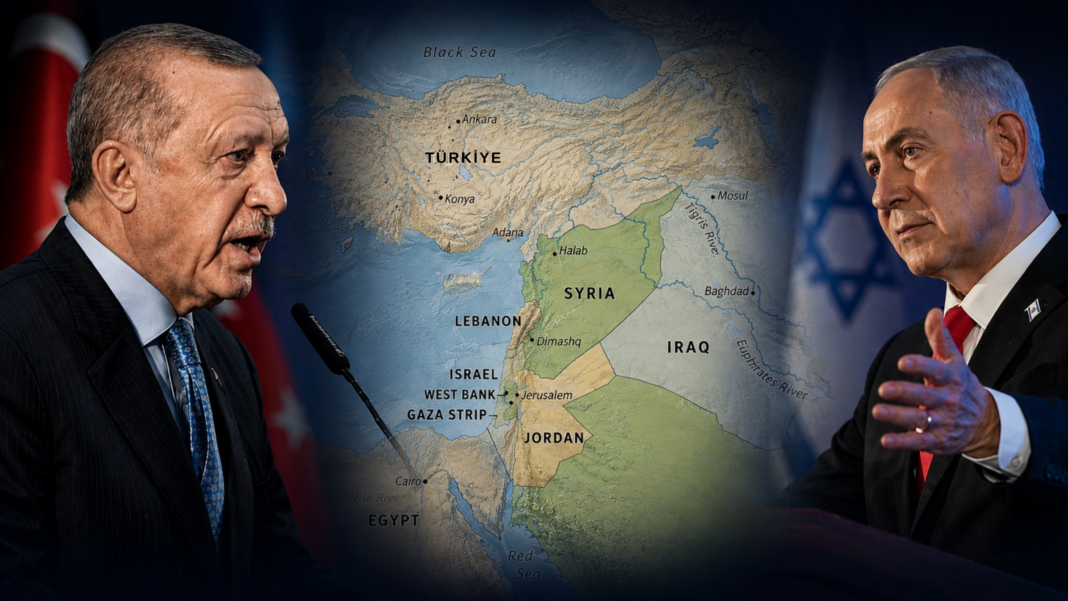
Legally and physically, Israel struck Syria. Strategically, the principal audience was Türkiye. Israel avoided striking Turkish territory or acknowledged Turkish forces while publicly tying the operation to a prospective Turkish deployment. The most plausible reading is coercive signalling by infrastructure denial: destroy the facility before a Turkish presence becomes operational and force Ankara to decide whether it is willing to rebuild, deploy and protect it.
This is more serious than a routine Syrian strike because it shifts the question from what Syria possesses to what Türkiye may be allowed to enable inside Syria.
The red line itself is not new. Its geographic reach and political explicitness are. In April 2025 Israel struck T4, Palmyra and Hama after Turkish teams had evaluated Syrian facilities. Abu al-Duhur repeats the operational logic: prevent a Turkish-supported capability from becoming a fait accompli.
The important difference is geography. Abu al-Duhur lies in northwestern Syria, far from Israel’s immediate frontier. If Israel claims a security interest in preventing Turkish military use there, the practical red line is no longer simply no Turkish military infrastructure near Israel. It becomes no Turkish-enabled capability in Syria that could materially constrain Israeli freedom of action.
Probably not in the immediate sense. The more credible Israeli concern is loss of operational freedom. Turkish-supported Syrian air defense, radar, electronic warfare, combat aviation or persistent drone capability could make Israeli operations over Syria more difficult even if Türkiye had no intention of attacking Israel.
The realistic Israeli fear is therefore less that Turkish aircraft will bomb Israel tomorrow and more that Türkiye may acquire the ability to tell Israel where it cannot fly tomorrow. For an Israeli doctrine built heavily around preventive action and freedom of manoeuvre, that is strategically significant.1
In Syria, increasingly yes. In Israel’s overall threat hierarchy, not yet. Iran developed an adversarial proxy and missile architecture explicitly directed against Israel. Türkiye is a NATO member, a major conventional military, Syria’s neighbour and a state whose interests still overlap with Western and Israeli interests in some areas.
Assad’s fall removed much of Iran’s former Syrian infrastructure while increasing Ankara’s influence over the new Syrian state. Israel therefore faces a paradox. Weakening Iran created strategic space that is being filled by an actor much harder to coerce than Iran’s Syrian proxy network.2
Türkiye does not necessarily need a large permanent occupation force to obtain strategic depth. Its preferred end state is more valuable than a collection of bases: a territorially integrated Syrian state whose central government is friendly to Ankara, capable of suppressing PKK/YPG-linked autonomous structures, able to control its borders and increasingly dependent on Turkish training, defense-industrial support and institutional assistance.
Permanent access to selected facilities would strengthen that model but is not the only mechanism. Training missions, advisers, equipment, drones, air defense, intelligence cooperation and Syrian forces operating Turkish systems can create substantial Turkish strategic influence without a formally declared Turkish airbase.3
There is no public evidence proving that causal chain and it should not be presented as fact. The timing is nevertheless strategically relevant. The Mecca Joint Defense Agreement was signed on 7 August. Israel and Syria discussed Turkish deployments on 14 August. Israel struck Abu al-Duhur on 18 August.
The stronger assessment is therefore not that Israel bombed the base because of Mecca. It is that Israel enforced an existing Syrian red line only eleven days after Türkiye entered a new collective-defense architecture with Saudi Arabia and Pakistan. That does not establish causation. It changes the strategic context in which the warning was delivered.
It should be discussed as a testable strategic hypothesis, not dismissed as a conspiracy theory and not promoted as established fact. The weak version is well supported: the Iran war produced the conditions in which the pact became attractive and the pact reduced Türkiye’s strategic insulation from regional conflict.
The stronger version claims deliberate design: external actors wanted Türkiye pulled into the Iran war and, having failed to achieve that directly, subsequent pressure in Syria created a new pathway to Turkish involvement. Public evidence does not establish such coordination. There is no verified evidence that Washington or Israel engineered the Mecca Pact for this purpose or that Abu al-Duhur was selected to activate it.
But the absence of proof does not make the structural effect imaginary. An alliance can entangle a state even when nobody designed the exact crisis that triggers the entanglement. That is the more defensible and analytically interesting conclusion.4
Its immediate strategic environment clearly was. The agreement emerged after Iranian attacks had reached Gulf states following the US-Israel attack on Iran and while Türkiye, Pakistan, Saudi Arabia and Egypt were coordinating around the conflict. Hakan Fidan insisted that the pact was not directed against Iran.
That can be true at the level of formal diplomatic intent while the agreement still remains a product of the Iran war at the level of strategic causation. A treaty does not need an anti-Iran clause to have been generated by Iranian pressure. States often build alliances against conditions rather than naming an enemy.5
The public record supports a narrower statement. Türkiye was under strong strategic pressure because it borders Iran, fields one of NATO’s largest militaries and maintained important diplomatic channels. Erdoğan repeatedly argued for negotiations, criticised both the US-Israeli attacks on Iran and Iranian attacks against Gulf states and offered Turkish mediation.6
What is not publicly demonstrated is a coordinated US-Israeli plan to force Türkiye into direct combat against Iran. That claim requires evidence we do not have. The realistic point is subtler. Washington and Israel would naturally benefit from greater regional burden-sharing against Iranian military pressure. Ankara had the capability to provide it but deliberately preserved strategic autonomy. The Mecca Pact now narrows that autonomy because an attack on Saudi Arabia or Pakistan can generate alliance expectations even if Türkiye still opposes the original war.
Türkiye was not successfully recruited into the war. It may nevertheless have entered an architecture through which the war can reach it.
Yes, but involved should not automatically mean entering a war. Before Mecca, Erdoğan could condemn Israeli operations, mediate with Iran and protect Turkish interests in Syria while keeping these policies institutionally separate. After Mecca, Türkiye has accepted explicit collective-security expectations with Saudi Arabia and Pakistan. After Abu al-Duhur, Israel has demonstrated willingness to use force against infrastructure associated with Turkish military influence.
Erdoğan therefore has a stronger domestic and strategic basis for arguing that Türkiye cannot remain merely an observer. The likely response is not an immediate attack on Israel. It is more likely to involve accelerated defense coordination with Saudi Arabia and Pakistan, reinforcement of Syrian military cooperation, stronger air-defense and intelligence arrangements, crisis consultations with Washington and calibrated military positioning designed to make another Israeli strike more costly.
Military diplomacy often communicates what political rhetoric deliberately leaves ambiguous. After the strike, Turkish military leadership contacted the US Chairman of the Joint Chiefs and reporting recorded contacts with regional counterparts. The Mecca framework is also expected to develop ministerial and military coordination mechanisms.
These calls are not evidence that collective defense was activated. The more realistic reading is crisis mapping: establish what Washington knew, signal that Ankara considers the incident serious, coordinate regional perceptions and determine what political and military support could exist if Israel repeats the action.
They should be treated as an indicator requiring verification rather than a confirmed mobilisation. Türkiye already maintains substantial forces and infrastructure connected with northern Syria. Movement of armour, air defense, logistics or personnel can reflect rotation, force protection, Syrian training requirements or deliberate reinforcement.
The more useful question is what would confirm deterrent reinforcement. Watch for layered air defense, electronic warfare, additional combat-air posture at southern Turkish bases, protected command-and-control nodes, dispersal measures and changes in Turkish rules of engagement. Tanks alone would be politically visible but less relevant to the Israeli air threat. Air defense, electronic warfare and rules of engagement would be the real indicators.
Turkish casualties. Israel has so far preserved a critical distinction by attacking infrastructure associated with prospective Turkish military activity without publicly acknowledged Turkish deaths. That gives Ankara room to condemn the action without being forced to restore deterrence through direct military retaliation.
If Israel knowingly strikes a facility containing Turkish military personnel and kills them, the political equation changes. Ankara would face pressure to demonstrate that Turkish forces cannot be targeted with impunity. The response could begin with air defense, escort aircraft, exclusion procedures, electronic challenge and Syrian capability reinforcement rather than a strike on Israel.
Not automatically. NATO collective defense is not a universal insurance policy for every Turkish military deployment outside Alliance territory. Geography, circumstances, attribution and Allied political judgement would matter. An attack on Turkish forces in Syria would more plausibly trigger urgent political consultation and potentially Article 4 discussions before any Article 5 question.
But this does not make NATO irrelevant. A sustained Israel-Türkiye military confrontation would immediately become an Alliance political problem even if collective-defense obligations were not legally triggered.
Potentially, because its political expectations are still undefined. Fidan described the mutual-defense principle as technically similar to Article 5 but the institutional machinery, operational planning, command arrangements, geographic scope and decision rules are still developing.
Ambiguity can deter because an adversary does not know how far partners will go. It can also destabilise because the members themselves may not know what they owe one another during a fast-moving crisis. The first serious test may therefore occur below formal collective defense through intelligence, logistics, diplomatic cover, air-defense cooperation or military planning.7
The answer may have changed since the pact was signed. The earlier Defense Domain assessment argued that Israel could be an indirect beneficiary because stronger Gulf deterrence would constrain Iranian retaliation and distribute the burden of containing the Iran-centred conflict. That logic remains valid.
Abu al-Duhur introduces the opposite possibility. If Israel increasingly treats Türkiye as a competitor and the pact gives Ankara political, military and strategic depth through Saudi Arabia and Pakistan, the same arrangement can become a constraint on Israeli freedom of action. An agreement created under one threat environment can acquire a different strategic meaning when the conflict geometry changes.
Only with increasing difficulty. Washington wants Israel secure, Iran constrained, the new Syrian government stable, Türkiye engaged, Gulf partners protected and the region kept out of another major war. Each objective is understandable. Together they are beginning to collide.8
A stronger Syrian state supported by Türkiye serves stability and reduced Iranian influence. The same development can threaten Israel’s freedom of action. Israeli preventive strikes may reassure Israeli planners while weakening Syrian sovereignty and provoking Türkiye. The deconfliction mechanism is necessary but insufficient. It can prevent aircraft from colliding. It cannot answer whether Israel has the right to veto Turkish-Syrian defense cooperation.
Yes, and this extends the logic developed in Defense Domain’s Third Player paper. Damascus may agree with Türkiye to rebuild an airbase. Türkiye may agree to train Syrian forces. Washington may prefer a stronger central Syrian government. Israel can still attempt to nullify the arrangement physically by striking the infrastructure.
The limitation is that veto power works only while the cost of enforcing it remains acceptable. It was relatively inexpensive to destroy Syrian or Iranian-linked assets. It becomes far more dangerous if the target is protected by a major Turkish military presence.9
Yes. Türkiye sees a stronger Syrian state as a solution to border insecurity, armed fragmentation and Iranian re-entry. Israel sees some of the same Syrian capabilities as future constraints or threats. Israel destroys those capabilities to preserve security and freedom of action. Ankara then concludes that Syria requires greater Turkish protection and capability. Increased Turkish involvement produces still greater Israeli concern.10
The dangerous feature is asymmetry of timing. Israel has an incentive to act early, before Turkish systems are deployed. Türkiye has an incentive to create facts quickly enough that Israel no longer considers preventive strikes low-risk. Both incentives favour acceleration.11
Not war. Entrenchment. Türkiye is more likely to make its role in Syria harder to reverse while avoiding a clean target for Israeli retaliation. That could mean deeper training arrangements, dispersed advisers, Syrian rather than Turkish ownership of Turkish-made systems, enhanced intelligence and air-surveillance cooperation, selective air-defense assistance and more formal US-backed notification mechanisms.
The military objective would be to move from a permissive Israeli strike environment toward one in which every strike carries political, operational and escalation costs.
Selective preventive enforcement. Israel has little interest in a direct war with Türkiye. It does have an interest in demonstrating that Turkish-enabled military infrastructure cannot simply appear in Syria without Israeli accommodation. That favours intelligence-led preventive strikes before Turkish personnel or systems become deeply embedded.
Israel will also push Washington to translate deconfliction into substantive restrictions on Turkish deployments. The Israeli dilemma is that repeated strikes can produce exactly the outcome they are intended to prevent: a Turkish conclusion that Syrian facilities must be protected by Turkish systems and personnel.12
It is possible as a hypothesis but presently weak as a factual claim. Provocation can be strategically rational, but the available evidence points more directly to Israel trying to prevent Turkish military entrenchment in Syria than to a deliberate plan to activate the Mecca Pact or drag Türkiye into the Iran war.
There is also a practical contradiction. If Israel genuinely wanted Türkiye pulled into the war against Iran, deliberately turning Ankara into an Israeli military adversary would be a risky method. It could instead push Türkiye, Saudi Arabia and Pakistan toward a more autonomous regional bloc less aligned with Israeli preferences.
The stronger conclusion is unintended strategic convergence: mechanisms created because of the Iran war are now becoming relevant to an Israel-Türkiye crisis they were not necessarily designed to manage.
Evidence of coordination, not merely chronology. Analysts should look for documented US or Israeli pressure on Ankara to accept operational roles against Iran, communications explicitly linking the Mecca Pact to those requests, Israeli intelligence assessments treating the pact as a reason to accelerate strikes, coordinated diplomatic demands limiting Turkish activity in Syria or evidence that Abu al-Duhur was selected specifically to test alliance commitments.
Without such evidence, the sequence remains suggestive but not probative. The disciplined position is neither to ridicule the hypothesis nor to adopt it. Keep it alive as a competing explanation and identify what evidence would confirm or falsify it.
The regional wars are beginning to connect through alliance commitments, military geography and competing security architectures. The Mecca Pact was born in the strategic environment created by the US-Israel-Iran war. The Northern Front analysis identified Türkiye’s non-entry as a boundary on escalation. Abu al-Duhur demonstrates that this boundary can be penetrated from another direction. Türkiye does not have to choose to join the Iran war for the wider conflict system to reach Turkish strategic interests.
At the same time, Israel’s attempt to preserve freedom of action in Syria increasingly collides with Türkiye’s attempt to rebuild a sovereign Syrian security order. Washington is trying to prevent that collision without resolving the contradiction underneath it.
The most realistic conclusion is not that a Türkiye-Israel war is imminent. It is that the region has moved into a phase where the next crisis can activate relationships built for the previous one. The danger lies less in a master plan than in cumulative entanglement. That is why the Mecca Pact matters more after Abu al-Duhur than it did on the day it was signed.13
The most dangerous near-term scenario is not a planned Türkiye-Israel war. It is a controlled Israeli preventive strike that produces Turkish casualties, followed by a Turkish attempt to restore deterrence and rapid military consultation under the Mecca framework. That pathway requires no conspiracy. It requires only miscalculation inside an increasingly connected regional security system.
- Permanent or rotational Turkish military presence at Abu al-Duhur or another Syrian airfield.
- Deployment of Turkish or Turkish-supplied medium or long-range air defense inside Syria.
- New Turkish rules of engagement covering Israeli aircraft near Turkish-supported Syrian facilities.
- Mecca Pact military-chief, ministerial or intelligence consultations explicitly addressing Israel or Syria.
- Saudi or Pakistani military assistance connected to protection of Turkish or Syrian infrastructure.
- Israeli strikes conducted despite confirmed Turkish personnel presence.
- US deconfliction arrangements evolving into negotiated geographic or capability limits.
- Israeli statements explicitly linking the Mecca Pact to threat assessments.
- Accelerated Syrian acquisition of Turkish drones, radar, electronic warfare or air-defense systems.
- Itamar Lifshitz and Erez Seri-Levy, “Israel’s Inter-War Campaigns Doctrine: From Opportunism to Principle,” Journal of Strategic Studies 46, no. 2 (2023): 293–318, https://doi.org/10.1080/01402390.2022.2104254; Steven E. Lobell, “Preventive Military Strike or Preventive War?” Cambridge Review of International Affairs 36, no. 5 (2023): 607–624, https://doi.org/10.1080/09557571.2021.1879731. Both support the logic of limited preventive force against emerging capability shifts.
- Amnon Aran, “Israeli Foreign Policy towards Turkey since 2011,” International Politics 63, no. 1 (2026): 25–49, https://doi.org/10.1057/s41311-024-00654-w; Mehmet Doğan Üçok, “Regime Change in Syria and the Emerging Israel-Turkey Conflict,” Middle East Policy 33, no. 1 (2026): 87–101, https://doi.org/10.1111/mepo.70019; Niv Farago, “Navigating the Post-Assad Landscape in Syria,” Korean Journal of Middle East Studies 46, no. 2 (2025): 95–129, https://doi.org/10.23015/kames.2025.46.2.004.
- Hae Won Jeong, “Geopolitical Rebranding of the ‘New Syria’ amid the Turkey-Gulf Rapprochement,” Middle East Policy 33, no. 1 (2026): 135–148, https://doi.org/10.1111/mepo.70054; Fidelia Danielle Renne, “The Rush for Syria,” Mediterranean Politics (2025), https://doi.org/10.1080/13629395.2025.2579441. Both treat post-Assad Syria through security reconstruction, patronage and sovereignty.
- Glenn H. Snyder, “The Security Dilemma in Alliance Politics,” World Politics 36, no. 4 (1984): 461–495, https://doi.org/10.2307/2010183; Tongfi Kim, “Why Alliances Entangle But Seldom Entrap States,” Security Studies 20, no. 3 (2011): 350–377, https://doi.org/10.1080/09636412.2011.599201.
- Stephen M. Walt, The Origins of Alliances (Cornell University Press, 1987); Ali Bakir, “Turkey’s Security Role in the Gulf Region,” Turkish Studies 24, no. 5 (2023): 809–831, https://doi.org/10.1080/14683849.2023.2182686. The first explains threat-driven alignment while the second documents Türkiye’s expanding Gulf security role.
- Meliha Altunışık, “Turkey’s Foreign Policy toward Israel,” International Politics 63, no. 1 (2026): 1–24, https://doi.org/10.1057/s41311-024-00619-z; Amnon Aran, Meliha Altunışık and Mustafa Kutlay, “Turkey’s Quest for Strategic Autonomy,” International Politics (2026), https://doi.org/10.1057/s41311-026-00751-y.
- Snyder, “Security Dilemma in Alliance Politics”; Kim, “Why Alliances Entangle.” Both show why ambiguity can strengthen deterrence while leaving support and restraint obligations uncertain.
- Farago, “Navigating the Post-Assad Landscape in Syria,” 95–129. The article directly argues for US-administered deconfliction as Turkish and Israeli military presence overlaps in post-Assad Syria.
- “External veto player” is an analytical extension in this paper. For the underlying mechanisms, see Renne, “The Rush for Syria,” on external patronage and sovereignty, and Lifshitz and Seri-Levy, “Israel’s Inter-War Campaigns Doctrine,” on sustained coercion below the threshold of major war.
- Robert Jervis, “Cooperation under the Security Dilemma,” World Politics 30, no. 2 (1978): 167–214, https://doi.org/10.2307/2009958; Sirus Asgarov, “Comparative Lessons from Turkey-Israel and Syria Relations,” Israel Affairs (2026), https://doi.org/10.1080/13537121.2025.2611818.
- Lobell, “Preventive Military Strike or Preventive War?”; Lifshitz and Seri-Levy, “Israel’s Inter-War Campaigns Doctrine.” Both identify incentives to act before an emerging capability becomes harder to reverse.
- Jervis, “Cooperation under the Security Dilemma”; Farago, “Navigating the Post-Assad Landscape in Syria.” Together they support the reciprocal-action and deconfliction logic.
click HERE to download as PDF.