This Week at a Glance:
• Houthis open new front as U.S. expands deployments
• Gulf infrastructure attacks escalate into system-level warfare
• Hormuz disruption drives global energy and shipping crisis
• UN and regional actors compete over maritime governance
• NATO cohesion tested by basing and Article 5 ambiguity
• Ukraine intensifies strikes on Russian energy system
• Hybrid warfare expands across cyber and cognitive domains
• Defense industry becomes direct target of conflict dynamics
• Indo-Pacific deterrence shifts with Japan strike capabilities
• Arctic competition accelerates amid climate and policy shifts
Strategic Overview
The current phase of conflict is centered across the Middle East, where a central war dynamic is driving multi-theater escalation involving regional states, proxy actors, and external powers. This widening geography is increasing escalation complexity and stretching traditional containment frameworks.
The erosion of NATO’s operational cohesion is accelerating through basing restrictions and ambiguity around Article 5 commitments. This friction creates strategic gaps that adversaries are beginning to exploit, as transactional security logic increasingly replaces fixed collective defense structures.
Warfare is shifting toward the degradation of economic and civilian lifelines. Reciprocal strikes on desalination, energy, and industrial nodes indicate a system-level approach that extends conflict impact beyond traditional military targets.
Global power dynamics are shifting toward decentralized maritime governance and conditional alliance commitments. Competing regional initiatives and constrained institutions highlight a move away from unified crisis management, reshaping control over strategic chokepoints.
Research Field Analysis
Regional Conflict & Stability
Iran War – Operational Assessment (Weeks 1–5)
Key Indicators
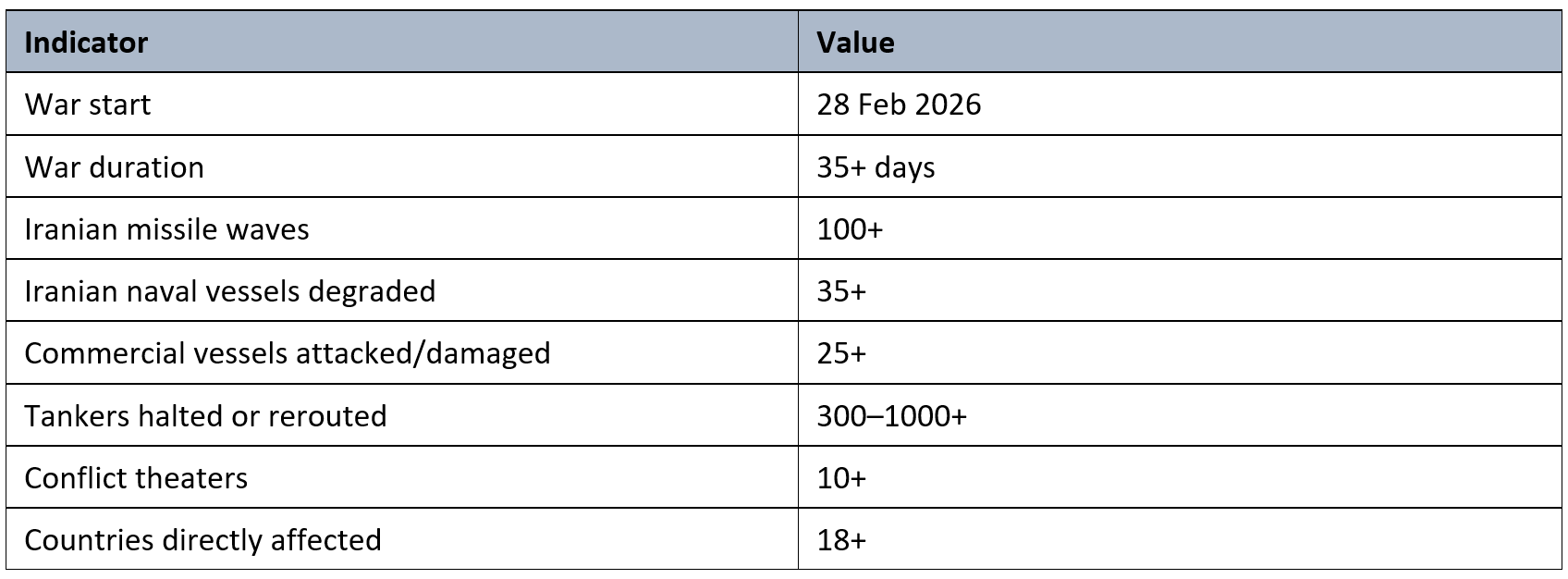
Operational Snapshot
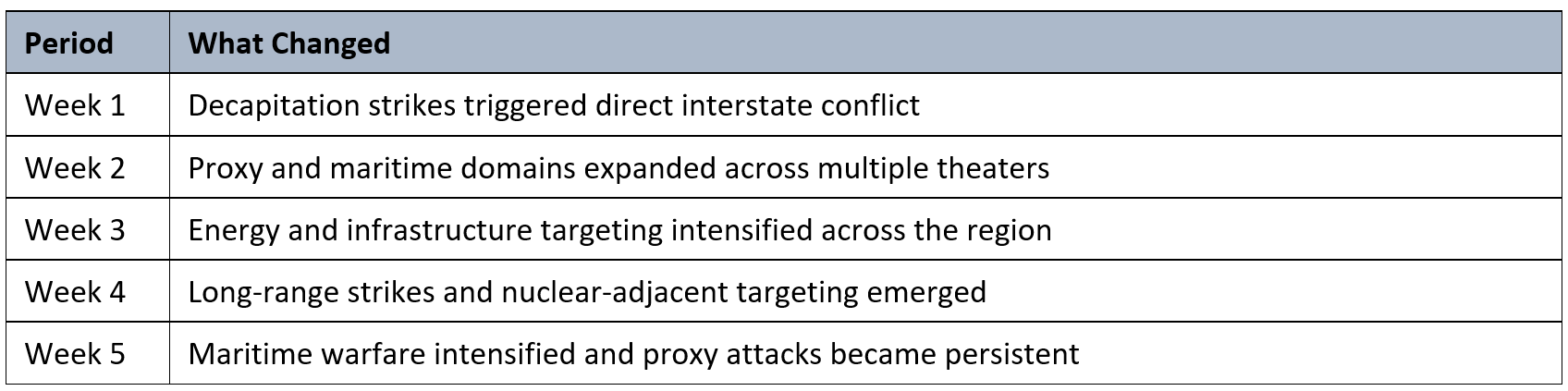
Conflict Evolution
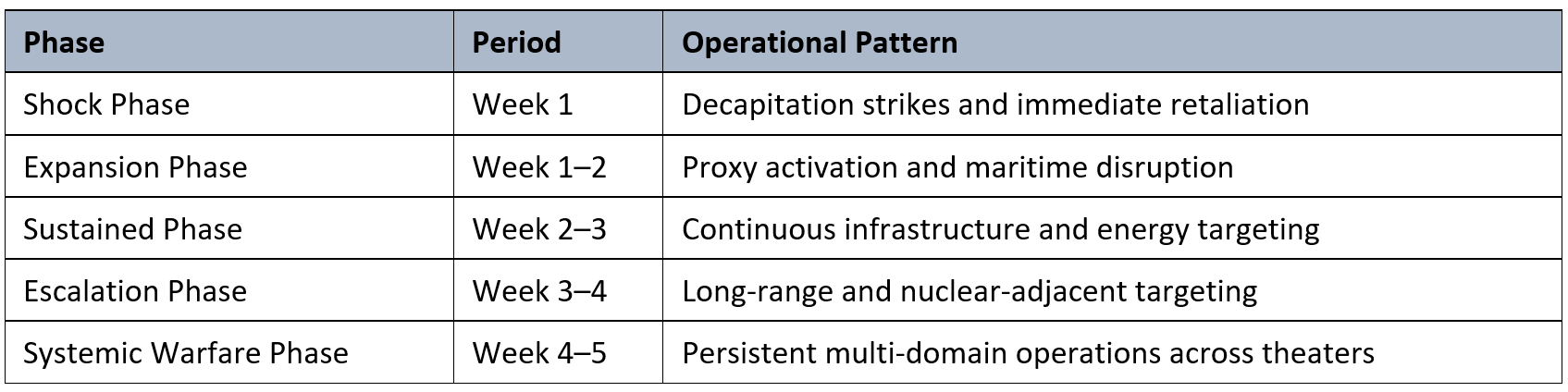
Operational Dynamics
The conflict has transitioned into a sustained, multi-domain pressure system.
• Maritime domain has become a central battlespace
Sustained vessel attacks, naval strikes, and mine-laying threats indicate a shift from disruption to continuous maritime contestation.
• Proxy warfare has evolved into a persistent operational layer
Iran-aligned groups are maintaining continuous pressure on U.S. bases, diplomatic sites, and coalition forces across multiple theaters.
• Energy systems are now shaping global economic impact
Strikes on LNG, refineries, desalination and export infrastructure are transforming the conflict into a driver of systemic economic disruption.
• Operational tempo has stabilized at high intensity
Missile waves, drone attacks and multi-front engagements indicate a continuous, non-episodic conflict pattern.
• Geographic spillover is approaching NATO periphery
Incidents near Turkish airspace, Cyprus and NATO-linked facilities increase escalation complexity beyond the core theater.
Weekly Strategic Shift
• Maritime conflict transitions into sustained battlespace
• Proxy attacks become continuous rather than episodic
• Energy targeting evolves into systemic economic pressure
• Spillover risk increases toward NATO-adjacent regions
• Operational tempo stabilizes into a continuous high-intensity baseline
Houthi Entry into Regional War
Houthi missile attacks on Israel mark a transition toward multi-front escalation. This expansion extends the operational geography beyond core state actors to include proxies. It complicates containment efforts across interconnected regional theaters.
82nd Airborne Rapid Deployment
U.S. 82nd Airborne units expand force posture toward scalable ground force readiness. This layered buildup enhances flexibility for multiple operational scenarios while maintaining ambiguity over direct engagement. It suggests a structured escalation framework preserving various response options.
UK Air Defense in Kuwait
UK deployment of the Rapid Sentry system reinforces defensive capabilities for critical infrastructure. By focusing on counter-drone systems, the UK is adapting to evolving regional threat patterns. This approach supports deterrence through protection rather than direct retaliation.
Systemic Infrastructure Targeting
U.S. strikes on transport infrastructure such as the Tehran-Karaj bridge, combined with Iranian drone attacks on desalination plants and refineries in Kuwait, indicate a shift toward targeting critical civilian systems. These actions disrupt energy, water, and mobility while increasing the risk of prolonged regional instability.
Humanitarian and Peacekeeper Exposure
Strikes affecting humanitarian infrastructure and UN personnel highlight the growing vulnerability of neutral actors. Expanding operational intensity is increasing collateral risk across non-combat entities. This reflects the erosion of protected spaces in modern conflict environments.
Kosovo Troop Deployment to Gaza
Kosovo’s participation in a U.S.-backed Gaza force reflects the expansion of multinational stabilization mechanisms. The formation of this force indicates a structured approach to managing transitional governance. Broad coalition models are emerging to manage security beyond active hostilities.
Hamas Disarmament Conditions
The sequencing dispute between withdrawal and disarmament creates a structural deadlock in Gaza. Hamas’ position ties demilitarization to territorial control, which remains mutually incompatible with Israeli prerequisites. This dynamic limits the prospects for rapid stabilization implementation.
Russian Retaliation Warning
Moscow warned that countries allowing Ukraine to use their airspace for drone strikes on Baltic energy infrastructure could become targets of retaliation. The statement follows intensified Ukrainian attacks on ports such as Ust-Luga and Primorsk, which are critical to Russia’s oil exports. By linking third-party airspace access to potential countermeasures, Russia is signaling a willingness to extend the conflict beyond direct combatants. This increases risk exposure for NATO-adjacent states indirectly supporting Ukrainian strike operations.
China-Mediated Border Negotiations
China’s mediation between Pakistan and Afghanistan aims to contain localized conflict through external diplomacy. The focus on ceasefire conditions indicates a shift toward structured de-escalation. Success depends on verifying security commitments amid persistent trust deficits.
Field Assessment
Regional stability is increasingly defined by sustained multi-theater pressure and interconnected escalation pathways. The convergence of proxy activity, infrastructure targeting, and cross-regional spillover is reducing the effectiveness of traditional containment mechanisms. Conflict dynamics are no longer geographically bounded, reinforcing a transition toward structurally persistent instability.
Energy & Maritime Security
Regional Proposals for Hormuz
Pakistan-hosted talks involving Turkey, Egypt and Saudi Arabia have introduced proposals to manage shipping through the Strait of Hormuz, including consortium-based oversight and regulated transit frameworks. These initiatives reflect an effort by regional actors to stabilize maritime flows independently of Western-led mechanisms. Their viability depends on coordination with both Iran and the United States.
Hormuz Selective Access Policy
Iran’s selective access policy introduces a conditional framework for maritime transit in the Strait. This approach redefines the chokepoint as a negotiated space for non-hostile vessels. It reflects a calibrated strategy combining economic pressure with controlled escalation.
Qatar LNG Force Majeure
Attacks on Ras Laffan have disabled significant global LNG export capacity. Long-term repairs indicate structural disruption rather than temporary outages for international energy markets. This incident represents one of the most severe disruptions to global supply chains.
Multilateral Coalition Formation
Britain has convened talks with around 40 countries to explore options for reopening the Strait of Hormuz, including naval protection and mine-clearing. The absence of concrete agreements and limited U.S. participation highlight the difficulty of forming a unified response, leaving coalition efforts at an early stage.
UN Trade Safeguard Mechanism
The UN is moving to establish a task force to maintain commercial shipping through the Strait of Hormuz, drawing on models such as the Black Sea Grain Initiative. The mechanism aims to mitigate disruptions in energy and fertilizer flows that are already affecting global food security. Its effectiveness will depend on coordination with member states and the ability to operate in a contested security environment.
Integrated Russian Energy System Targeting
Ukraine has expanded its campaign beyond export terminals to target multiple layers of Russia’s energy system. Strikes on Baltic ports such as Ust-Luga and the loss of roughly 40% of Primorsk’s storage capacity are constraining exports, while attacks on refining assets like Novo-Ufimsk are reducing domestic processing capacity. Together, these actions indicate a shift from isolated disruption to cumulative system degradation across logistics, storage, and refining.
Field Assessment
Maritime security is increasingly defined by negotiated governance and systemic infrastructure attrition. The targeting of refining hubs and chokepoints is creating structural risks for global supply stability. Multinational frameworks are replacing traditional enforcement models in contested environments.
Hybrid Threats, Cognitive Warfare & Information Operations
NATO Cognitive Warfare Integration
NATO is expanding Enhanced Vigilance Activities across the Baltic, Eastern Europe and the Arctic to address sabotage, cyber threats and infrastructure risks. These operations combine military assets with an emphasis on societal resilience, reflecting a shift toward managing hybrid threats below the Article 5 threshold.
Russian Hybrid Domain Expansion
Russian hybrid strategy integrates cyber intrusions and disinformation to shape institutional outcomes. By targeting electoral systems and public trust, these activities aim to erode societal cohesion. Narrative manipulation achieves systemic effects while remaining below conventional conflict thresholds.
European Commission Cloud Breach
A supply-chain compromise involving a stolen AWS API key enabled attackers to access European Commission cloud systems, exposing data from dozens of EU entities. The breach included tens of thousands of files containing personal and institutional information. The incident highlights vulnerabilities in shared digital infrastructure and delayed detection within interconnected government systems.
Field Assessment
Hybrid warfare is erasing the boundaries between institutional security and societal resilience. The integration of cyber and cognitive operations creates persistent risks to governance legitimacy. Societal awareness is now a front-line defense requirement for alliances.
Defense Technology, Industry & Economic Security
Ukraine-Gulf Defense Partnerships
Ukraine has signed defense cooperation agreements with Qatar and the UAE, offering expertise in air defense and drone warfare. Military specialists have been deployed to support counter-drone capabilities, strengthening Ukraine’s defense industry links with emerging Gulf security frameworks.
Industrial Attrition of Strategic Materials
Iranian strikes on aluminum smelters in the UAE and Bahrain have disrupted key production sites supplying global markets. This shifts pressure from maritime disruption to direct industrial output loss, extending the conflict into critical supply chains with longer-term economic effects.
Strike on Missile Component Production
Ukraine is targeting defense-industrial infrastructure to disrupt Russia’s long-term missile production. By focusing on upstream nodes, Kyiv aims to degrade military capacity over time. This reinforces a campaign to impose cumulative pressure across multiple sectors.
GCAP Interim Funding Bridges
The trilateral fighter program faces structural financial uncertainty despite new interim funding. Budgetary pressures in the UK may influence timelines for delivering next-generation air combat capabilities. The program represents a shift toward unified international industrial structures.
Japan Counterstrike Deterrence Shift
Japan’s integration of Tomahawk missiles marks a transition toward active counterstrike deterrence. This deployment enhances operational reach and signals a recalibration of national security doctrine. It reflects broader strategic adaptation to Indo-Pacific security dynamics.
U.S. Navy Laser Weapon Testing
The reactivation of prototype laser systems highlights a gap between technological ambition and fielded capacity. While effective against drones, scaling these directed energy systems remains a challenge. This reflects a transitional phase toward next-generation tactical maturity.
Field Assessment
Defense industrial sustainability is now a primary target in high-intensity theater conflicts. Advanced strike capabilities and specialized operational knowledge are emerging as dominant strategic assets. Industry bottlenecks represent the most critical modern security vulnerability.
Global Power Competition & Systemic Transitions
Alliance Fragmentation and Institutional Divergence
Diverging positions among NATO members are becoming operationally visible in the Iran war. France refused airspace access for Israeli aircraft carrying U.S. weapons, Italy denied U.S. use of Sigonella base, and Spain closed its airspace to conflict-related operations. These decisions reflect growing European reluctance to support operations perceived as escalatory or outside NATO’s core mandate.
Signals from Washington have introduced uncertainty into alliance commitments. Pentagon statements linking Article 5 to political discretion, combined with criticism of allied support, point to a shift toward conditional security guarantees. France has reinforced this divergence by rejecting a NATO role in the Gulf.
These fractures are also reflected in global governance structures. Divisions within the UN Security Council, particularly opposition from China and Russia to authorizing force in Hormuz, are limiting collective action. As a result, crisis response is increasingly shifting toward coalition-based or regional arrangements rather than unified institutional mechanisms.
Russian Strategic Nuclear Signaling
Russian Yars missile drills focus on maintaining the survivability of its strategic nuclear deterrent. Training for concealment and mobile response reinforces second-strike credibility during heightened tensions. These exercises serve as controlled escalation signaling within strategic competition.
Norway EU Membership Reconsideration
Norway is revisiting EU accession as a security-driven framework for the Arctic. Geopolitical competition and Russian interests are elevating the importance of deeper institutional alignment. This shift highlights how regional dynamics influence long-term political integration decisions.
Contradictions in U.S. Arctic Strategy
Misalignment between strategic intent and policy execution is undermining U.S. operational capacity in the Arctic. Disruptions to contracting ecosystems and tensions with allies risk weakening logistical and strategic positioning. This reflects structural challenges in aligning long-term geopolitical ambitions with operational realities.
NATO Force Posture in Iraq
The withdrawal of NATO personnel from Iraq reflects conflict spillover into broader coalition deployments. Relocating advisory missions to Europe indicates an increased threat perception from regional proxies. This reduction of physical presence marks a significant operational adjustment.
Field Assessment
Systemic transitions are characterized by the erosion of traditional alliance norms and institutional fragmentation. Global power competition is reshaping long-term geopolitical alignments in the Arctic and Middle East. Strategic authority is increasingly decentralizing.
Future Conflict, Climate & Humanity
Accelerated Arctic Ice Retreat
Arctic ice loss is advancing faster than projected, with declining ice volume and rising ocean temperatures accelerating seasonal melt cycles. This is opening new maritime routes while increasing competition over resources and strategic positioning in the region. At the same time, disruptions to ocean circulation and weather systems are introducing broader risks to global food security and stability.
Field Assessment
Climate stressors and the degradation of humanitarian infrastructure are redefining the human cost of conflict. Environmental shifts and the erosion of neutral protections will drive future instability. Societies must adapt to increasingly systemic non-traditional threats.
Cross-Domain Strategic Signals
Transactional Defense Alignments
The shift toward conditional basing and discretionary collective defense signals a decline in traditional alliance stability. This friction complicates regional force projection and allows adversaries to exploit gaps in unified deterrence. Security guarantees are increasingly negotiated on a crisis-by-crisis basis.
Upstream Industrial Attrition
Targeting aluminum smelters, missile plants, and refining units reflects an evolution toward direct industrial degradation. These strikes create cascading supply chain vulnerabilities that extend far beyond the immediate battlefield. National resilience is now inextricably tied to upstream production nodes.
Fragmented Maritime Governance
The emergence of UN-led initiatives and regional consortium proposals for Hormuz reflects a fragmentation of maritime security authority. The reduced centrality of the United States suggests a transition toward distributed and conditional chokepoint governance. Control of strategic waterways is increasingly negotiated rather than enforced.
What to Watch Next Week
• UN Security Council vote on Hormuz resolution
• Follow-up to Pakistan-led mediation efforts
• Expansion of U.S. force posture in the region
• Operational deployment of UK air defense in Kuwait
• Further Ukrainian strikes on Russian energy infrastructure
• Progress on maritime security coalition formation
click here to download as PDF.