This Week at a Glance:
- Iran war shifts to fragile ceasefire with fragmented fronts
- Hormuz turns into controlled maritime chokepoint
- Energy infrastructure becomes primary battlespace
- Lebanon conflict diverges from ceasefire framework
- NATO cohesion strained under U.S.–Europe divergence
- Ukraine and Russia expand energy and maritime strikes
- Hybrid threats intensify across cyber and subsea domains
- China and North Korea increase strategic signaling
Strategic Overview
The conflict environment this week shifted from rapid escalation to a fragile and conditional stabilization phase centered on a limited U.S.-Iran ceasefire. The absence of unified enforcement and diverging interpretations has prevented true de-escalation. Continued operations in Lebanon and across the Gulf indicate fragmentation into parallel theaters rather than convergence.
Energy systems have emerged as the central battlespace. Targeting of petrochemical facilities, pipelines, and maritime routes reflects a shift toward systemic economic coercion. Iran’s controlled access model in the Strait of Hormuz reinforces this dynamic, turning a global chokepoint into a managed leverage instrument.
At the systemic level, the week exposed fractures in alliance structures and global governance. Tensions within NATO, failure of UN consensus on maritime security, and the rise of unilateral or coalition-based enforcement models point to erosion of coordinated frameworks. In parallel, expanding hybrid threats and infrastructure targeting reinforce the shift toward multi-domain competition.
Research Field Analysis
Regional Conflict & Stability
Iran War – Operational Assessment (Weeks 1–6)
Key Indicators
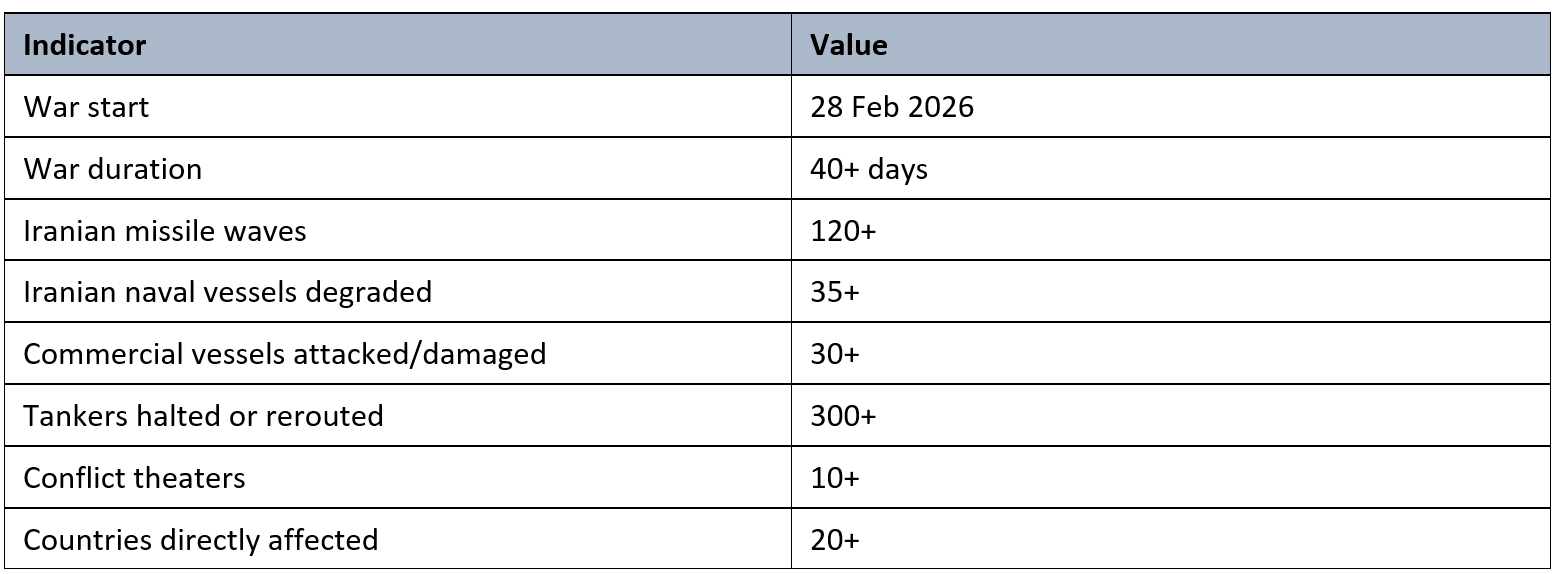
Operational Snapshot
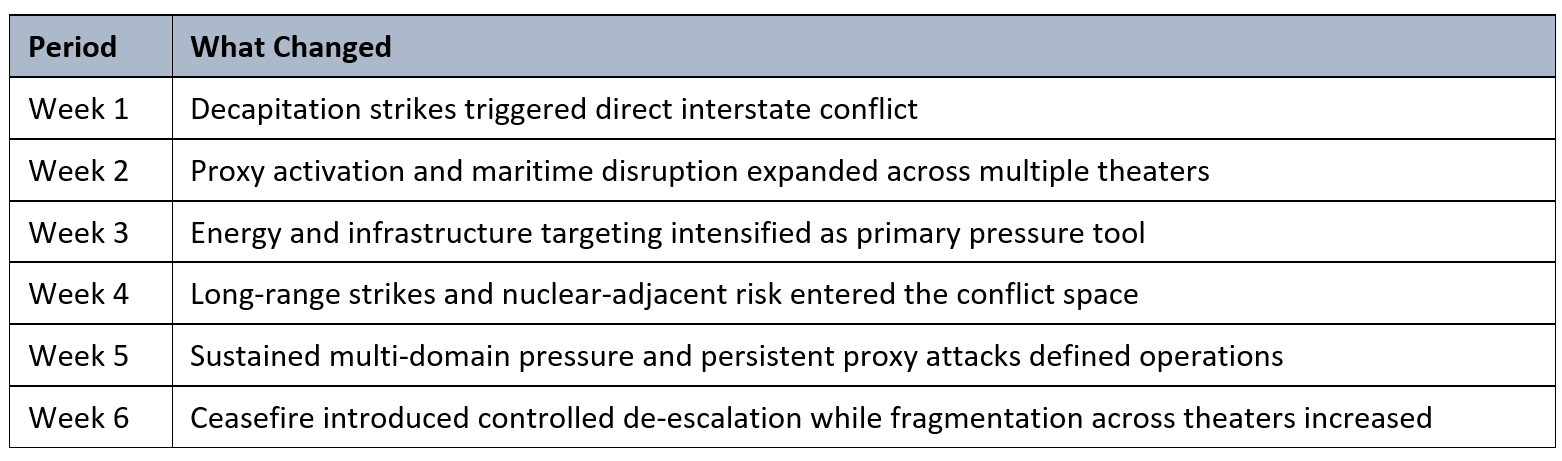
Conflict Evolution
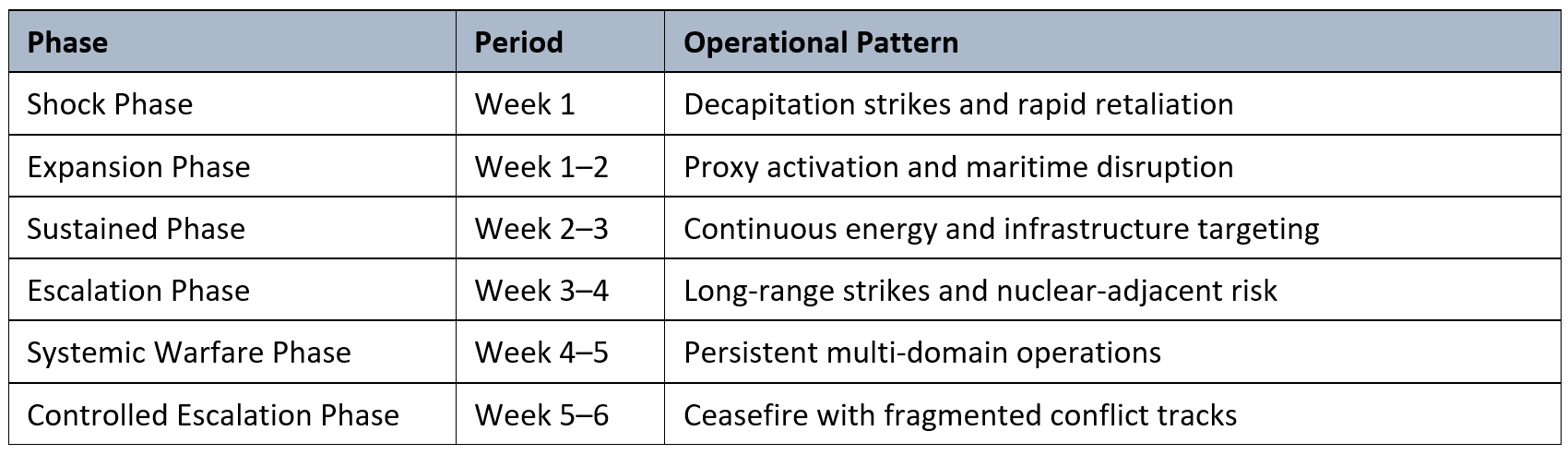
Operational Dynamics
The conflict has transitioned into a sustained, multi-domain pressure system.
- Maritime domain has become a central battlespace
Vessel attacks, naval strikes, and controlled transit regimes indicate continuous maritime contestation. - Proxy warfare has evolved into a persistent operational layer
Iran-aligned groups maintain pressure on U.S. bases, diplomatic sites, and regional assets across multiple theaters. - Energy systems have become the center of gravity
Targeting of production, refining, and export infrastructure is driving systemic economic disruption. - Operational tempo remains high despite ceasefire conditions
Missile and drone activity continues across multiple fronts. - Geographic spillover is expanding toward NATO-linked zones
Incidents near Türkiye and the Eastern Mediterranean increase escalation complexity.
Weekly Strategic Shift
- Maritime domain shifts from disruption to controlled battlespace
- Proxy attacks remain continuous across multiple theaters
- Energy warfare expands into system-wide economic pressure
- Ceasefire introduces fragmentation rather than stabilization
- Spillover risk extends toward NATO-linked zones
- Operational tempo remains high despite ceasefire conditions
Iran War – Air Domain Friction and Operational Limits
The downing of U.S. aircraft, including an F-15E and A-10, challenged assumptions of uncontested air superiority. Iranian air defenses engaged multiple platforms during strike and recovery phases. Resistance during U.S. search-and-rescue operations highlighted operational friction in contested airspace. The high-risk extraction mission exposed vulnerabilities in personnel recovery under hostile conditions.
Iran War – Fragmented Ceasefire and Parallel Conflict Tracks
The U.S.-Iran ceasefire introduced a temporary pause but failed to establish a unified framework. Diverging interpretations among the U.S., Iran, and European actors created gaps in enforcement. While Hezbollah halted attacks under its interpretation, Israel continued large-scale strikes in Lebanon. This has created parallel operational tracks, undermining mediation coherence and increasing escalation risk.
Lebanon Theatre – Escalation Beyond Ceasefire Framework
Israel’s expanded airstrikes across Beirut, the Bekaa Valley, and southern Lebanon reflect sustained pressure on Hezbollah outside the ceasefire framework. The widening scope, including civilian areas, has increased displacement and humanitarian strain. Strikes in mixed regions such as Ain Saadeh deepen internal fragmentation and sectarian tension.
Gulf Theatre – Targeting of Command Structures and Distributed Assets
The killing of IRGC intelligence chief Majid Khademi signals continued targeting of senior leadership. Iranian strikes on U.S. positions in Kuwait demonstrate the ability to target distributed assets beyond fixed bases. These attacks focused on satellite systems, munitions, and operational enablers, reflecting a shift toward command and intelligence nodes.
Iran War – Escalation Signaling and Coercive Posturing
Iran’s rejection of time-bound ceasefire proposals, combined with U.S. threats to target infrastructure, reflects coercive escalation dynamics. At the same time, U.S. strikes remained calibrated to avoid energy infrastructure. This creates a dual-track dynamic where military pressure and negotiation coexist.
Türkiye – Urban Spillover Risk
The attack near the Israeli consulate in Istanbul highlights the vulnerability of diplomatic and symbolic targets. Such incidents show how local actors exploit broader geopolitical tensions, increasing internal security risks in non-belligerent states.
South Asia – Containment Diplomacy Efforts
China-mediated talks between Afghanistan and Pakistan reflect efforts to contain regional instability. The emphasis on dialogue indicates attempts to prevent secondary crises while major powers remain focused elsewhere.
Ukraine–Russia Theatre – Tactical Truce Without Strategic Shift
The 32-hour Easter ceasefire underscores continued strategic deadlock. While both sides paused temporarily, past violations and entrenched positions limit prospects for progress. The truce reflects humanitarian signaling rather than movement toward resolution.
Field Assessment
Regional conflict dynamics are increasingly defined by fragmentation across geographic and operational dimensions. Parallel conflict tracks, particularly between the Iran core theater and Lebanon, highlight the absence of a unified framework. Expanded targeting of leadership, infrastructure, and distributed assets reflects a shift toward system-focused strategies. Spillover risks are growing, while ceasefires function as temporary pauses rather than resolution paths.
Energy & Maritime Security
Strait of Hormuz – From Blockade to Controlled Access Regime
Iran has shifted from full disruption of the Strait of Hormuz to a controlled access model. Transit remains conditional, allowing Tehran to maintain leverage over global energy flows without sustaining a full blockade. This transforms Hormuz into a managed strategic pressure point.
Gulf Theatre – Expansion of Energy Infrastructure Targeting
Strikes across the Gulf now target petrochemical facilities in the UAE, Kuwait, Bahrain, and Saudi Arabia. Key nodes such as Jubail and Asaluyeh, along with supporting systems, are being degraded. This reflects a shift toward economic warfare targeting energy production capacity. The reciprocal pattern reinforces escalation around industrial vulnerability.
Gulf Theatre – Targeting of Export Routes and Redundancy Systems
The strike on Saudi Arabia’s East-West pipeline signals a shift toward targeting alternative export routes. As a bypass to Hormuz, its disruption undermines global energy redundancy. Attacks on backup systems expand Iran’s ability to constrain flows beyond the Strait. This reflects a strategy of full-spectrum energy denial across primary and secondary pathways.
Global Maritime System – Disruption, Uncertainty, and Selective Flow
Maritime traffic through Hormuz remains reduced, with shipping operating under uncertainty. Major companies have delayed re-entry pending security clarity. Permit-based navigation has created a politically filtered maritime environment, reinforced by repeated incidents.
Ukraine-Russia Theatre – Systematic Targeting of Energy Export Infrastructure
Ukraine has intensified strikes on Russian export infrastructure, targeting Primorsk, Ust-Luga, CPC terminals, and Sheskharis. These attacks disrupt storage, loading, and pipeline operations critical to export capacity. The cumulative effect is degradation of Russia’s energy revenues and logistical resilience.
Black Sea Theatre – Integration of Maritime and Energy Targeting
Operations in the Black Sea increasingly combine military and economic objectives. Ukrainian strikes on naval assets and offshore energy infrastructure demonstrate integrated multi-domain targeting. This challenges both Russia’s naval presence and its maritime resource use. The Black Sea is evolving into a contested space linking military control and energy security.
European Maritime Domain – Militarization of Sanctions Enforcement
Russia’s use of naval escorts for sanctioned tankers signals active protection of energy flows. The UK and allies have increased monitoring and signaled readiness to interdict vessels linked to sanctions evasion. This turns enforcement into a contested maritime issue shaped by military presence. The overlap between regulation and naval operations raises confrontation risks in European waters.
Field Assessment
Energy and maritime dynamics are defined by controlled access, infrastructure targeting, and militarization of commercial flows. Hormuz has shifted into a managed chokepoint, while Gulf and pipeline strikes reflect expansion into systemic energy warfare. Energy logistics are now a central battlespace across multiple theaters.
Hybrid Threats, Cognitive Warfare & Information Operations
Iranian Cyber Operations against U.S. Infrastructure
Escalation in cyber attacks targeting PLC and SCADA systems introduces physical risk to U.S. domestic utilities. Digital operations complement kinetic theaters by exploiting operational technology vulnerabilities. This reflects the growing role of cyber in shaping modern conflict.
UK Counters Russian Undersea Infrastructure Threat
Monitoring specialized submarines near energy and communication networks highlights subsea infrastructure as a strategic vulnerability. Public disclosure serves as a gray-zone signaling mechanism for deterrence. Infrastructure protection is becoming central to national security postures.
Field Assessment
Hybrid threats are increasingly targeting operational infrastructure rather than purely digital systems. Cyber attacks on industrial control systems and monitoring of subsea assets indicate a shift toward physically disruptive outcomes. This expands the battlespace into civilian systems and increases escalation ambiguity.
Defense Technology, Industry & Economic Security
Germany Refines Military Mobility Rules
Formalizing oversight of military-age populations reflects a shift toward latent mobilization preparedness. Strengthening registration enables rapid force expansion under crisis conditions. Berlin is positioning for enhanced self-defense capacity within a voluntary framework.
Ukraine Develops Low-Cost Air Defence
Targeting interception costs below $1 million challenges the current economics of missile defense. Leveraged wartime innovation and international partnerships aim for scalable and sustainable solutions. This transition may reshape global procurement priorities for missile defense.
Gulf States Explore Low-Cost Interceptor Drones
Drone saturation warfare is driving the adoption of economically sustainable interception models. Ukrainian battlefield innovation is being marketed to address high-cost missile stockpile depletion. States are prioritizing scalable counter-drone ecosystems to maintain defense viability.
North Korea Tests Cluster Warheads and EW
Emphasis on low-cost, mass-producible systems indicates adaptation to modern asymmetric conflict patterns. Developing tools for electromagnetic disruption and infrastructure denial expands deterrence models beyond nuclear reliance. This complicates defense planning for technologically dependent militaries.
Field Assessment
Defense industrial sustainability is becoming a central strategic factor. Innovation is decentralizing production and readiness models, while industrial bottlenecks remain a critical vulnerability in high-intensity conflict.
Global Power Competition & Systemic Transitions
Transatlantic Alliance – Strain Under External Conflict Pressure
The Iran war has exposed growing tensions within NATO over burden-sharing and operational scope. U.S. pressure on European allies to support Gulf operations has met limited response, raising questions about cohesion. Disputes over airspace, basing, and participation indicate a shift toward more conditional collective defense. This weakens predictability and accelerates debates on European strategic autonomy.
Global Governance – Breakdown of Consensus on Maritime Security
The failure of the UN Security Council to adopt a framework for securing the Strait of Hormuz highlights divisions among major powers. Russia and China’s veto reflects resistance to Western-led enforcement mechanisms. Maritime security is increasingly shaped by unilateral or coalition-based initiatives, reducing the effectiveness of global governance structures.
Russia–Iran Alignment – Operational Integration Beyond Formal Alliance
Russian satellite surveillance supporting Iranian targeting, alongside cyber cooperation, indicates growing operational integration. Intelligence-sharing on military bases and energy infrastructure suggests coordination to enhance strike effectiveness. This alignment operates below formal alliance thresholds but increases operational complexity across multiple theaters.
Economic Statecraft – Expansion of Trade-Based Coercion Tools
The U.S. move to impose potential 50% tariffs on countries supplying Iran expands economic tools within strategic competition. By linking trade access to security alignment, Washington extends deterrence into the economic domain. This approach aims to shape third-party behavior but risks friction with major economies and existing trade frameworks.
China Strategy – Dual-Track Pressure on Taiwan
China’s increased naval deployments in the South and East China Seas signal sustained military pressure around Taiwan. At the same time, Beijing maintains political engagement with Taiwan’s opposition, promoting cooperation narratives. This dual-track approach combines military presence with political influence to shape the environment without direct escalation.
Middle Power Positioning – Türkiye and Regional Security Integration
Ukraine’s growing security cooperation with Türkiye reflects an emerging pattern of middle power alignment. Kyiv leverages battlefield experience, particularly in drone warfare, while Türkiye emphasizes maritime security in the Black Sea. This cooperation highlights how mid-tier actors are shaping regional security frameworks beyond traditional alliances.
Field Assessment
Global competition is increasingly defined by fragmented alliances, erosion of multilateral governance, and hybrid alignment structures. Economic tools, intelligence cooperation, and persistent military signaling are expanding the competitive toolkit, reflecting a shift toward a decentralized global order.
Future Conflict, Climate & Humanity
Bangladesh Launches Mass Vaccination Campaign
The measles outbreak illustrates systemic vulnerabilities in public health capacity in resource-constrained environments. Rapid spread and healthcare overcrowding turn health disruptions into broader humanitarian stressors. Coordinated international intervention is required for containment.
Iran Warns of Nuclear Risk near Bushehr
Strikes near operational nuclear infrastructure introduce radiological risks into conventional conflict. Repeated incidents increase the probability of cascading failures affecting environment and population centers. This challenges existing frameworks for infrastructure protection and international oversight.
Field Assessment
Future conflict is increasingly shaped by the intersection of conventional operations with radiological risks and public health shocks. These dynamics expand conflict beyond traditional military domains and challenge societal resilience.
Cross-Field Strategic Signals
Fragmented Ceasefire Architecture
The divergence in how the U.S., Iran, Israel, and European actors interpret the scope of the ceasefire highlights the absence of a unified conflict management framework. Rather than stabilizing the conflict, the agreement has produced parallel operational tracks, particularly in Lebanon. This fragmentation reduces the effectiveness of mediation and increases the likelihood of localized escalation despite formal de-escalation mechanisms.
Chokepoint Governance as Strategic Leverage
The transition from full disruption to controlled access in the Strait of Hormuz signals a structural shift in how maritime chokepoints are used in conflict. By regulating transit through permits and volume caps, Iran has transformed a global commons into a managed leverage system. This model may set a precedent for future conflicts where access, rather than denial, becomes the primary tool of coercion.
Expansion of Energy Warfare into Systemic Layer
The targeting of petrochemical hubs, export pipelines, and supporting infrastructure across multiple regions reflects a shift from isolated strikes to systemic energy warfare. Both primary and backup export routes are now contested, indicating that energy logistics networks themselves have become central battlespace components rather than supporting structures.
Militarization of Commercial and Civil Infrastructure Domains
The use of naval escorts for sanctioned shipping, combined with increased threats to subsea infrastructure and cyber targeting of industrial systems, reflects a broader trend of militarization across traditionally civilian domains. Commercial shipping, energy systems, and digital infrastructure are increasingly integrated into conflict dynamics, raising the risk of escalation beyond conventional military boundaries.
What to Watch Next Week
- U.S.-Iran ceasefire talks begin in Islamabad.
- Iran to implement and enforce Hormuz transit limits.
- Israel may open talks with Lebanon on Hezbollah disarmament.
- U.S.-Europe consultations on NATO tensions intensify.
- Ukraine-Russia Easter ceasefire outcome to be determined.
click here to download as PDF.