

Key Points :
- Germany’s defense credibility is likely to be tested through maritime resilience.
- Germany’s ability to sustain allied movement could shape NATO readiness.
- The Baltic-North Sea corridor is becoming Europe’s quiet stress line.
- EU tools matter most where military speed alone is insufficient.
- Ambiguous maritime incidents could become the main escalation trigger.
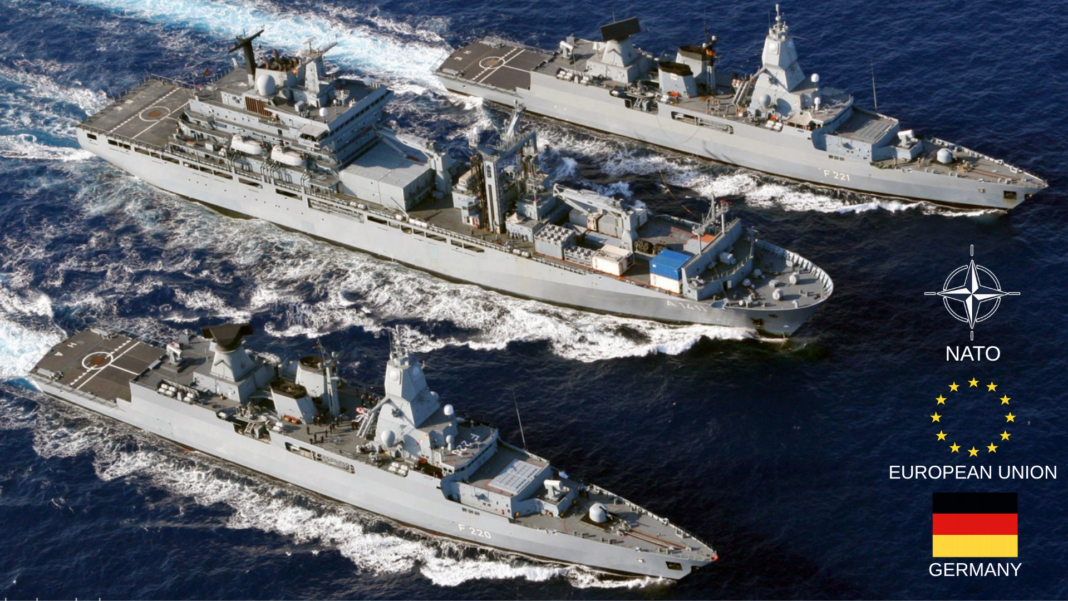
Germany’s new defense concept will be tested less by the document itself than by what happens around ports, cables, energy terminals and NATO-EU coordination under pressure. A crisis in the Baltic or North Sea would not begin as a conventional battlefield problem. It could start with damaged infrastructure, suspicious vessel behaviour, a cyber disruption at a port or delayed military movement through civilian transport networks. That is why the maritime domain matters. Germany’s role is no longer only to generate forces for NATO, but to connect military readiness with infrastructure resilience, industrial depth and credible crisis management at sea.
The Overall Concept of Military Defense, announced in April 2026, was presented as the publicly accessible part of the Bundeswehr’s first military strategy and the force plan derived from it.1 Reuters reported that Germany kept its target of 260,000 active-duty soldiers and a total force structure of 460,000 personnel, including 200,000 reservists.2 Defense Minister Boris Pistorius described the concept as a “living document”, a formulation that matters because Germany is trying to move from static force planning towards an adaptable posture shaped by NATO readiness requirements, European industrial constraints and infrastructure exposure.
Seen from the coast, the concept becomes more concrete. Germany’s security now depends on the ability to move allied forces, protect maritime infrastructure, sustain energy flows and maintain civilian-military coordination under stress. The Baltic-North Sea corridor is therefore not a side issue. It is the most plausible near-term arena in which the new defense posture will be tested.
Russia’s war against Ukraine restored a basic lesson to European defense planning: modern warfare is sustained not by advanced platforms alone, but by stockpiles, maintenance capacity, ammunition, spare parts, logistics and trained personnel. Royal United Services Institute (RUSI)’s early assessment highlighted the intensity of consumption and the pressure on sustainment in prolonged conflict.3 Buying new systems is only one part of readiness; platforms must be supplied, repaired and operated through a long crisis.
The lesson is also maritime. In the Black Sea, coastal missiles, naval drones and commercial sensor networks have shown that large platforms can be constrained by layered surveillance and precision strike. The Baltic differs in depth, geography and NATO presence, but the pattern of low-signature, sensor-based operations carries directly across to confined-sea security.
For Berlin the more concrete lesson is closer to home. Between October 2023 and December 2025, the Baltic Sea saw a recurring pattern of damage to undersea cables and pipelines: the Balticconnector incident linked to the Chinese-flagged Newnew Polar Bear in October 2023, the severing of the BCS East-West (Baltic Cable System East-West) and C-Lion1 cables by the Yi Peng 3 in November 2024, and the Estlink 2 power cable damaged by the Cook Islands tanker Eagle S on Christmas Day 2024. The Finnish boarding of the Eagle S, and the subsequent seizure of the Fitburg in late December 2025, mark a shift towards more assertive coastal-state action.5 Each case carries a different attribution problem: a third-country flag complicating state responsibility, anchor-dragging that can be framed as accident, and shadow-fleet linkages that blur the line between commercial and hybrid activity. These are the patterns Germany’s defense concept will be measured against, not the textbook scenarios of conventional war.
Germany’s concept broadly aligns with NATO and the European Union, but the two institutions impose different kinds of pressure. NATO’s recent planning focuses on readiness, force generation, deterrence and the defense of the eastern flank. The Vilnius Summit Communiqué identified regional defense plans as a central driver of NATO force organisation, while the NATO Force Model seeks a larger and more ready pool of forces.6,7 This makes Germany not only a combat contributor but also a transit, reception and sustainment hub between Western Europe and the eastern flank – a function tested under realistic conditions during Steadfast Dart 2026 in February 2026.8
The EU’s role is different. It does not provide a NATO-style operational command chain. Its contribution lies in defense industry, joint procurement, cyber resilience, critical infrastructure protection and military mobility – building capacity through legal, industrial and financial tools rather than operational command.9,10,11
This division can be useful, but it is not automatically harmonious. NATO demands speed in a crisis. The EU builds capacity through slower legal, industrial, financial and regulatory tools. Germany’s practical challenge is to make these timelines compatible. If a cable is damaged in the Baltic, NATO may increase surveillance and patrols quickly. The EU may respond through sanctions, port-state controls, insurance pressure, infrastructure repair and legal mechanisms. The operational problem for Berlin is to connect both tracks without delaying response or over-militarising a commercial maritime space.
A reasonable objection is that Germany’s primary defense test lies on land rather than at sea. The permanent stationing of Panzerbrigade 45 in Lithuania, the first standing deployment of a German combat brigade abroad since 1945, points to the eastern flank as the centre of gravity. Yet the maritime domain is precisely what binds that commitment together. Reinforcement, sustainment and ammunition flows for the eastern flank pass through North Sea and Baltic ports, German rail corridors and energy infrastructure exposed to the same vessels and seabed routes that have already produced repeated incidents. The land mission cannot be separated from the maritime conditions that enable it.
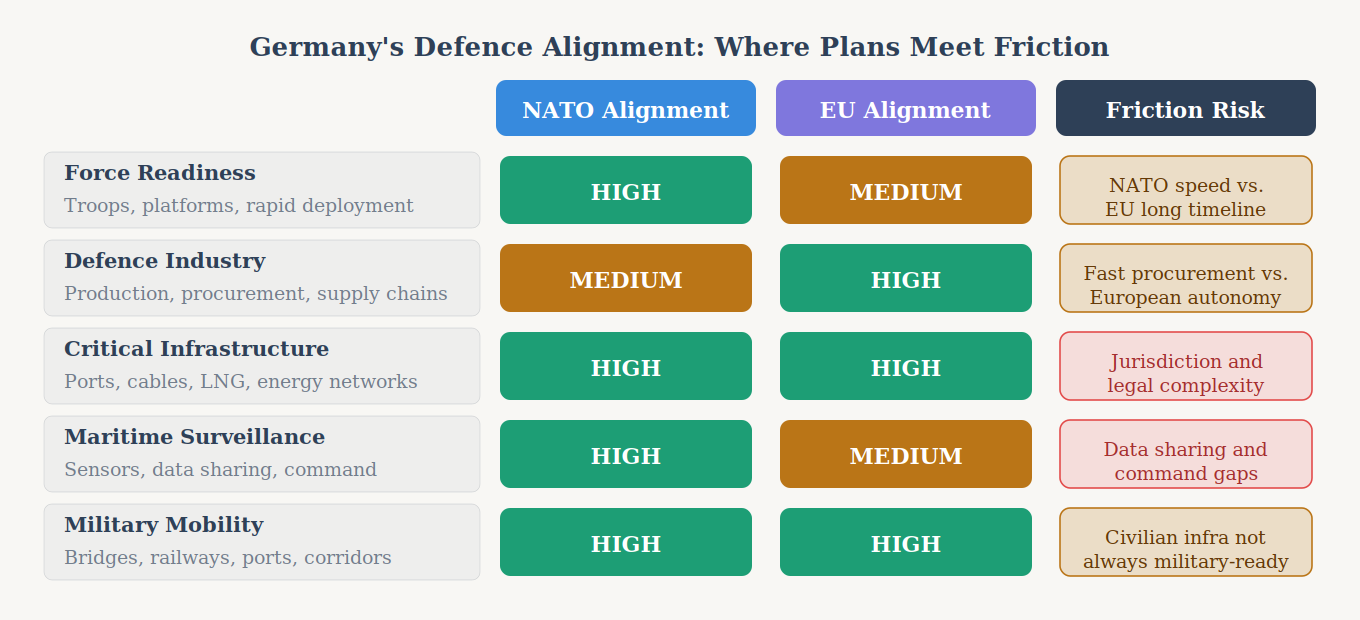
The central question is not whether Germany recognises the problem, but whether it can convert recognition into usable capacity. Maritime resilience requires more than naval presence: it depends on enabling layers that span surveillance, port readiness, cyber resilience, ammunition depth and rapid information sharing with allies and private operators. Without these layers, higher defense spending and larger force targets may improve readiness on paper while leaving operational bottlenecks unresolved.
Germany has begun to strengthen some of these enabling layers, but the scale of demand remains larger than any single programme. The German Navy has ordered eight P-8A Poseidon maritime patrol aircraft, with the first aircraft handed over in 2025, to improve maritime surveillance and anti-submarine capability for NATO tasks in the North Atlantic and Baltic Sea.12 Germany is also expanding its K130 corvette force, with the fifth ship of the second batch christened in April 2026, a class suited to coastal reconnaissance and maritime target engagement in the North and Baltic Seas.13 The longer-term F126 frigate programme has slipped to a 2031 delivery date, with a parallel MEKO A-200 procurement approved as a bridging measure.14,15 Industrial integration and shipyard capacity remain binding constraints even when political will and funding exist. Programme commitments do not remove the near-term pressure on crews, mine countermeasures, port readiness and information-sharing networks.
The gaps that matter most in the near term are less visible: mine countermeasure capacity suited to the Baltic’s confined and infrastructure-heavy waters, port readiness for military reception and logistics under pressure, secure information sharing with allied and civilian operators, cyber resilience across port digital systems and energy terminals, and the munitions depth needed to sustain operations through a prolonged crisis.
Russia has been the explicit threat reference in the German concept, and the Baltic operational picture reflects that directly. Russian submarines have conducted intelligence-gathering runs near the Gotland gap and at the entrance to the Gulf of Finland, while unmanned aerial vehicles have repeatedly violated airspace over German and Swedish coastal installations. AIS manipulation – vessels switching off transponders or broadcasting false positions – has been documented repeatedly in the shadow fleet operating in Baltic waters. These activities do not individually cross the threshold of armed attack, but they probe surveillance coverage, test response times and erode the distinction between commercial and military activity that NATO’s legal response architecture depends on.16
The Baltic Sea is the clearest operational test. Finland and Sweden’s accession to NATO changed the regional geometry without removing risk in narrow, crowded and infrastructure-heavy waters. NATO’s Baltic Sentry, launched in January 2025, reflects this shift by increasing presence, surveillance and undersea infrastructure security.17
Kaliningrad sits at the centre of Baltic operational planning in a way that Germany’s concept does not address openly. Russia’s Baltic Fleet, based at Baltiysk, is the primary naval force in the theatre, but it operates within a strategic enclave that NATO planners must either neutralise or contain early in any escalation. The Gulf of Finland narrows to a chokepoint where mining by Finnish or Estonian forces could seal the exit for Russian surface units, limiting the fleet’s ability to threaten NATO reinforcement lines or Baltic port approaches. For German planners, Kaliningrad also constrains land-based reinforcement: the Suwalki corridor linking Poland and Lithuania runs directly between the enclave and Belarus, making it the most compressed vulnerability in NATO’s eastern posture. Any serious Baltic maritime planning for Germany involves holding these variables simultaneously – and the concept’s silence on Kaliningrad suggests either deliberate restraint or an area where classified planning carries the weight.18
The North Sea plays a different role. It connects Germany’s energy transition, offshore infrastructure, LNG terminals and port access. As Germany reduces dependence on Russian gas, North Sea energy flows become part of national resilience. The vulnerability profile of LNG terminals along the North Sea coast has been assessed as a strategic chokepoint in European energy security, with physical, digital and maritime risks converging at the same coastal nodes.19 Ports become the bridge between the two seas: in crisis they would not only keep trade moving but also support force reception, refuelling, repair, ammunition handling and civil-military traffic management.
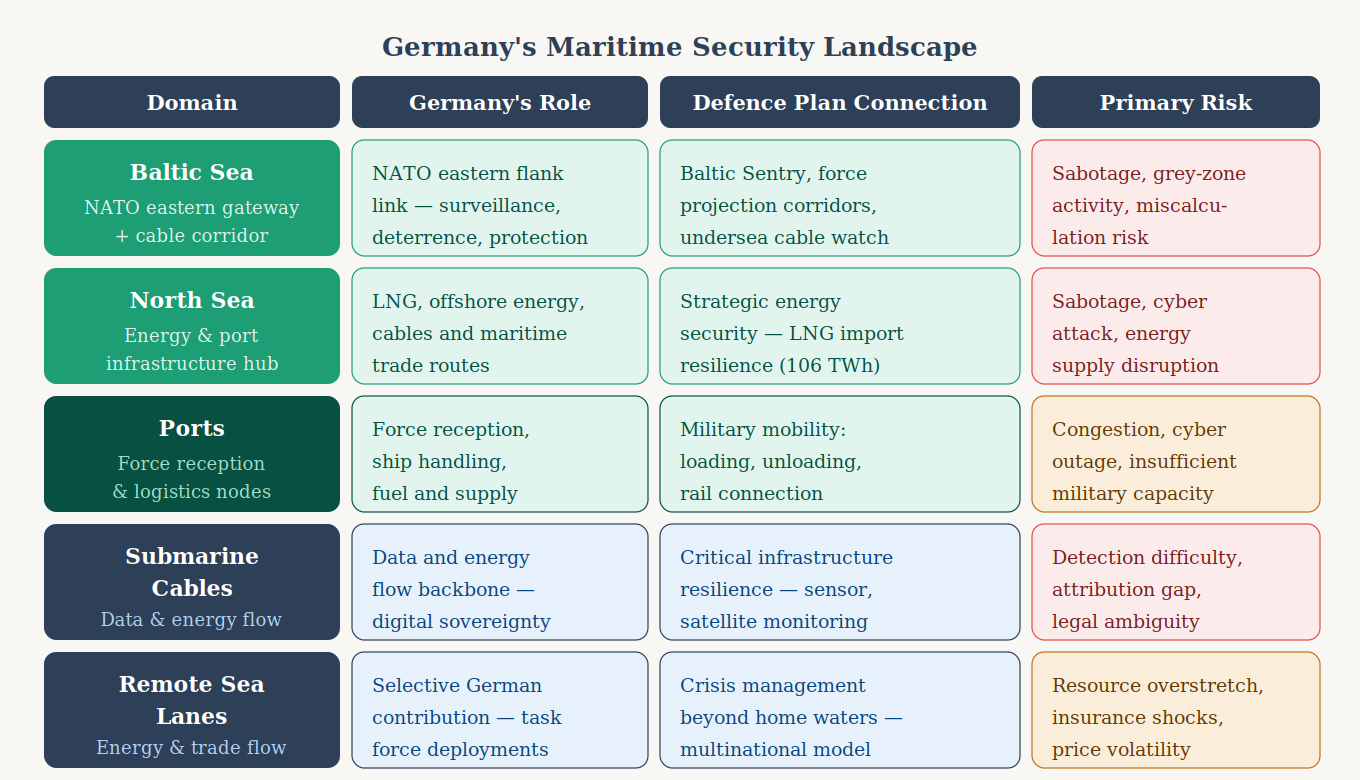
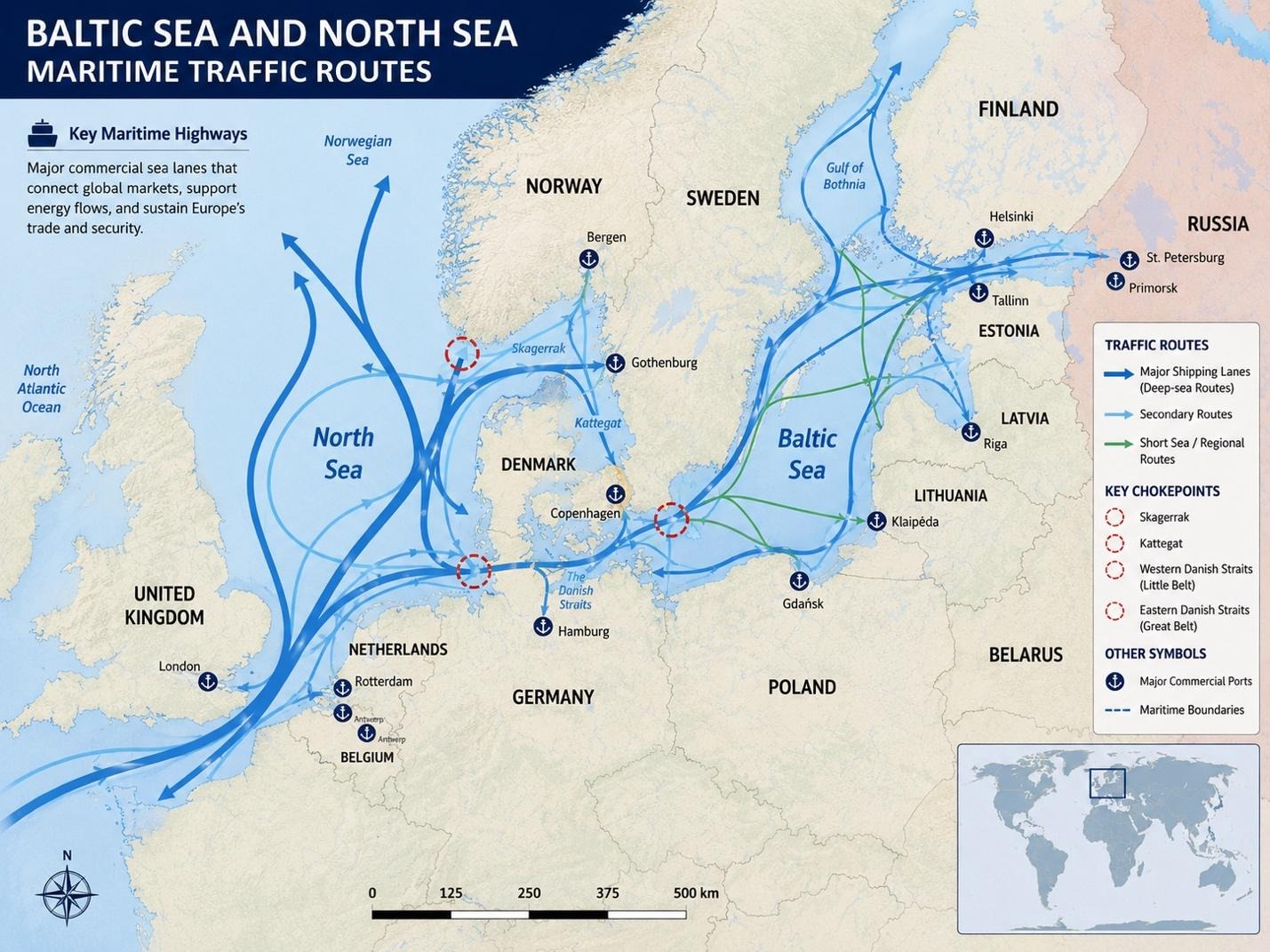
The plausible trajectory is sustained, controlled pressure rather than abrupt military rupture. The critical variable is not the scale of any single incident but what follows it – the gap between the speed of military signalling and the slower legal-economic machinery the EU can bring to bear.
Russia has several tools available to test Germany and its Baltic neighbours without crossing into open conflict. Hypersonic missiles – including Oreshnik-class systems – can reach Baltic port infrastructure and energy terminals within minutes of launch, compressing decision time to near zero and rendering traditional air-defense layering insufficient at current NATO densities in the region. Swarm drones and loitering munitions have been used extensively in Ukraine to saturate defensive systems and strike fixed infrastructure; the same logic applies to LNG terminals, port cranes and communication nodes. Unmanned surface vessels offer a low-attribution option for cable interference or port approach probing. Taken together these capabilities form a hybrid toolkit designed not necessarily to destroy but to create persistent uncertainty, delay response and exhaust surveillance and interception assets over time.20
Three scenarios illustrate how that gap could widen or be managed. They are not mutually exclusive and could overlap in a prolonged period of sub-threshold pressure.
In a managed deterrence scenario, NATO presence in the Baltic and North Sea increases gradually through Baltic Sentry-style patrols, while the EU strengthens port-state controls and infrastructure repair frameworks. The mechanism is sustained signalling without a defining incident; the stake is whether NATO and EU instruments move on compatible timelines.
An infrastructure incident scenario begins with damage to a cable, pipeline or port system under attribution-resistant conditions, similar in pattern to the Estlink 2 or BCS East-West cases. The mechanism is a contested investigation running on a slower timeline than the public demand for response. The stake is the credibility of the response architecture itself.
In a maritime overstretch scenario, repeated incidents combine with elevated NATO surveillance, exercises such as Steadfast Dart and a sustained shadow-fleet presence to push German naval capacity, port readiness and mine countermeasure assets beyond planned tempo. The stake is whether the gap between platform availability and operational demand can be closed by allied burden-sharing before it produces visible failures.
Table 1: Possible Maritime Security Scenarios
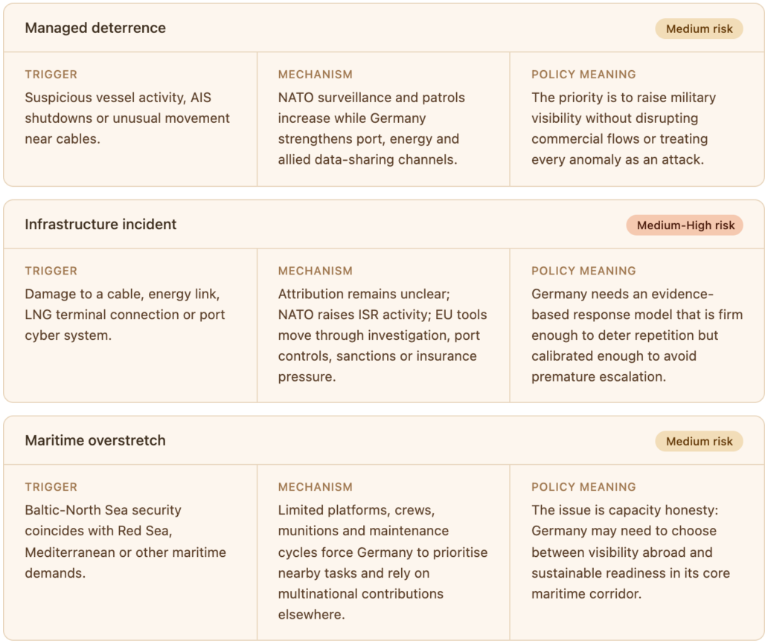
The escalation risk in each scenario moves through the same underlying chain: damage occurs, attribution remains contested, military and legal-economic responses run on different timelines, and a denial or counter-signal from the responsible party arrives before technical evidence is complete. Treating every incident as a deliberate military attack would be dangerous. Treating repeated incidents as routine coincidence would be equally risky. Germany’s task is to help build a response architecture that holds both risks in view at the same time.
The practical control points are specific. The German Navy needs surveillance discipline, mine warfare readiness and clear protocols for operating near commercial shipping lanes. Civilian authorities need legal attribution frameworks, port-state authority and secure communication channels with private operators. NATO and the EU need to close the gap between military signalling speed and legal-economic response time – arrangements that must be in place before a crisis, not negotiated during one.
Germany’s Overall Concept of Military Defense is, by design, a politically manageable document. It does not name NATO’s internal fractures, does not engage with the question of European strategic autonomy, and does not acknowledge that the Greenland episode revealed something structural – that a Europe built to deter Russia in the east has no ready answer when pressure arrives from a different direction, or from within the Alliance itself. That restraint may be deliberate. Germany may be navigating the first stage of a deeper strategic shift, keeping the document light enough to avoid domestic and allied friction while laying the groundwork for what comes next. If that reading is correct, the real test is not whether Germany delivers on what the concept says, but whether it can move credibly toward what the concept has chosen not to say.
The concept represents a genuine shift, but its credibility will be decided by coordination rather than ambition. The maritime domain brings the core pressures together: NATO’s demand for speed and readiness, the EU’s slower industrial and legal tools, the sustainment lessons drawn from Ukraine, and the strategic vulnerability of ports, cables and energy terminals. A Germany that links these layers in practice – connecting surveillance with evidence standards, platform investment with port readiness, and military signalling with calibrated legal response – can function as a real hub for European security. If those connections remain on paper, the concept will be remembered as a well-timed document rather than a turning point. The test is already under way, and it is visible at sea.
- German Federal Ministry of Defence. The Overall Concept of Military Defence: Military Strategy and Plan for the Armed Forces, Responsibility for Europe. Bundeswehr, 2026. Accessed 7 May 2026. https://www.bmvg.de/resource/blob/6093998/678875025812878cfa657f9801f62ffc/dl-gesamtkonzeption-der-verteidigung-eng-data.pdf
- Reuters. “Germany unveils military strategy, sticks to troop target.” 22 April 2026. Accessed 7 May 2026. https://www.reuters.com/business/aerospace-defense/germany-unveils-military-strategy-sticks-troop-target-2026-04-22/
- Royal United Services Institute. Mykhaylo Zabrodskyi, Jack Watling, Oleksandr V. Danylyuk and Nick Reynolds. Preliminary Lessons in Conventional Warfighting from Russia’s Invasion of Ukraine: February-July 2022. 30 November 2022. Accessed 7 May 2026. https://www.rusi.org/explore-our-research/publications/special-resources/preliminary-lessons-conventional-warfighting-russias-invasion-ukraine-february-july-2022
- Center for Strategic and International Studies. Lessons from the Ukraine Conflict: Modern Warfare in the Age of Autonomy, Information and Resilience. Accessed 7 May 2026. https://www.csis.org/analysis/lessons-ukraine-conflict-modern-warfare-age-autonomy-information-and-resilience
- Reuters via gCaptain. “Timeline of Suspected Underwater Sabotage in Baltic Sea.” 2 January 2026. Accessed 10 May 2026. https://gcaptain.com/timeline-of-suspected-underwater-sabotage-in-baltic-sea/
- NATO. Vilnius Summit Communiqué. 11 July 2023. Accessed 7 May 2026. https://www.nato.int/en/about-us/official-texts-and-resources/official-texts/2023/07/11/vilnius-summit-communique
- NATO. NATO Force Model. Accessed 7 May 2026. https://www.nato.int/en/what-we-do/deterrence-and-defence/nato-force-model
- Bundeswehr. “Steadfast Dart 2026.” 20 February 2026. Accessed 10 May 2026. https://www.bundeswehr.de/en/mission-and-tasks/exercises/steadfast-dart-2026
- Council of the European Union. A Strategic Compass for Security and Defence. Accessed 7 May 2026. https://www.consilium.europa.eu/en/policies/strategic-compass/
- European Commission. White Paper for European Defence Readiness 2030. Accessed 7 May 2026. https://defence-industry-space.ec.europa.eu/eu-defence-industry/white-paper-european-defence-readiness-2030_en
- European Commission. “First-ever European Defence Industrial Strategy to enhance Europe’s readiness and security.” 5 March 2024. Accessed 7 May 2026. https://commission.europa.eu/news-and-media/news/first-ever-european-defence-industrial-strategy-enhance-europes-readiness-and-security-2024-03-05_en
- Naval News. “Boeing Delivers First P-8A Poseidon Maritime Patrol Aircraft to Germany.” 6 October 2025. Accessed 7 May 2026. https://www.navalnews.com/naval-news/2025/10/boeing-delivers-first-p-8a-poseidon-maritime-patrol-aircraft-to-germany/
- Naval Today. “German Navy christens fifth and final K130 Batch II corvette.” 30 April 2026. Accessed 7 May 2026. https://www.navaltoday.com/2026/04/30/german-navy-christens-fifth-and-final-k130-batch-ii-corvette/
- Damen. “Introducing the F126 Frigate Project.” Accessed 7 May 2026. https://www.damen.com/vessels/defence-and-security/custom-built-combatants/introducing-the-f126-frigate-project
- Naval News. “Latest situation regarding F126 and MEKO Frigate Projects in Germany.” 30 January 2026. Accessed 10 May 2026. https://www.navalnews.com/naval-news/2026/01/latest-situation-regarding-f126-and-meko-frigate-projects-in-germany/
- NATO Maritime Command (MARCOM). Baltic Sea Security: Russian Submarine and UAV Activity in the Baltic Region. NATO, 2024. Accessed 13 May 2026. https://mc.nato.int/missions/baltic-sea-security
- NATO. “NATO launches Baltic Sentry to increase critical infrastructure security.” 14 January 2025. Accessed 7 May 2026. https://www.nato.int/en/news-and-events/articles/news/2025/01/14/nato-launches-baltic-sentry-to-increase-critical-infrastructure-security
- Center for Strategic and International Studies. Kaliningrad: Russia’s Baltic Stronghold and NATO’s Planning Dilemma. CSIS, 2023. Accessed 13 May 2026. https://www.csis.org/analysis/kaliningrad-russias-unsinkable-aircraft-carrier
- Sümer, Mehmet. “LNG Terminals as Europe’s Most Vulnerable Strategic Nodes.” Defense Domain, 21 April 2026. Accessed 8 May 2026. https://defensedomain.com/lng-terminals-europes-vulnerable-nodes/
- International Institute for Strategic Studies. The Military Balance 2024: Chapter Four – Russia and Eurasia. IISS, 2024. Accessed 13 May 2026. https://www.iiss.org/publications/the-military-balance
click HERE to download as PDF.