Key Points:
• GCASC–Lebanon deal reshapes Eastern Mediterranean dynamics
• Lebanon’s internal fragility enables Greek Cypriot leverage
• US–EU backing strengthens Greek Cypriot legal positioning
• Emerging alignments target Türkiye’s Blue Homeland doctrine
• Agreement aims to narrow Türkiye’s negotiation space
Summary
This article examines the geopolitical background of the Exclusive Economic Zone (EEZ) Boundary Agreement signed between the Greek Cypriot administration of Southern Cyprus (GCASC)1 and Lebanon on 25/26 November 2025, as well as its implications for ongoing maritime jurisdiction disputes in the Eastern Mediterranean. The agreement, originally drafted in 2007, was finalized after an 18-year deadlock due to multilayered factors, including Lebanon’s fragile economy and political structure, the EU’s search for energy security, and perceived shifts in regional power balances.
Maritime Jurisdiction and Legal Framework
Definition of an Exclusive Economic Zone (EEZ)
Regulated under the 1982 United Nations Convention on the Law of the Sea (UNCLOS), the EEZ is a relatively new concept in international maritime law. It refers to a sea zone beyond and adjacent to a state’s territorial waters, where the coastal state has exclusive rights over economic activities. The EEZ may extend up to 200 nautical miles (approximately 370 km) from the baselines from which territorial waters are measured. Within this zone, states possess sovereign rights to explore, manage and exploit natural resources, both living and non-living, on the seabed, subsoil, and water column (e.g., oil, gas, fisheries).
When EEZs overlap between adjacent or opposing coastal states, boundaries are typically determined through agreements based on equitable solutions or the median line principle. Treaty-based delimitation is considered the norm.
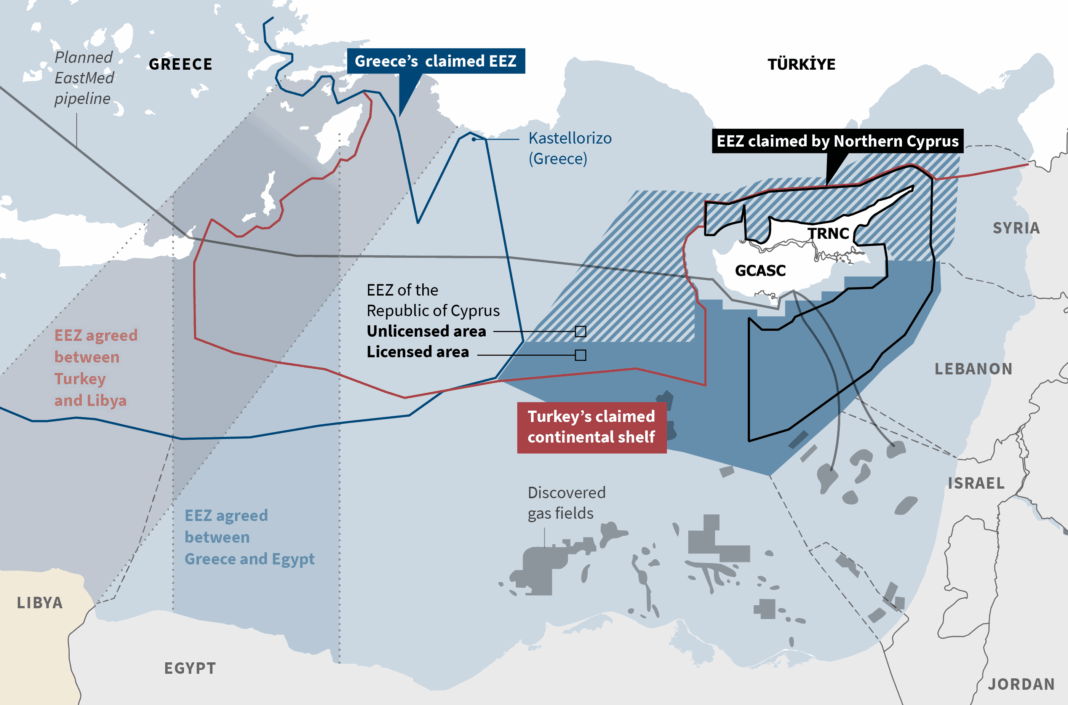
However, Türkiye is not a party to UNCLOS. The primary reason lies in long-standing disputes with Greece in the Aegean Sea. Numerous Greek islands located close to the Turkish mainland are seen as a strategic advantage for Greece, whereas for Türkiye they create a geographical disadvantage. Türkiye argues that maritime boundaries should not be determined solely by median line calculations, but rather must reflect equitable principles and the natural prolongation of the continental shelf.
At the core of the Eastern Mediterranean dispute lie two key landmasses: the island of Kastellorizo (Meis) and Cyprus.
Positions of the Parties
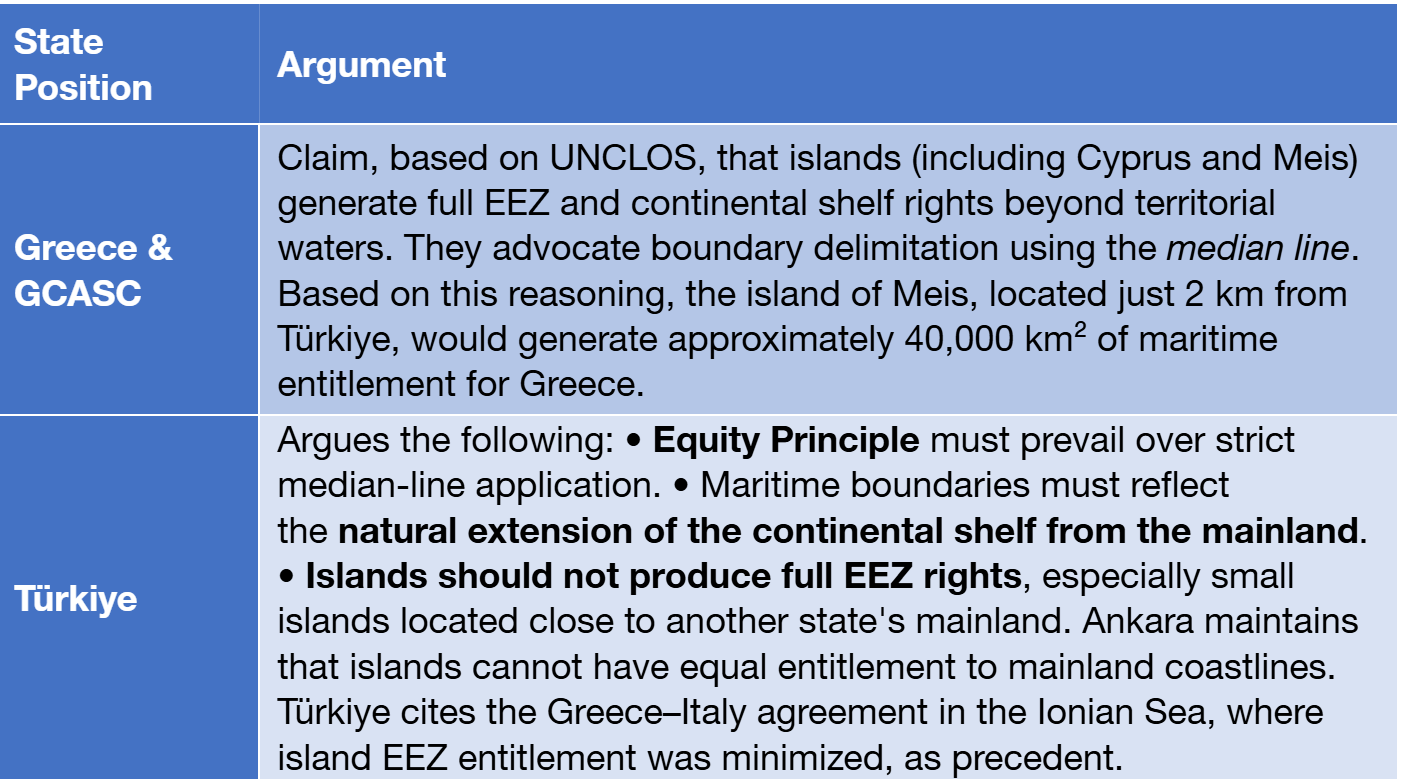
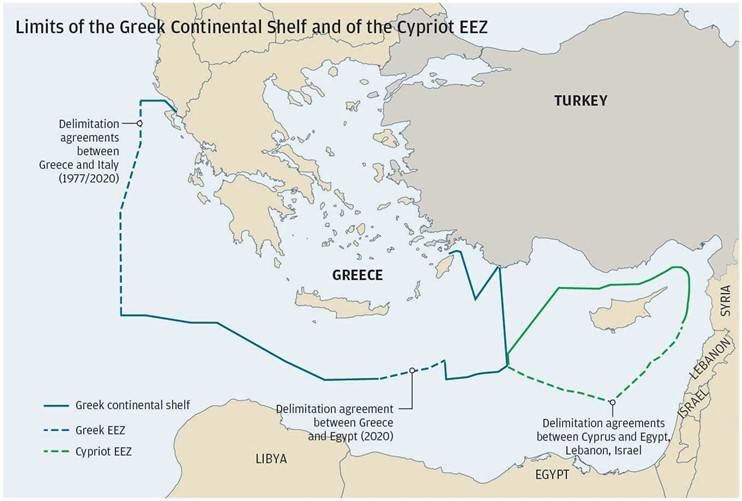
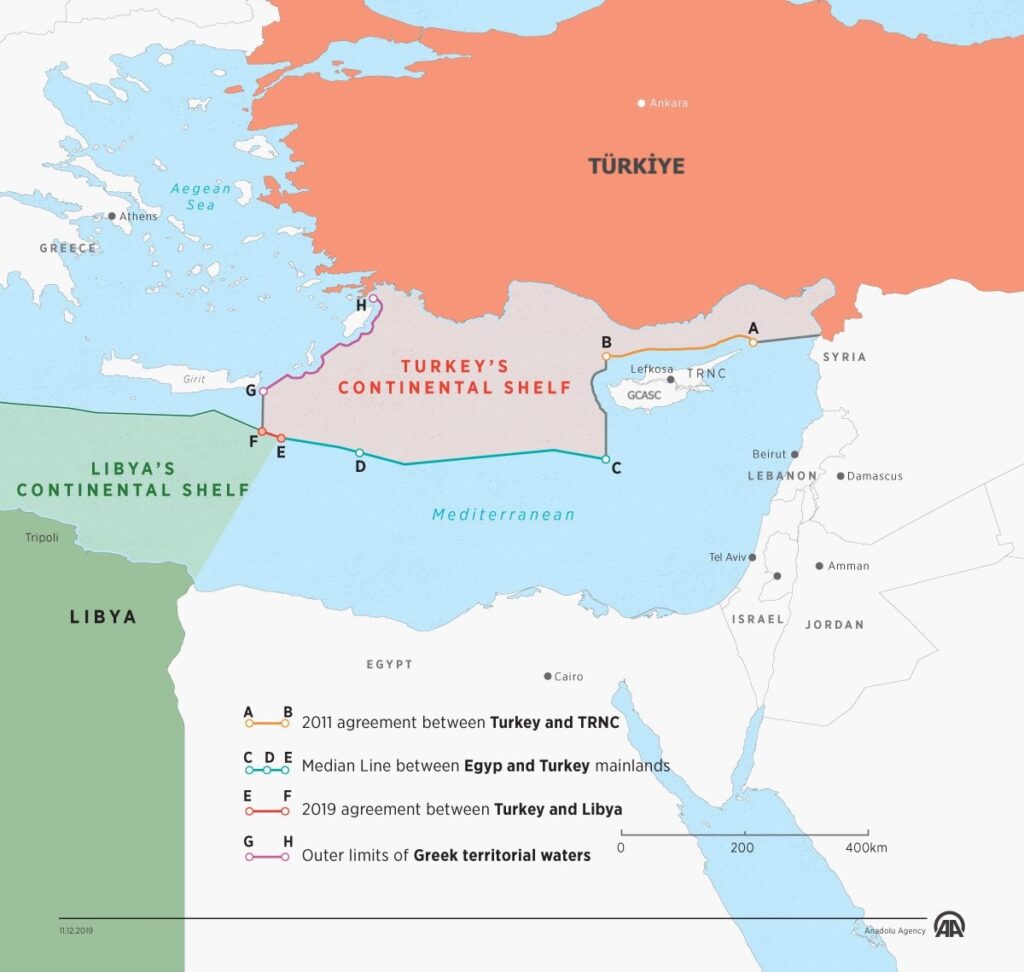
Therefore, Türkiye rejects the granting of full EEZ rights to islands, stating that allowing a tiny island to generate a maritime area 40 times larger than itself is irrational and incompatible with equity.
Other EEZ Agreements in the Eastern Mediterranean & Türkiye’s Position
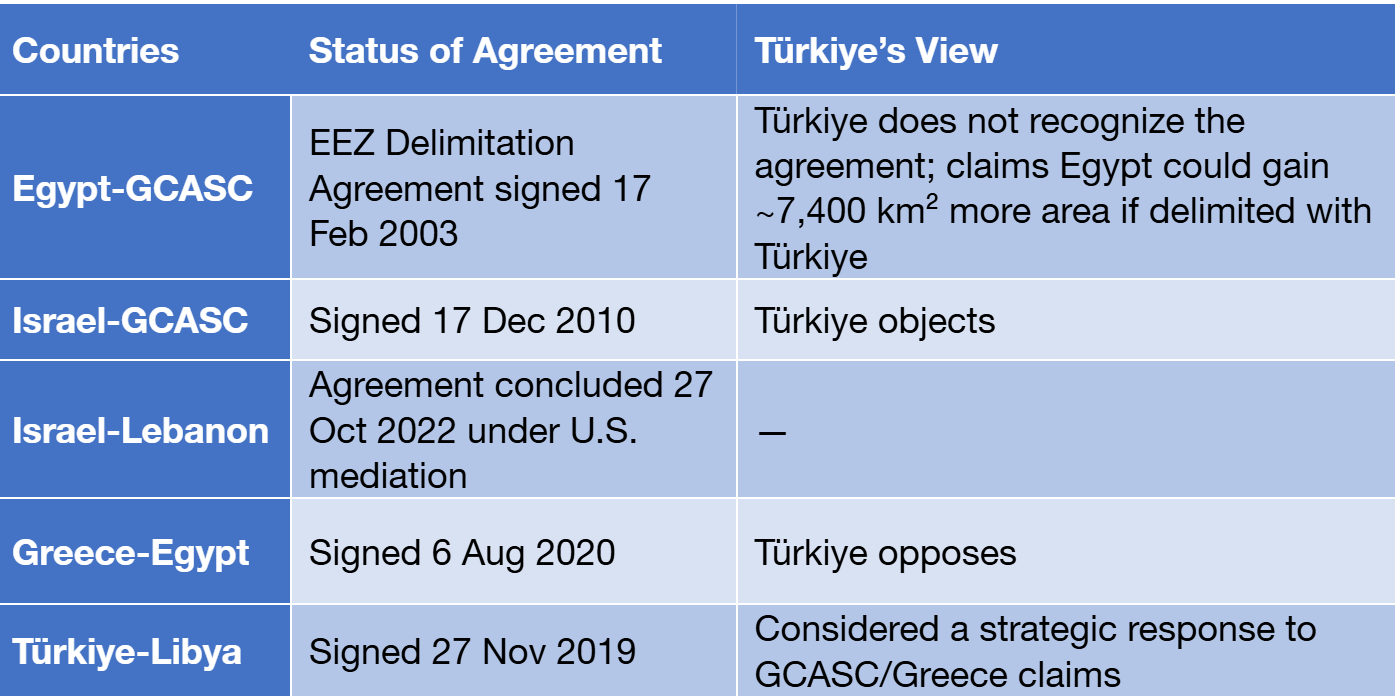
Since 2003 the GCASC has consistently executed strategic maritime diplomacy, capitalizing on the breakdown of Türkiye-Egypt relations to sign the first major delimitation agreement with Egypt. Although Egypt lost potential area in the deal, it opted to align with GCASC rather than Türkiye.
GCASC, claiming to represent the entire island, has since continued signing delimitation treaties with neighboring coastal states. However, a legal and political problem emerges here.
The GCASC Question: Legitimacy and Representation
The Republic of Cyprus was established in 1960 as a bicommunal partnership state. However:
• In 1963, the Greek Cypriot side attempted unilateral constitutional changes (the Akritas Plan) and engaged in violent actions, excluding Turkish Cypriots from government.
• In response to a coup backed by the Greek junta aimed at eliminating Turkish presence on the island, Türkiye intervened under the 1960 Guarantee Agreement, securing the livelihood of Turkish Cypriots but resulting in de facto partition.
• In 2004, the Annan Plan was accepted by Turkish Cypriots (65% yes) but rejected by Greek Cypriots (76% no). Despite this, the GCASC was admitted to the EU as the sole representative of the entire island.
For these reasons, Türkiye argues that the GCASC does not legally represent the whole island and that agreements signed unilaterally by the Greek Cypriot administration are invalid. Türkiye asserts that all agreements signed by the GCASC since 2003 disregard the equal rights of Turkish Cypriots.
In response, Türkiye signed the 2011 Continental Shelf Delimitation Agreement with TRNC and the 2019 Türkiye-Libya EEZ Agreement, forming its own counter-strategy.
The GCASC-Lebanon Agreement (2025)
The most recent treaty finalized by the GCASC is its EEZ Delimitation Agreement with Lebanon-initially drafted in 2007 but left pending for 18 years until 26 November 2025. The delimited zone does not directly overlap with Türkiye’s continental shelf claims, but Ankara rejects the agreement on the grounds that the GCASC cannot represent Turkish Cypriots.
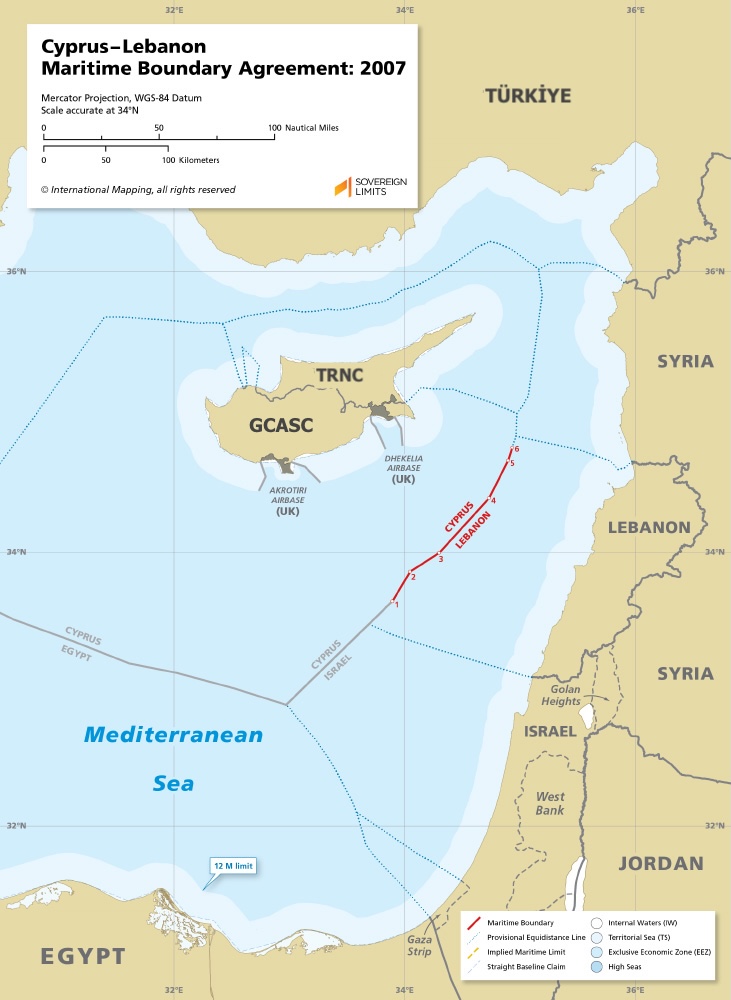
Why Did It Remain Frozen for 18 Years?
Lebanon’s internal political structure provides the answer.
Lebanon’s leadership positions are allocated according to sectarian distribution:
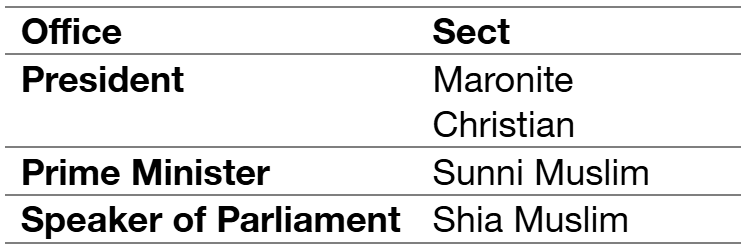
Parliament seats are also distributed on a 1:1 Christian-Muslim quota, with parties organized along sectarian identity rather than ideology. This system, based on the 1943 National Pact and revised under the 1989 Taif Agreement, prevents exclusion of any communal group but leads to:
• power-sharing stability
• slow decision-making, patronage, weak state capacity
The 2007 agreement lingered because one bloc viewed it as a Western opening, while the opposing faction opposed it for fear it would damage relations with Türkiye.
The maritime boundary agreement was formally signed on 26 November 2025 at the Baabda Presidential Palace, by Joseph Aoun (President of Lebanon) and Nikos Christodoulides (President of the GCASC).
The deal itself is signed; however, full legislative ratification in Lebanon may still follow due to internal political processes. The delay in the original 2007 draft was largely caused by Lebanon’s sectarian power-sharing system, which has historically slowed decision-making and produced competing foreign-policy preferences within the government.
GCASC describes it as historic, stability-enhancing, and key for energy cooperation. Lebanon sees it as a financial lifeline amid economic collapse. Critics, especially Hezbollah, argue Lebanon surrendered approx. 5,000 km² of potential maritime space and claim Western support is intended to weaken Hezbollah’s role over maritime resources.
Türkiye sharply rejected the deal, stating:
“The GCASC does not represent the entire island. The agreement ignores the rights of Türkiye and the TRNC and is legally invalid. Türkiye will continue to protect its own rights and those of the TRNC.”
Israel welcomed the agreement as a boost to regional energy cooperation, aligning with its own EEZ deal with GCASC and development of the Leviathan field. Western actors, including the EU, praised it as stabilizing-reflecting how EU membership empowers the GCASC diplomatically.
Why Now? Key Motivations Behind the Agreement
• Lebanon’s Economic Collapse & Search for Support: The agreement coincided with a nearly €1 billion EU aid package to Lebanon. GCASC also promised to support Lebanon’s EU partnership track, suggesting an implicit political and economic exchange. The timing also aligns with the upcoming EU summit in Cyprus.
• Leadership Change in Lebanon: The appointment of General Joseph Aoun as president likely accelerated negotiations. Aoun’s administration appears inclined to balance Hezbollah’s influence and reconnect with Western actors.
• Energy Ambitions of the GCASC: GCASC aims to expedite production from the Aphrodite gas field and targets gas exports to Europe by 2027, pending investment from the World Bank and private energy firms. Clarified maritime borders facilitate this.
• Perceived Power Shifts in the Region: Lebanon may believe Türkiye’s regional leverage has weakened, while Israel-GCASC cooperation offers more stability for energy development.
• Western Incentives: EU-US policy has increasingly prioritized strengthening the Israel-GCASC-Greece axis while reducing reliance on Russian gas. Eastern Mediterranean reserves could potentially supply 4-5% of total EU consumption. Estimated reserves around GCASC are approx. 500 bcm.
Conclusion
Driven primarily by economic need, GCASC and Lebanon have moved to secure legal clarity over parts of the Eastern Mediterranean home to significant hydrocarbon potential. While this promises revenue for coastal states and partial relief for Europe’s energy demand, unresolved political and maritime disputes remain a major obstacle.
The Eastern Mediterranean resembles a geopolitical chessboard:
• GCASC and Greece leverage EU membership and legal diplomacy
• Türkiye counters through alliances with Muslim states, military presence, and Libya/TRNC agreements
• Yet Türkiye’s strained regional relations, especially with Egypt, have weakened its negotiating hand
This latest agreement reflects that shift.
If we are to consider the steps Türkiye may take from this point onward, several potential developments come into focus.
• Türkiye will likely continue to assert in all international platforms, including the UN and NATO, that it does not recognize the agreement.
• Türkiye will continue to militarily obstruct any activities to be carried out in the region, as it has done before.
• In addition, based on its existing accords with the Turkish Republic of Northern Cyprus (TRNC), Ankara may deploy its seismic research and drilling vessels, accompanied by naval elements, to areas it views as being infringed upon by what it describes as a “pirate” agreement. This appears to be the most concrete and probable form of response.
• Another possible option is the so-called “Libya card,” whereby Türkiye may further strengthen the 2019 maritime boundary delimitation agreement and expand energy cooperation with Libya’s internationally recognized government.
• Türkiye may also attempt to persuade Lebanon that the agreement could bring more long-term harm than benefit. However, given the current political environment, this approach seems difficult to successfully implement. As for the future of the agreement itself, it is uncertain whether the Lebanese Parliament will ratify it; domestic political opposition and Hezbollah’s stance will be decisive. Even if it does pass, implementation is expected to face serious practical challenges and risks due to objections raised by Turkey and the TRNC.
• The only remaining country without a maritime delimitation treaty in the region is Syria. Considering ongoing shifts and Türkiye’s narrowing strategic options, reaching an EEZ agreement with Syria may soon become a critical necessity, despite the complexity of the Syrian conflict.
Ultimately, the GCASC-Lebanon agreement completes GCASC’s chain of treaties with Egypt, Israel, and Lebanon, leaving Syria as its final unbounded neighbor. The dispute is not solely legal or geographic, but fundamentally tied to the unresolved Cyprus status and Western efforts to counterbalance Hezbollah’s influence. Therefore, Türkiye must prioritize effective diplomacy and alliance-building over confrontation.
Sources
- Reuters, 26 Nov 2025 “Lebanon, Cyprus sign maritime demarcation deal, paving way for possible energy exploration.”
- Reuters, 27 Nov 2025 “Turkey says Lebanon-Cyprus maritime deal violates Turkish Cypriots’ rights.”
- AP News, “Lebanon and Cyprus finalize sea border agreement after almost 20 years.”
- Asharq Al-Awsat, “Türkiye says Lebanon-Cyprus maritime deal violates Turkish Cypriots’ rights.”
- Euronews, 2019 “Turkey signs maritime boundaries deal with Libya.”
- Cyprus Mail, 27 Nov 2025 “Turkey rejects Lebanon-Cyprus maritime deal.”
- Euronews, 2019 “Turkey signs maritime boundaries deal with Libya.”
- Greek City Times, “Cyprus formally rejects Turkey-Libya maritime deal.”
- UNCLOS (1982), United Nations Convention on the Law of the Sea
- International Energy Agency, Eastern Mediterranean energy assessments
- USGS, Levant Basin petroleum and gas estimates
- EastMed Pipeline Project, European Commission Energy Directorate
- UN Reports, Annan Plan Referendum (2004), Cyprus Negotiation Documents
- https://www.iene.eu/the-ordeal-of-the-greek-eez-p6076.html
- https://www.aa.com.tr/en/africa/analysis-strategic-legal-aspects-of-turkey-libya-deal/1673079
- https://sovereignlimits.com/boundaries/cyprus-lebanon-maritime
- Türkiye does not recognize the Republic of Cyprus and refers to it as the “Greek Cypriot administration” or “Greek Cypriot administration of Southern Cyprus (GCASC)”, as it does not consider it the sole representative of the island. Türkiye’s official position is that the Turkish Cypriot people have their own state, the Turkish Republic of Northern Cyprus (TRNC), and that any agreement on the island must respect the political and sovereign equality of both communities. Türkiye is the only country in the world to recognize the TRNC. ↩︎