

Key Points:
• NSS-2025 replaces order-driven US strategy with an interest-based framework.
• NATO’s burden structure shifts with rising expectations for European spending near 5 percent of GDP.
• Russia is repositioned as a potential stabilizing actor due to US prioritization of China.
• US strategy relies on high-end enablers while Europe carries conventional defense weight.
• The West faces a decade of adaptation or growing fragmentation depending on strategic discipline.
Summary
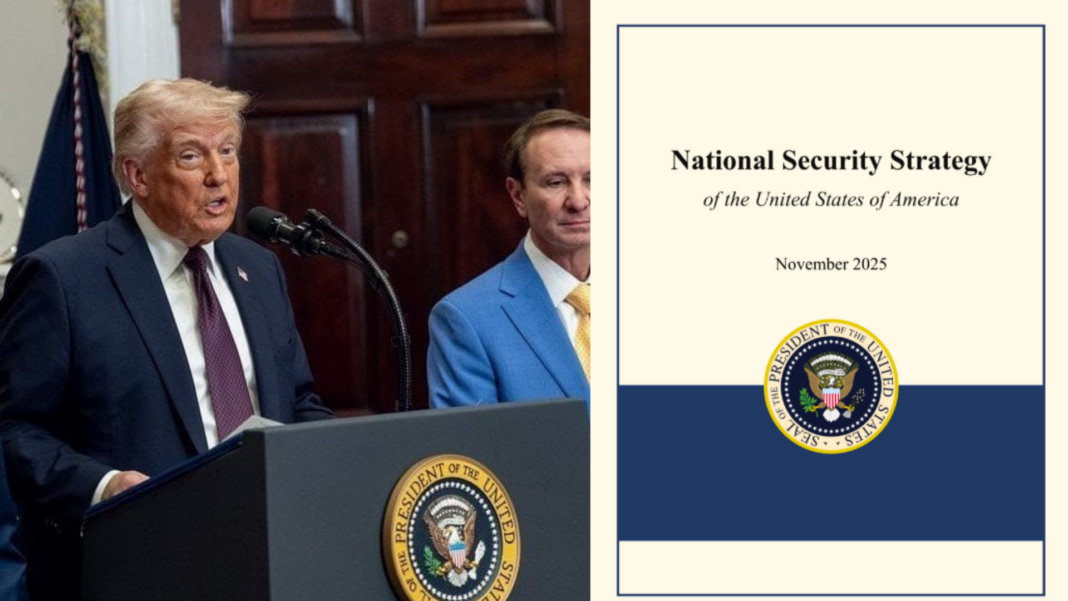
The release of NSS-2025 signals a decisive recalibration in US strategic posture. Washington shifts from global stewardship to interest-driven statecraft with sovereignty, economic leverage and border integrity at the center of national strategy. This reorientation reduces Europe’s position as a strategic priority and recasts NATO as a performance-aligned platform rather than a community bound by shared political identity. The US retains control of high-end strategic enablers while pushing European states to assume most regional deterrence responsibilities. These dynamics reshape the transatlantic balance and set the conditions for a distributed security ecosystem where adaptation determines system resilience. The West enters a period in which structural discipline rather than legacy assumptions will define outcomes.
Executive Assessment
The US National Security Strategy 2025 (NSS-2025) marks a decisive shift in American strategic posture. The 2022 strategy was anchored in defending the rules-based international order, multilateral alliances and a democracy versus autocracy framing. NSS-2025 redirects the strategic core toward narrow national interests, sovereignty, border control and economic power.
The impact on the transatlantic system is significant. Europe moves from strategic centerpiece to regional security consumer. European states are pushed to carry more defense weight while the US focuses on the Western Hemisphere, re-industrialization and economic statecraft. NATO remains important but operates under a new model built on conditional support tied to performance, spending and alignment instead of shared political identity.
This white paper delivers a neutral and evidence-based assessment of the discontinuities introduced by NSS-2025 and outlines the resulting strategic consequences for NATO, the EU, Ukraine and the broader geopolitical environment.
Key Findings
NSS-2025 introduces three major shifts in US strategic logic.
• From global stewardship to interest-driven statecraft.
NSS-2025 rejects the post-Cold War idea of the US as global order manager. Strategy is refocused on core interests, border integrity, industrial strength and national autonomy.
• From alliance-centric globalism to transactional burden-shifting.
NSS-2025 demands far higher allied defense spending including the 5 percent of GDP benchmark for NATO. Alliances become platforms for cost redistribution. NSS-2022 viewed alliances as force multipliers that anchor US global strategy.
• From climate and governance to energy dominance, border control and economic warfare.
NSS-2022 elevated climate change, democracy promotion and transnational risk management. NSS-2025 replaces these with energy expansion, migration control and industrial base rebuilding.
These shifts reallocate US strategic focus away from Europe and rewire the threat and partner hierarchy.
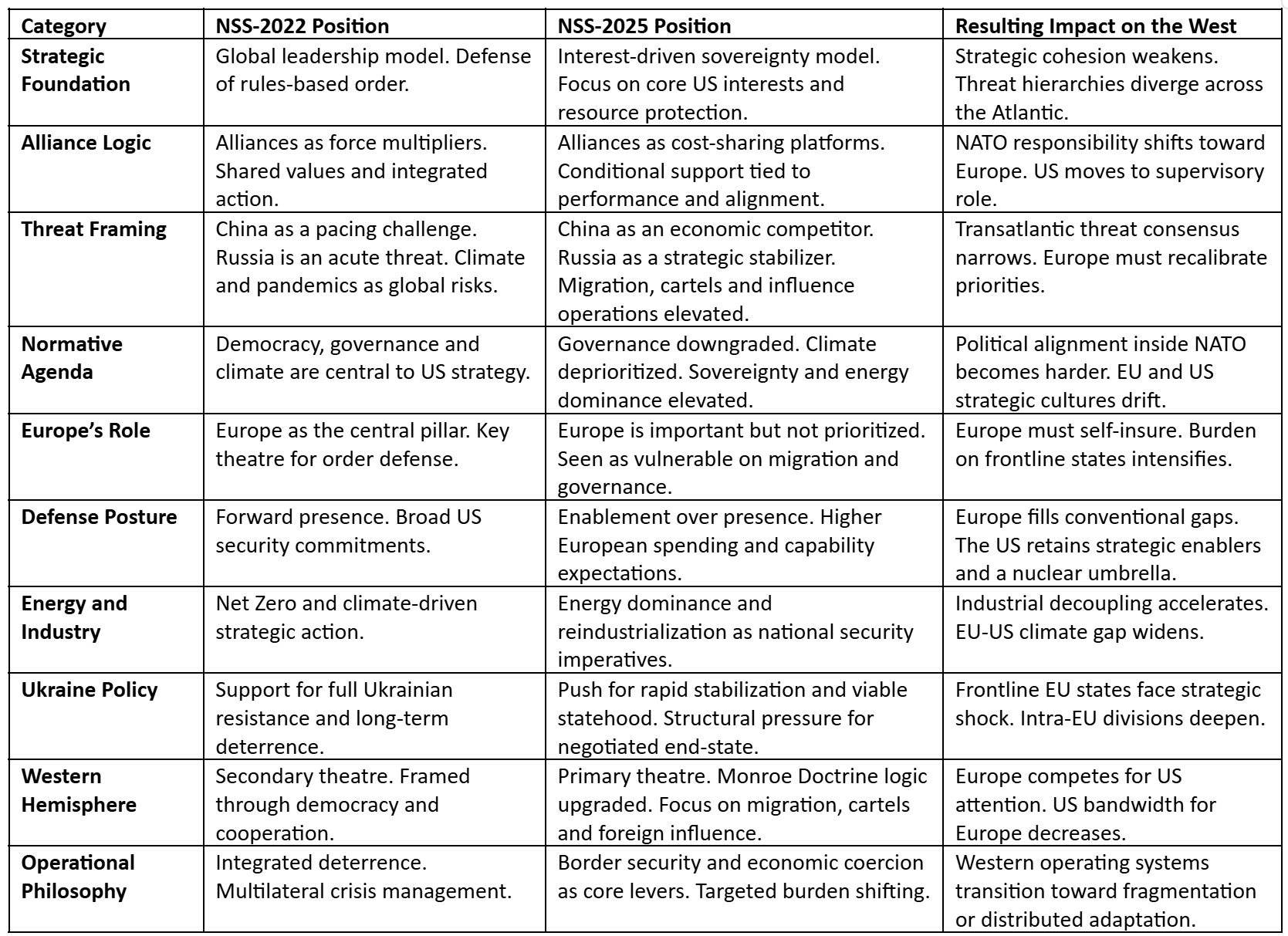
Strategic Discontinuities Between NSS-2025 and NSS-2022
Threat hierarchy reconstruction
NSS-2022 treated China as a pacing challenger, Russia as an acute threat and climate, pandemics and systemic shocks as global risks requiring collective action.
NSS-2025 reorders this framework with emphasis on:
• economic and technological competition with China
• rapid stabilization and strategic balancing with Russia
• mass migration, cartel activity and Western Hemisphere influence operations
• industrial sovereignty and energy supply security
This compresses the range of what the US views as strategically relevant.
NSS-2025 treats Russia not as an acute threat but as a potential strategic stabilizer. The rationale reflects a shift in US prioritization. Washington wants to reduce European theater risk exposure and free resources for economic and technological competition with China. A stable or at least predictable Russia enables the US to prevent a two-front strategic distraction and avoid long-term entanglement in Europe. This approach also opens room for selective cooperation with Moscow in the Arctic where competition with China is intensifying and where Russian logistical and territorial assets carry weight for US access and navigation interests.
Alliance model transformation
NSS-2025 advances a transactional alliance logic.
• NATO allies must assume primary responsibility for their regions
• US resources are reweighted to the Western Hemisphere and Indo-Pacific economic competition
• Multilateral institutions matter only when they support national sovereignty
NSS-2022 treated alliances as essential tools for shaping a stable global environment and countering authoritarian powers. The result is a structural divergence in transatlantic expectations.
NSS-2025 formalizes a harder burden-shifting agenda. The US expectation that NATO allies move toward defense spending levels near 5 percent of GDP is the clearest indicator. This benchmark is not symbolic. It signals a structural change in alliance governance that elevates the US into a supervisory role. Europe must carry the weight of day-to-day deterrence. The US manages architecture coordination and high-end strategic functions.
Normative agenda reversal
NSS-2022 centered on governance, human rights, anti-corruption, climate norms and democratic resilience.
NSS-2025:
• rejects climate governance as a strategic priority
• removes democracy promotion as an organizing principle
• prioritizes sovereignty and non-interference
• frames Europe’s governance choices on migration, regulation and identity as weakening Western resilience
This produces new political frictions between Washington and Brussels.
Europe reframed
NSS-2022 viewed Europe as a core pillar of global strategy due to the Ukraine war and the defense of the rules-based order.
NSS-2025:
• treats Europe as important but no longer prioritized
• describes Europe as facing civilizational challenges driven by migration and governance choices
• expects higher defense spending and operational responsibility
• positions the US to support political forces aligned with sovereignty-first approaches
This shifts the foundation of the transatlantic compact.
Implications for the Transatlantic System
Strategic consequences
Europe’s strategic weight is reduced. The Western Hemisphere and Indo-Pacific economic competition rank higher in US planning. This drives a shift from strategic integration to regionalization.
Europe must self-insure. The US maintains high-end enablers but not the full spectrum European deterrence posture. Misaligned positions on climate, migration and energy sharpen transatlantic friction lines.
The US maintains high-end enablers which are capabilities that give allies overwhelming advantage without requiring large-scale forward deployment of American ground forces. These include advanced ISR, strategic lift, cyber and space assets, integrated missile defense networks and the nuclear umbrella. An enabler is a resource that delivers decisive technological superiority for deterrence while limiting US exposure.
Under NSS-2025 the US intends to manage the Western security system at the architectural level but deploy its resources to theaters where it sees higher strategic return. This includes the Western Hemisphere where migration and influence threats dominate and the Indo-Pacific where the economic and technological contest with China sets long-term US priorities. Europe is expected to operate the conventional shield of NATO while the US maintains the strategic spine.
Political consequences
NSS-2025 openly critiques European political trends and signals alignment with nationalist parties that oppose EU policies on migration, climate and governance. This is unprecedented in US strategy documents and creates risks.
• NATO cohesion may become politicized
• US-EU relations may face structural strain
• Strategic sub-blocs inside Europe may solidify
Military consequences
US NATO posture shifts from presence to enablement. Frontline European states must assume primary responsibility for conventional deterrence.
The US expects:
• higher European defense spending
• faster modernization
• greater industrial investment in munitions, ISR, air defense and naval assets
This mirrors longstanding NATO capability gap concerns.
These shifts confirm that the US role inside NATO is evolving from force provider to system orchestrator. Washington keeps control of nuclear forces and strategic enablers and sets the doctrinal direction of the Alliance. European states are expected to field the bulk of conventional mass, industrial output and forward deterrence posture. This division of labor reflects NSS-2025’s intent to reduce US operational exposure in Europe while maximizing influence over the Alliance’s strategic design.
Outlook for 2025–2035: Fragmentation or Adaptation
The next decade will show whether the West evolves into a distributed security ecosystem or enters a phase of fragmentation.
Scenario 1: Fragmenting West
Likely if:
• US-EU tensions over Ukraine, migration, climate and political identity increase
• NATO remains operationally coherent but politically fractured
• European defense industrialization fails to scale
This scenario produces overlapping coalitions instead of a unified West.
Scenario 2: Adaptive West
Possible if:
• Europe accelerates defense spending and consolidates industrial capacity
• The US maintains strategic consistency
• The Ukraine settlement stabilizes without producing permanent intra-European division
This creates a more decentralized yet resilient transatlantic order with a clearer division of labor.
Conclusion
NSS-2025 resets the operating assumptions of Western security. The US narrows its strategic exposure while reinforcing high-end deterrent functions. Europe must expand capabilities and take responsibility for regional defense. The future of the West depends on strategic discipline, coherent industrial planning and the ability to absorb this new distribution of roles without political fragmentation. The architecture of Western power will be shaped less by legacy frameworks and more by adaptability over the next decade.
White Paper Structure Note
This paper serves as the opening section of a multi-chapter Defense Domain report which will be published in a short period. It establishes the strategic foundations for the upcoming chapters on NATO force evolution, EU strategic autonomy, Ukraine security outcomes, defense industrial modernization and regional geopolitical dynamics. It aligns the analytical approach and prepares the reader for a structured expansion of the themes introduced here.
Sources:
- The White House. (2025). National Security Strategy of the United States of America
- The White House. (2022). National Security Strategy of the United States of America
- European Union. (2022). A Strategic Compass for Security and Defence
- NATO. (2023). Defence Expenditure of NATO Countries
- International Institute for Strategic Studies. (2023). The Military Balance
- RAND Corporation. (2024). Allied readiness and burden-sharing assessments
- Royal United Services Institute. (2023). Ukraine conflict briefings
- Kagan, R. (2021). The new age of disorder. Foreign Affairs
- Liégeois, M. (2020–2024). Studies on alliance politics and NATO strategy. UCLouvain
- Walt, S. M. (2018). The hell of good intentions. Farrar Straus and Giroux
- Financial Times. (2022–2024). Transatlantic security and European defense coverage
- Reuters. (2022–2024). US–EU strategic reporting
- The Economist. (2022–2024). NATO cohesion and European political analysis