

Key Points:
- Open-ended pressure is giving way to decisive, outcome-oriented enforcement operations.
- Successful enforcement requires alignment across six critical operational and political gates.
- Conflict drift, not deliberate war, is the most likely escalation pathway
- Israel strikes; the U.S. and UK manage escalation through regional military support.
Summary
The current state of tensions between Israel and Iran marks a watershed moment in Middle Eastern security. Just as the US operation in Venezuela demonstrated that “discrete coercive outcomes” can be achieved without classic military mobilization, the Israel-Iran theater is now governed by the logic of “gate compression“. What was once a predictable cycle of routine diplomatic and military pressure has transitioned into a highly synchronized system of legal, political, and operational readiness.
The breakthrough in modern escalation is not merely about troop numbers but synchrony. By coordinating diplomatic positioning, legal scaffolding, and persistent Intelligence, Surveillance, and Reconnaissance (ISR), the US and its allies have created a standing campaign posture. While current indicators suggest a “plausible but bounded” environment, the infrastructure for a culminating action is already in place, meaning the transition to war could occur within a compressed window of mere weeks.
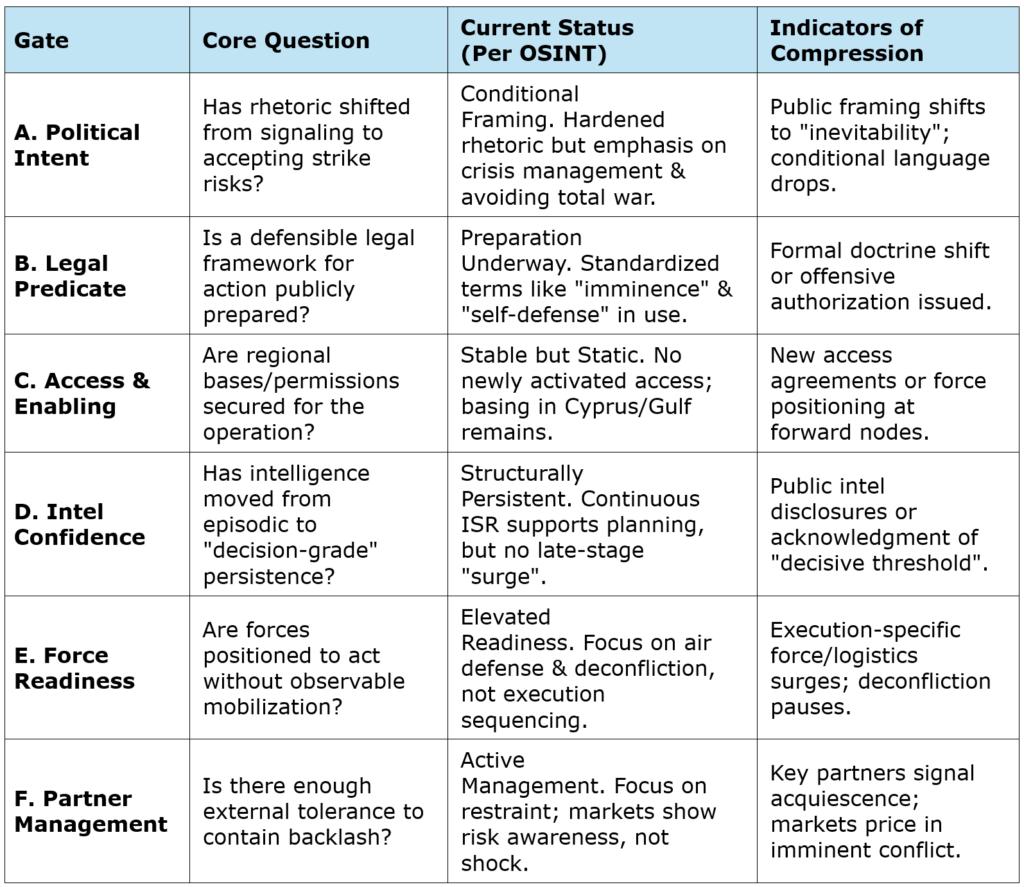
The Strategic Decision Model – The “Six Gates” to Culmination
A professional assessment of imminent conflict relies on the alignment of six decision gates. When these are compressed into a single window, the system has moved toward a culminating outcome:
Gate A: Political Intent Crystallization
Definition: The shift from using military posture as a “signal” to accepting the actual risks of a decisive strike.
Current Evidence: Rhetoric from Israel, the US, and the UK has hardened significantly, emphasizing “unacceptable thresholds” and the “right to self-defense”. However, the sources note that messaging still maintains “conditional framing“. Leaders continue to publicly emphasize “crisis management” and the avoidance of a total regional war rather than framing an attack as “inevitable”.
Gate B: Legal Predicate and Narrative Scaffolding
Definition: Building a defensible legal framework (e.g., self-defense or enforcement) that is prepared to withstand international contestation.
Current Evidence: Preparation is “visibly underway”. Allied messaging has standardized terms like “imminence,” “necessity,” and “collective self-defense”. While officials appear ready to defend potential actions against legal challenges, no formal doctrine shift or “offensive authorization” has been publicly issued.
Gate C: Access and Enabling Arrangements
Definition: Ensuring regional hubs (bases and transit nodes) are permissive and that partners will not block the operation.
Current Evidence: Regional basing remains stable in Cyprus, the Gulf, and Europe. There are unverified reports of Russia evacuating personnel from Israel and accelerated UK/US force movements, but these have not been corroborated by major news wires. At present, there is no evidence of “newly activated” access arrangements that would typically signal an imminent strike.
Gate D: Intelligence Confidence on Pattern of Life
Definition: Moving from episodic data collection to “structural persistence,” where continuous monitoring allows for “decision-grade” targeting without a visible last-minute surge.
Current Evidence: ISR (Intelligence, Surveillance, and Reconnaissance) is structurally persistent across the region. Monitoring of maritime activity and infrastructure is continuous, which supports contingency planning. However, there has been no late-stage “intelligence surge“ or public acknowledgment that specific targeting confidence has reached a “decisive threshold”.
Gate E: Force Readiness and Deconfliction
Definition: Positioning forces so they are authorized to act without the need for classic, observable mobilization.
Current Evidence: US, UK, and allied forces maintain “elevated readiness,” but the focus remains on air defense, naval presence, and force protection. The sources highlight a lack of “execution-specific force sequencing” or logistics surges that would imply a kinetic action is about to begin. Deconfliction channels remain active, suggesting the system is still prioritized for “escalation control”.
Gate F: Coalition and Partner Management
Definition: Securing enough external tolerance (or “managed non-opposition”) so that a strike does not trigger immediate regional intervention or economic collapse.
Current Evidence: Management is “deliberate and active,” with a focus on restraint and stability. While energy markets show awareness of the risk, they have not yet displayed “shock behavior”. Partner behavior currently reflects preparedness for volatility rather than the acceptance of a near-term military strike.
The “Day After”: Post-Strike Scenarios
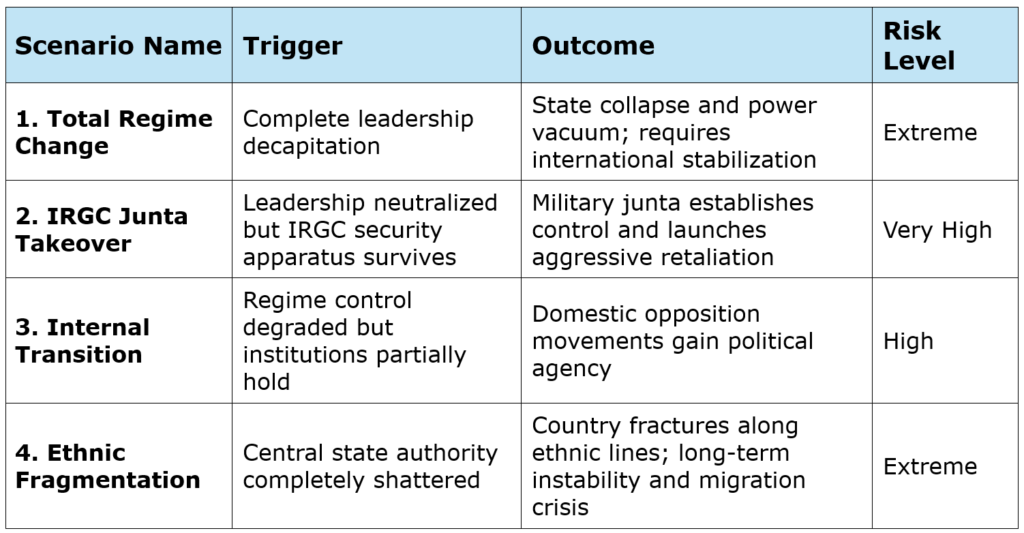
Should the US and Israel transition to a culminating strike, the regional impact would depend on the internal stability of the Iranian state.
Scenario 1: Total Regime Change
A “decapitation-style” strike succeeds in removing the top leadership, potentially ending the current regional power balance. Such an outcome would necessitate an immediate international effort to stabilize the country’s governance to prevent a total systemic collapse. This scenario is considered a “high impact” event that would fundamentally rewrite the Middle East’s security architecture. However, the sources note that there is currently insufficient evidence of the coalition clearance or legal framing required for such an operation. The primary risk remains a power vacuum that could lead to unforeseen regional instabilities despite military success.
Scenario 2: Revolutionary Guard (IRGC) Takeover
If the top leadership is neutralized but the security apparatus survives, the Revolutionary Guard could establish a military-led junta to maintain order. This would likely lead to a “Most Dangerous” scenario where a cornered military leadership engages in aggressive asymmetrical retaliation to prove domestic strength. The IRGC would likely rely on its proxy network to launch coordinated strikes against regional interests, further compressing the decision window for the US and Israel. Such a transition might preserve the regime’s shell while hardening its most violent tendencies, turning a strike into a catalyst for a more overt multi-actor conflict.
Scenario 3: Internal Opposition and Transition
A strike that significantly degrades the regime’s command and control could empower domestic opposition movements to reclaim political agency. This scenario envisions a transition toward a government that seeks integration with international norms, potentially ending the “structural risk” associated with the current regime’s behavior. For this to be sustainable, external partners would need to manage the transition through “alignment effects” like aid packages or sanctions relief to prevent anarchy. However, the sources suggest that current coalition focus remains on “deterrence and containment” rather than active regime transition planning.
Scenario 4: Ethnic Fragmentation
If the central state’s ability to enforce control is shattered, the country could fracture along traditional ethnic lines, similar to the “accidental escalation” models. This “High Impact” disaster would likely see regions like Kurdistan or Baluchestan seeking autonomy, creating a chaotic environment where borders are contested. The resulting instability would be difficult for external actors to arrest, potentially leading to a long-term crisis of migration and localized warfare. This outcome represents the “worst-case” version of structural drift, where a military success leads to a long-term geopolitical catastrophe that no actor intended.
Conclusion
The “monopoly” of traditional, slow-moving warfare is over. As demonstrated by the 2026 Venezuela model, the window for action can shorten from months to weeks the moment the six decision gates begin to compress.
The sources suggest that the greatest danger is “mis-weighting“ signals, which means waiting for traditional indicators like declarations of war or mass troop movements. Under the logic of the 2025 National Security Strategy, American power now prefers culmination over indefinite pressure. While the current trajectory between Israel and Iran remains “plausible but bounded,” the strategic environment now rewards actors who can act decisively inside these compressed windows. Effective warning depends on recognizing the quiet alignment of these gates before execution, not explaining them after the fact.
click here to download as PDF.