Key Points :
- Swarm UUVs expand sea denial and deterrence through scalable, distributed undersea operations.
- AI and autonomy are transforming UUVs into operational force multipliers.
- Underwater communication limits drive mission command and distributed autonomy.
- Armed UUV swarms overwhelm antisubmarine defenses through mass and maneuver.
- Data fusion is replacing confirmed contacts with confidence-based situational awareness.
- Hybrid manned-unmanned fleets will shape future maritime competition and escalation.
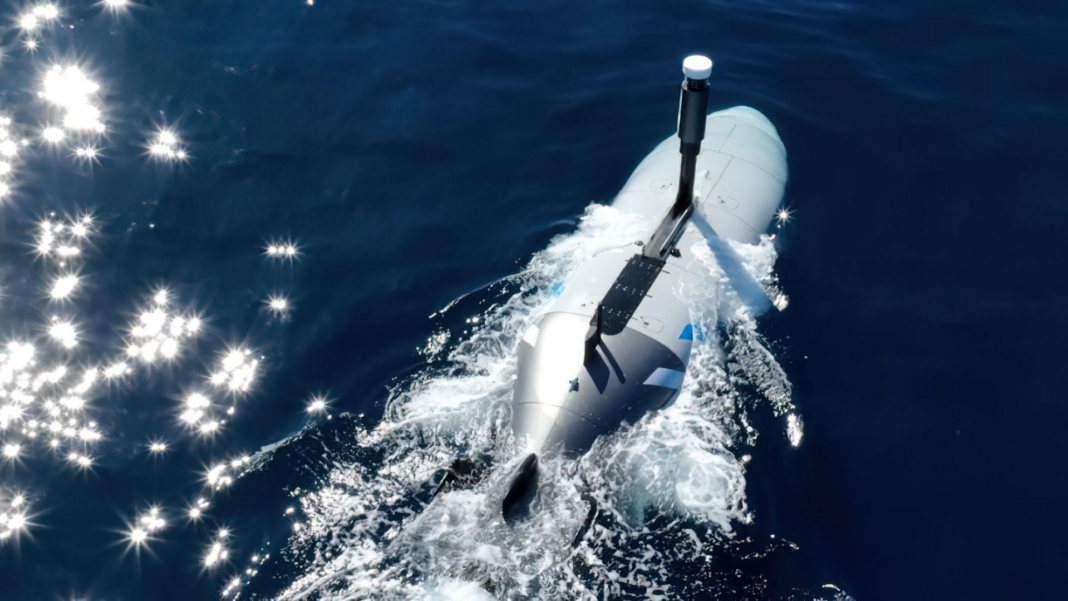
The balance of naval power is gradually shifting underwater, where unmanned systems are redefining how sea control, sea denial, and deterrence are exercised. Although submarines remain central to strategic stability, naval planners increasingly view unmanned undersea vehicles as complementary instruments for distributed sea denial and escalation control.
Officials experienced in fleet modernization indicate that advances in autonomy, navigation, endurance, and modular payloads are turning UUVs from simple support tools into force multipliers in operations. This development does not replace traditional platforms but rather broadens the deterrence framework into a connected undersea domain.
Strategic Context: Expanding the Deterrence Equation
For decades, submarines have represented the core of deterrence due to stealth, survivability, and strike credibility. UUVs introduce a different dimension. They offer scalable presence, distributed risk absorption, and persistent forward positioning without immediate escalation signals. This shift broadens deterrence logic. Instead of relying solely on high-value platforms, navies can disperse capability across numerous autonomous systems. Distributed presence complicates adversary planning and increases uncertainty regarding response thresholds.
Capability and Operational Assessment
UUVs are grouped into two main categories: Remotely Operated Vehicles (ROVs), which depend on continuous communication links, and Autonomous Underwater Vehicles (AUVs), which execute pre-programmed missions and adjust behavior using onboard processing. Historically, their roles focused on intelligence, surveillance, and reconnaissance (ISR), hydrographic survey, and mine countermeasures. The central advantage was the reduction of personnel risk in hazardous coastal and contested environments.
A swarm of UUVs typically comprises a small group of vehicles, often between four and twelve, that share roles as reconnaissance nodes, relay elements, and effector platforms. The command model is built around mission command rather than centralized control: commanders define intent and engagement parameters, and the vehicles execute autonomously with limited communications. This structure creates a mobile underwater surveillance line, unlike the fixed ‘wait-and-strike’ logic of traditional minefields.
Thanks to modular payload systems, mine systems, torpedo-type munitions, and disposable attack vehicles can be integrated. Distributing attack capability across multiple nodes complicates anti-submarine planning and forces the spread of defensive resources. As a concrete example, in recent years, unmanned underwater vehicles have been used in attacks on port infrastructure and high-value ships. These developments show that static defense measures may not be sufficient against distributed and low-cost threats.
Communications and command remain critical constraints. Underwater, radio and satellite signals (including GPS) are ineffective, forcing reliance on low-bandwidth, high-latency acoustic modems that are vulnerable to environmental interference. This makes real-time, joystick-style control of swarms impractical and pushes navies towards a mission command model, in which commanders define intent, rules of engagement, and boundaries, while UUVs execute autonomously with embedded AI. Intermittent “store-carry-forward” solutions (seabed relays, parked gateways, and airborne links) provide periodic synchronization while preserving operational security.
Navigation and endurance are equally decisive. Since GPS does not penetrate underwater, UUVs depend on inertial navigation, which drifts over time. Terrain-Aided Navigation, using sonar to match seabed features with preloaded maps, partially corrects this drift. Research in quantum and advanced inertial sensors promises further gains. On the energy/power side, lithium-ion batteries still dominate but limit time on station; fuel cells and emerging underwater charging concepts aim to significantly extend persistence and reduce recovery cycles. Longer endurance allows swarms to remain near chokepoints, critical sea lines, and undersea infrastructure for extended periods, strengthening deterrence without overt escalation.
Balance of Power and Escalation Risks
Distributed UUV swarms increase the uncertainty factor in the balance of naval power. While reducing reliance on high-value platforms, they make the detection and classification process more difficult for the opposing side. However, this also brings risks. Acoustic uncertainty increases the risk of misidentification. Difficulty in attribution complicates climb calculations. The anti-submarine warfare side can respond with advanced multi-sensor networks, unmanned counter-systems, wide-area sonar barriers, and data fusion algorithms.
In addition, cyber and electronic warfare methods against autonomous systems will also gain importance. The line between reconnaissance, probing, and actual attack can blur when autonomous systems operate under broad rules of engagement. This ambiguity may deter some actors, but it can also increase the risk of miscalculation in crises if thresholds and signaling mechanisms are not clearly understood by all parties.
Strategic Implications and Doctrinal Challenges
Hybrid Fleet Architecture
The strategic transformation driving modern naval planning is the transition from platform-centric to network-centric undersea operations. UUV swarms can extend the sensor and weapons envelope of submarines, surface combatants, and shore-based systems, creating layered defense and offense operating well beyond the physical presence of manned platforms.
When integrated with Unmanned Surface Vehicles (USVs) and Unmanned Aerial Vehicles (UAVs), these systems form multi-domain swarms that expand battlespace situational awareness and deepen defensive architecture.
For deployment planners, the implication is clear: future fleet composition must be rigorously hybrid. Unmanned systems absorb disproportionate operational risk, conduct persistent and dangerous tasks, and generate distributed effects across broad maritime spaces. Manned platforms retain high-level command authority, strategic decision-making, and the political signaling functions that capital ships have traditionally provided.
Doctrinal and Legal Adaptation
This evolution demands comprehensive doctrinal adaptation:
- Command structure: Operators must train for intermittent control, probabilistic situational awareness, and complex human-machine teaming under information constraints
- Engagement protocols: Rules of engagement must account for autonomous targeting decisions and define escalation boundaries clearly
- Legal frameworks: Responsibility and accountability for autonomous system actions require new legal and normative structures
- Interoperability: Allied navies must develop compatible autonomous system architectures and communication protocols to enable coalition operations
Without this adaptation, navies risk fielding sophisticated systems whose operational implications exceed institutional understanding.
Possible Scenarios
Scenario 1: Crisis in a Maritime Chokepoint
In a regional crisis, a coastal state deploys UUV swarms to enforce sea denial in a narrow chokepoint. Persistent autonomous patrols generate uncertainty and compel a stronger navy to commit disproportionate ASW resources for safe transit. The result is enhanced bargaining leverage without exposing high-value manned assets.
Scenario 2: Protection of Critical Undersea Infrastructure
A major power deploys mixed UUV and USV swarms to protect seabed infrastructure, including pipelines and data cables. Distributed reconnaissance and defensive nodes create layered security. This persistent presence deters sabotage by increasing detection probability and operational complexity for attackers.
Scenario 3: Strike on a High-Value Asset
A notional scenario in the Strait of Hormuz could involve an actor employing small, low-signature UUVs to strike a high-value naval or commercial asset, using the congested and multi-threat environment (air, surface, cyber, and electronic warfare) to overwhelm defenses, confuse the defenders, and get close without being detected before carrying out a precise underwater attack.
Conclusion
Swarm UUVs are accelerating the transformation and weaponization of the undersea domain. By adding scalable, distributed presence and strike capability to traditional submarine forces, they expand the tools available for sea denial, deterrence, and escalation management.
Technological advances in autonomy, navigation, communications workarounds, and energy systems are turning UUVs from niche support platforms into operational force multipliers that reshape both the conduct and the perception of undersea operations.
At the same time, these systems introduce significant risks: ambiguity in attribution, complex escalation dynamics, and heightened dependence on robust data fusion and resilient command-and-control. The strategic challenge for navies is to harness the advantages of swarm UUVs while managing their vulnerabilities through hybrid fleet design, adapted doctrine, and clear signaling in crisis.
States that best integrate manned and unmanned platforms into coherent, network-centric undersea architectures, while maintaining clear escalation governance, are most likely to achieve maritime stability and protect national interests. Conversely, unmanaged proliferation of autonomous undersea systems without adequate doctrine and governance structures risks unintended escalation and strategic miscalculation.
Sources
- https://www.everycrsreport.com/files/20200330_R45757_27c929d1a1b02217ecdf210e 920d5b5a3fa99874.html
- Ronald O’Rourke, “Navy Large Unmanned Surface and Undersea Vehicles: Background and Issues for Congress,” Congressional Research Service, R45757, updated March 25, 2025
- Naval War College Review – Distributed Maritime Operations
- RAND Corporation – Autonomous Systems in Maritime Warfare
- Proceedings (U.S. Naval Institute) – Mine Warfare and Seabed Operations
click HERE to download as PDF.