
This Week at a Glance:
• US and Israel strikes triggered direct interstate war with Iran.
• Leadership decapitation created succession uncertainty in Tehran.
• Strait of Hormuz disruption paralyzed global tanker traffic.
• Drone and missile strikes expanded the conflict across multiple theaters.
• Ukrainian interceptor drones are reshaping air defense economics.
• NATO cohesion faced strain over basing rights and trade pressure.
• Arctic militarization accelerated amid climate driven strategic shifts.
Strategic Overview
US and Israeli strikes transformed a period of coercive signaling into open interstate war. The killing of Iran’s Supreme Leader and senior commanders introduced leadership succession during active conflict, creating uncertainty over escalation thresholds and command continuity inside Iran.
The conflict is now unfolding across several interconnected operational layers including long-range strike warfare, maritime disruption and regional proxy activity. Sustained missile exchanges between Iran and Israel form the core battlefield dynamic, while attacks on shipping and energy infrastructure expand the confrontation into the global economic domain.
Maritime disruption around the Strait of Hormuz generated a systemic shock to global energy logistics. Tanker attacks, shipping suspensions and insurance withdrawals forced commercial carriers to reroute traffic while Gulf energy infrastructure came under direct attack.
Technological dynamics are also reshaping the operational environment. Low cost interceptor drones developed in the Ukraine war are rapidly diffusing to other regions. These systems provide cheaper alternatives to missile based air defense and are beginning to alter the cost structure of modern air warfare.
At the geopolitical level, alliance cohesion and strategic alignments are under pressure. Disputes over basing rights between the United States and European partners highlight growing tension within NATO, while Russia and regional actors attempt to position themselves diplomatically within the crisis.
Research Field Analysis
Regional Conflict & Stability
Iran War Escalation
US and Israeli strikes on Tehran marked the transition from coercive pressure to direct interstate war with Iran. The killing of the Supreme Leader and senior military commanders forced the activation of Iran’s constitutional succession mechanisms while the country simultaneously launched large scale missile retaliation against Israel.
The conflict now operates as a sustained exchange of missile and drone strikes rather than a limited punitive campaign. Leadership disruption inside Iran increases uncertainty regarding decision making and escalation management.
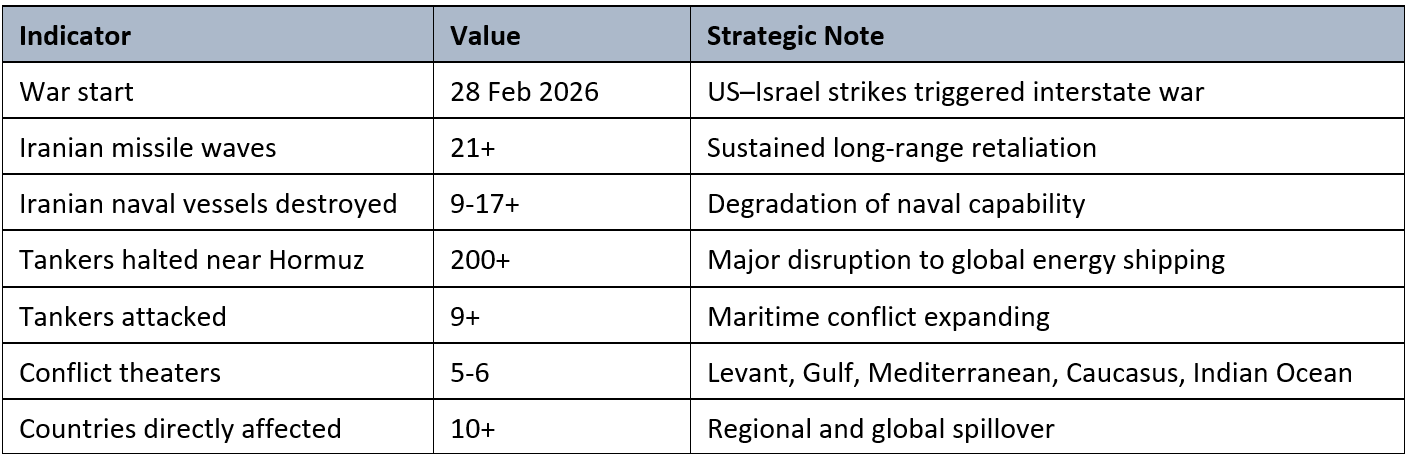
Iran War – Week 1 Key Indicators
Conflict Escalation Ladder
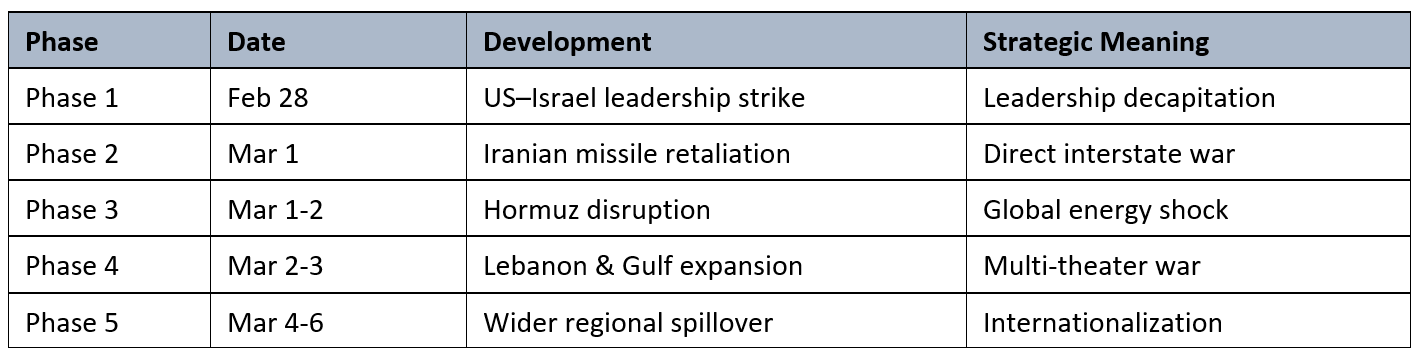
During the first week of the war several escalation thresholds were crossed in rapid succession. What began as a targeted strike operation quickly evolved into a multi-theater confrontation affecting energy routes, regional security and global military posture.
Conflict Geography
Within the first week the conflict expanded across several interconnected operational theaters stretching from the Levant to the Indian Ocean.
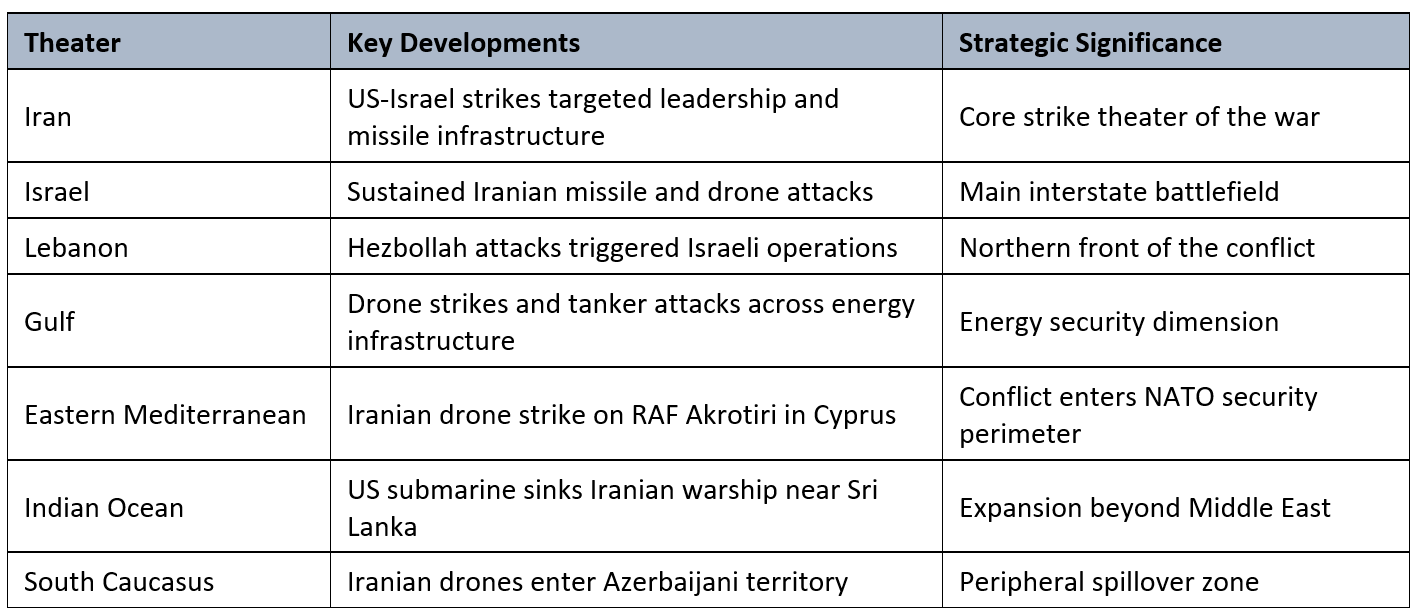
Horizontal Expansion of the Conflict
Military activity rapidly expanded beyond the initial strike exchange. Operations and security incidents occurred in Lebanon, Cyprus, Azerbaijan and Pakistan.
This horizontal expansion indicates that the conflict is evolving into a multi-theater confrontation involving both state and non-state actors. Wider geographic exposure increases the risk of unintended escalation and third party involvement.
Key Strategic Thresholds Crossed
Several escalation thresholds were crossed during the first week of the conflict.
Leadership Decapitation
The killing of Iran’s Supreme Leader represents one of the most significant leadership targeting operations against a sovereign state in modern Middle Eastern conflict history.
Direct Interstate Missile Warfare
Iran’s sustained missile campaign transformed the confrontation into open state-to-state conflict.
Energy and Maritime Warfare
Attacks on tankers and threats to the Strait of Hormuz introduced a global economic dimension to the war.
Regional Proxy Activation
Hezbollah’s involvement opened a second operational front against Israel.
Direct Attacks on Allied Military Infrastructure
Drone strikes against RAF Akrotiri and attacks on US bases expanded the conflict beyond the original combatants.
South Asia Escalation
Regional tensions also intensified in South Asia as Pakistan conducted air strikes on Taliban positions including the Bagram air base. Border clashes with Afghanistan displaced large numbers of civilians and suggest a shift from limited border incidents toward overt interstate confrontation.
Ukraine War Context
Developments in the Ukraine war continue to influence the broader strategic environment. Kyiv reported signals that Russia may consider security guarantees linked to future negotiations, although enforcement mechanisms remain unresolved.
Energy & Maritime Security
Hormuz Chokepoint Disruption
The Strait of Hormuz emerged as the central maritime flashpoint following the initial strikes. IRGC warnings, tanker attacks and commercial risk assessments effectively halted traffic through one of the world’s most critical energy chokepoints.
More than 150 vessels remained stationary in Gulf waters while major shipping companies suspended Hormuz crossings and imposed war risk surcharges.
Gulf Energy Infrastructure Attacks
Drone strikes targeted energy infrastructure across Oman, Qatar and Saudi Arabia. Storage facilities, export terminals and energy logistics infrastructure were hit, forcing regional producers to adjust export routes and supply planning.
These strikes demonstrate the vulnerability of centralized energy infrastructure during regional conflict.
Expansion of Energy Warfare
Energy related attacks also expanded beyond the Gulf. Ukrainian drone strikes targeted Russian export infrastructure in the Black Sea and Mediterranean region.
This trend indicates that energy logistics networks are increasingly becoming strategic targets during modern conflicts.
Hybrid Threats, Cognitive Warfare & Information Operations
Cyber Operations in Active Conflict
Cyber operations emerged alongside kinetic military escalation. Iranian government websites and digital services were compromised while religious applications displayed anti regime messaging.
These attacks suggest an effort to disrupt communication networks and shape internal perception during wartime escalation.
Domestic Security Spillover in Europe
European security agencies warned that the Middle East conflict may generate secondary security risks inside Europe. Europol highlighted increased threats of cyber attacks, online radicalization and extremist mobilization linked to the conflict.
External conflicts increasingly produce domestic security pressures in digitally connected societies.
Gray Zone Military Signaling
Hybrid activities also appeared in the military domain. Swedish forces jammed a Russian drone near a French aircraft carrier while Romanian fighter aircraft responded to a drone intrusion into national airspace.
These incidents illustrate how gray zone probing and hybrid signaling continue alongside conventional military escalation.
Defense Technology, Industry & Economic Security
Layered Strike Architecture
US operations demonstrated a technologically layered strike architecture combining strategic bombers, advanced fighter aircraft, cruise missiles and unmanned systems.
This approach reflects the integration of high end platforms with lower cost autonomous capabilities.
Operational Complexity and Coordination Risks
The density of missile and drone activity also revealed operational risks. During Iranian attacks, Kuwaiti air defense mistakenly shot down three US aircraft, highlighting coordination challenges within complex air defense environments.
High tempo multi domain warfare increases the risk of misidentification and friendly fire incidents.
Diffusion of Drone Defense Innovation
Ukrainian interceptor drones are becoming an important technological innovation. These systems can destroy hostile UAVs at a fraction of the cost of missile interceptors.
The United States and Gulf states are exploring the use of these systems, demonstrating how battlefield innovation rapidly spreads across regions.
Industrial Competition and Defense Programs
The Franco German Future Combat Air System program faces delays due to disputes between Dassault and Airbus over leadership and work share.
Industrial governance challenges may slow the development of Europe’s next generation fighter capabilities.
Global Power Competition & Systemic Transitions
Alliance Friction Over Military Basing
The Iran conflict has exposed diverging responses among NATO members. The United States threatened trade retaliation after Spain refused the use of its bases for Iran related operations, while Portugal allowed access to facilities in the Azores.
These differences highlight emerging tensions within alliance structures.
Strategic Positioning by Major Powers
Russia has attempted to position itself as a diplomatic intermediary between Iran and Gulf states. This approach reflects Moscow’s effort to expand influence during periods of Western strategic distraction.
Major power competition increasingly intersects with regional crisis management.
European Deterrence Debate
France announced steps to expand its nuclear doctrine by integrating European partners into strategic exercises and planning discussions.
This development reflects ongoing debates regarding European strategic autonomy and the long term reliability of transatlantic security guarantees.
Future Conflict, Climate & Humanity
Arctic Security Transformation
Sweden deployed JAS 39 Gripen aircraft to Iceland as part of NATO Arctic air policing missions monitoring Russian bomber activity from the Kola Peninsula.
The deployment reflects growing concern over security dynamics in the High North.
Climate Driven Strategic Geography
Retreating Arctic ice is expanding operational access to northern sea lanes and air corridors. Longer navigation seasons increase the strategic importance of Arctic surveillance and military presence.
Climate change is therefore shaping future theaters of strategic competition by altering geographic access and operational conditions.
Cross Domain Strategic Signals
Multi Theater Escalation
The Iran conflict now spans multiple geographic theaters including the Levant, Gulf, Eastern Mediterranean, South Asia and the South Caucasus. Expanding strike geography increases the probability of accidental escalation.
Maritime Chokepoint Vulnerability
Disruption at the Strait of Hormuz demonstrates how attacks on critical maritime chokepoints can generate immediate global economic effects.
Distributed Air Defense Economics
Low cost interceptor drones are reshaping the economics of air defense. These systems allow states to counter large volumes of autonomous threats without relying exclusively on expensive missile interceptors.
What to Watch Next Week
• UN Security Council discussions on Middle East escalation.
• Developments in Iran’s interim leadership structure.
• Possible naval escort initiatives for Hormuz shipping routes.
• US EU tensions regarding basing rights and trade measures.
• Government arbitration over the future of the FCAS program.
click here to download as PDF.