This Week at a Glance:
- Iran war dynamics shifted toward global maritime blockade enforcement.
- Hormuz disruption became a systemic energy chokepoint crisis.
- Israel’s Lebanon buffer zone strained ceasefire stability.
- Regional diplomacy remained fragile amid Iran-linked tensions.
- Russia-Ukraine war intensified infrastructure-based attrition.
- Europe accelerated defense transformation under energy and security pressure.
- Hybrid and cyber threats expanded across Europe’s security space.
- China increased coordinated military signaling across the Indo-Pacific.
- Nuclear risk and deterrence pressures continued to rise.
Strategic Overview
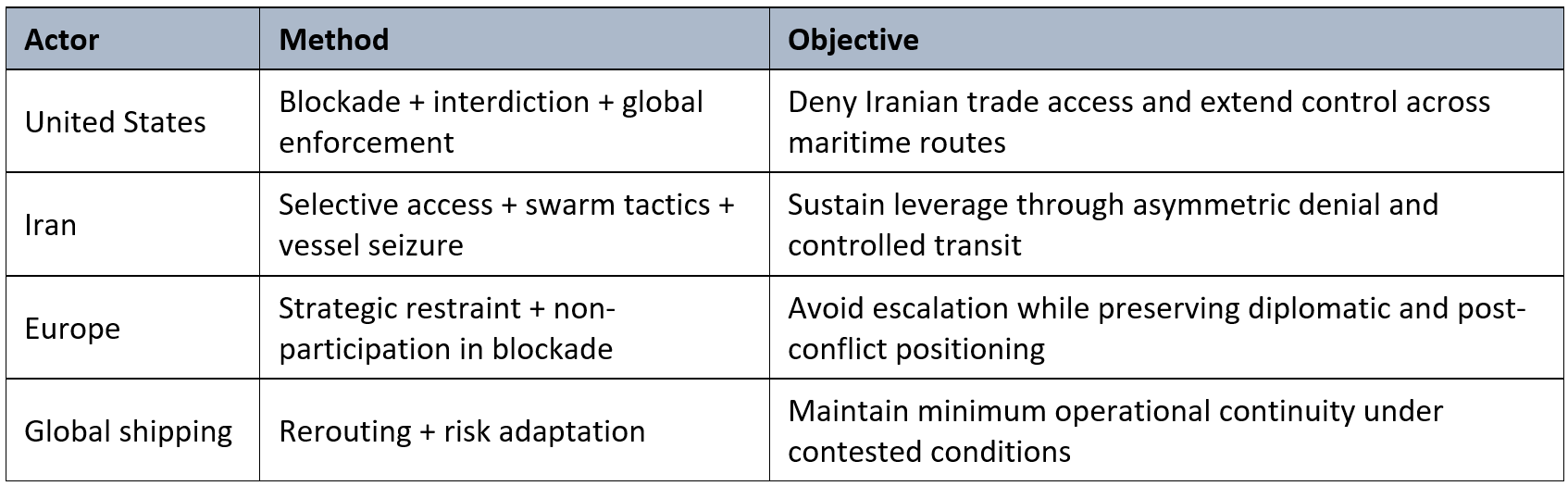
The Iran war is evolving into a dual-control maritime conflict system centered on the Strait of Hormuz. The United States has expanded its blockade from regional interdiction into a global enforcement network targeting Iranian-linked shipping across multiple maritime zones. Iran, in response, has shifted toward asymmetric denial through fast-boat swarms, vessel seizures, and selective access control. This interaction has created a contested access regime where neither side fully controls the corridor, but both actively shape access conditions.
At the operational level, the conflict is increasingly defined by an infrastructure-centric attrition model. Reciprocal strikes on energy facilities, ports, and logistics networks reflect a shift from battlefield-centric warfare to economic degradation strategies. The objective is not immediate military defeat, but the erosion of national resilience and the disruption of systems that sustain warfighting capacity. This model is now evident across both the Middle East and the Russia-Ukraine theater.
At the systemic level, alliance structures are under strain as conflict pressures expose diverging priorities and dependencies. European states continue to balance security commitments with energy vulnerabilities while accelerating defense-industrial expansion and strategic autonomy initiatives. This dynamic is producing a more transactional security environment where participation, burden-sharing, and alignment are increasingly conditional rather than automatic.
The convergence of maritime coercion, infrastructure attrition, and alliance fragmentation signals a broader transition in how modern conflict operates. Control is no longer defined solely by territorial dominance, but by the ability to regulate access, disrupt systems, and shape decision-making across interconnected domains. If sustained, this model is likely to produce prolonged instability rather than decisive outcomes, with escalation risks concentrated in chokepoints, critical infrastructure, and alliance fault lines.
Research Field Analysis
Regional Conflict & Stability
Iran War – Operational Assessment (Weeks 1–8)
Key Indicators
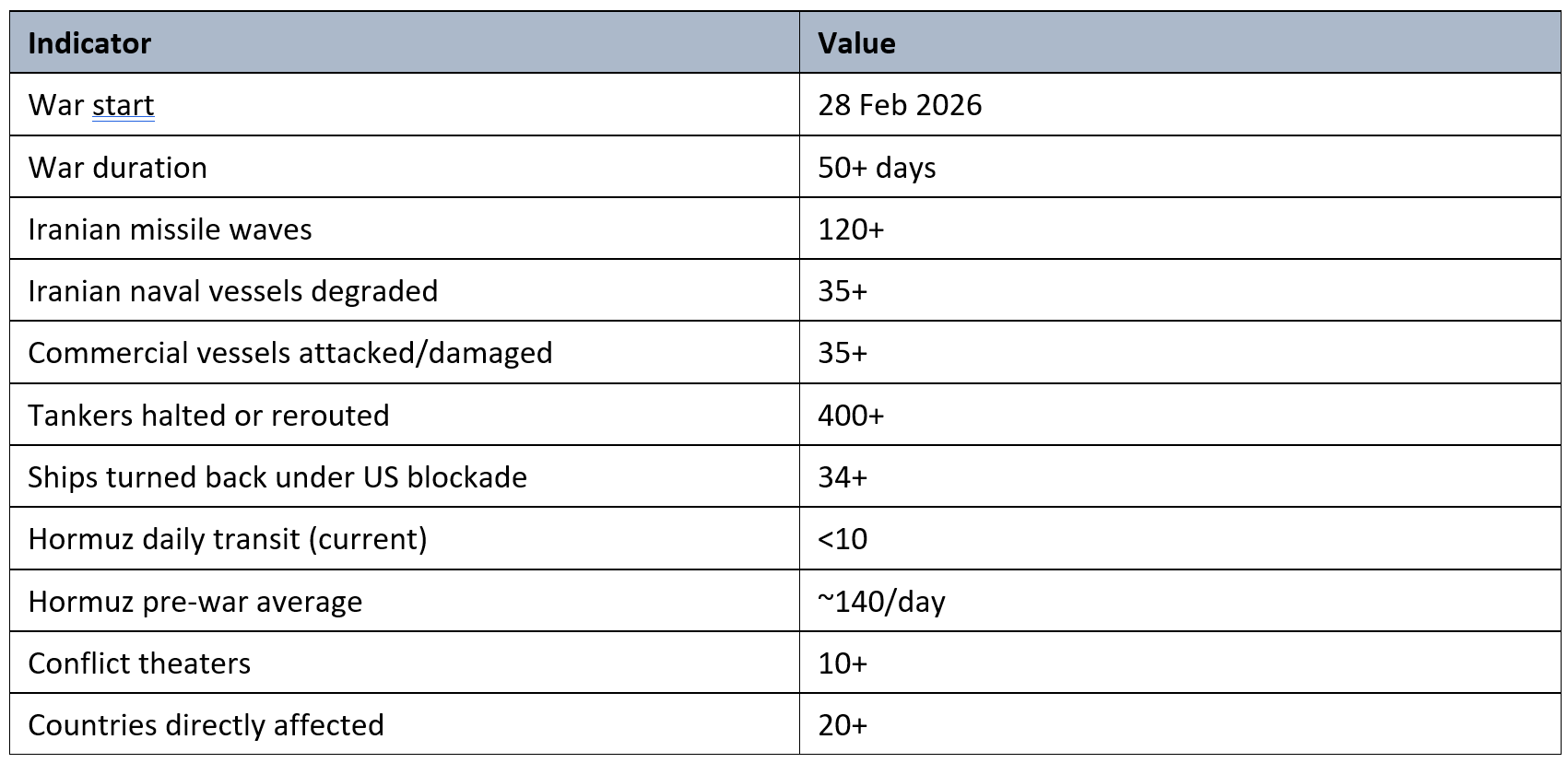
Operational Snapshot
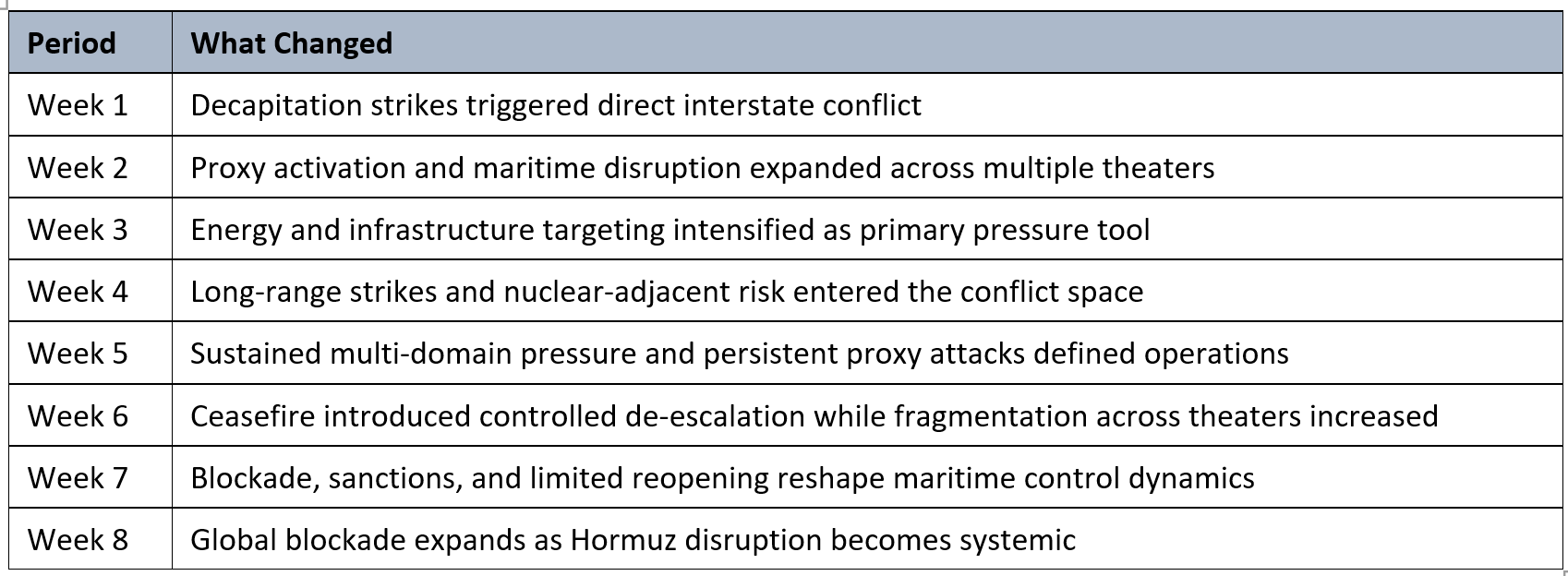
Conflict Evolution
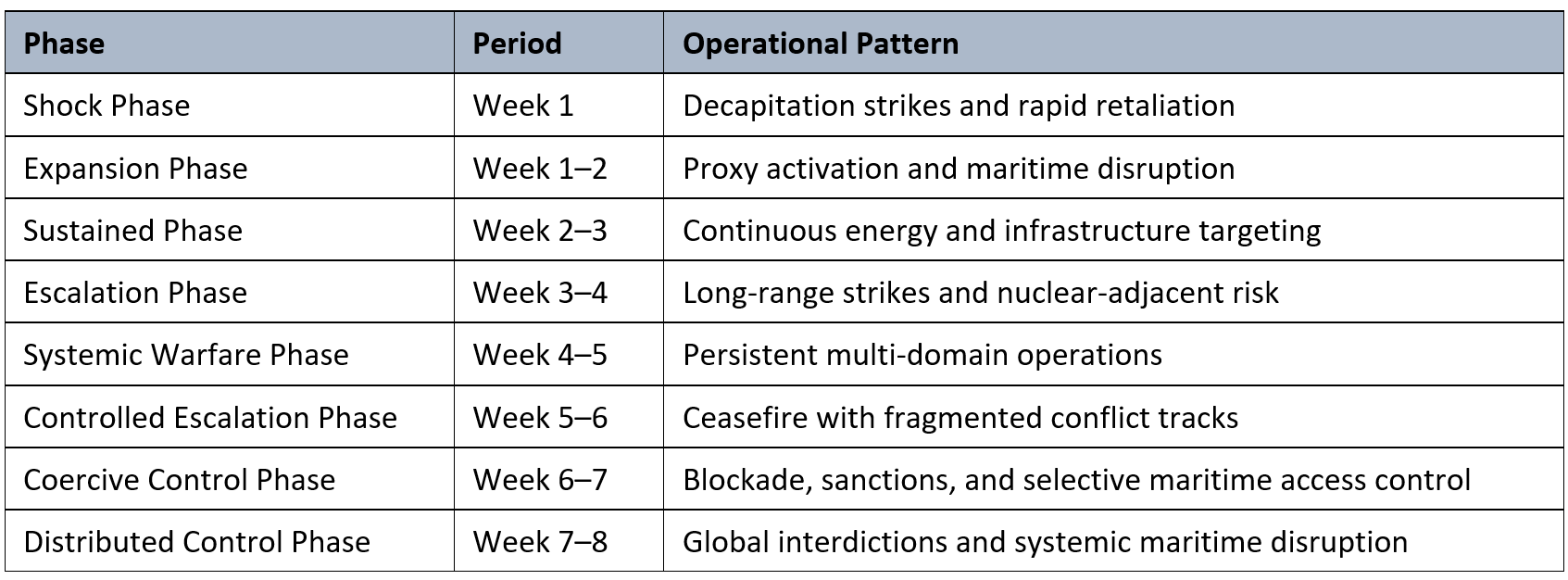
Operational Dynamics
The conflict has evolved into a structured coercion system combining military, economic, and maritime tools.
- The maritime domain has transitioned into a controlled coercion space
Blockade enforcement, selective transit permissions, and interdictions define a managed but contested environment. - Economic warfare is now integrated with military operations
Secondary sanctions and financial pressure reinforce physical blockade mechanisms. - Proxy warfare remains active but no longer drives escalation
While still operational, proxy activity plays a secondary role in current dynamics. - Energy systems remain the central pressure node
Disruption, rerouting, and controlled reopening of flows shape global economic impact. - Diplomatic channels have re-emerged without resolving core conflicts
Ceasefires and negotiations continue but remain fragile and conditional. - Maritime control has expanded beyond the chokepoint into global interdiction space
US operations now target Iranian-linked shipping across wider maritime routes, reflecting a shift from localized blockade to distributed enforcement. - Asymmetric naval tactics have re-emerged as a primary Iranian tool
Fast-boat swarms, vessel seizures, and selective access enforcement reinforce a denial-based control model. - Systemic disruption of maritime traffic is now persistent
Shipping flows remain structurally degraded, marking a transition from temporary disruption to sustained operational condition.
Weekly Strategic Shift
- Maritime control expands from chokepoint pressure to global enforcement architecture
- US blockade evolves into distributed interdiction across international waters
- Iran intensifies asymmetric denial through vessel seizures and swarm tactics
- Hormuz traffic collapse signals sustained disruption rather than temporary shock
- Conflict stabilizes into managed coercion without resolution
- Diplomatic activity continues but remains structurally constrained
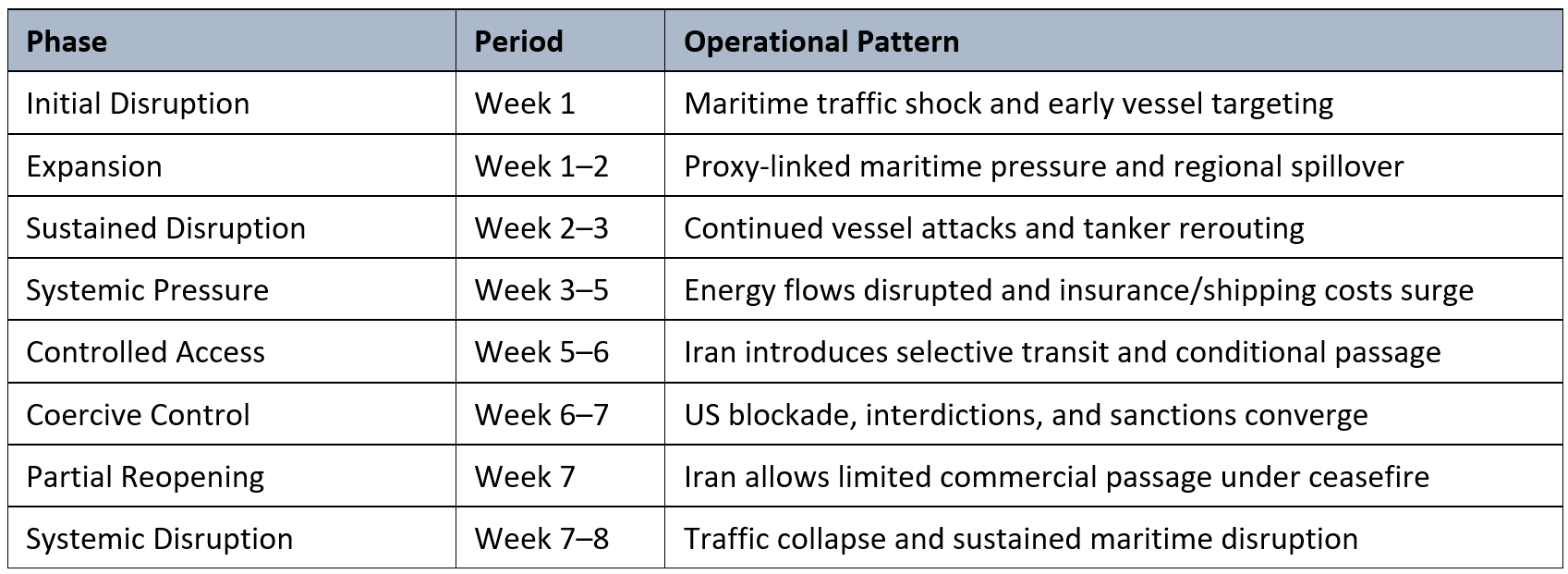
Hormuz Maritime Dynamics
Phase Evolution
Control Competition Model
Strategic Note
The Strait of Hormuz has transitioned from a contested transit corridor into a structurally degraded maritime system.
US blockade enforcement has expanded beyond the region into a distributed interdiction network targeting Iranian-linked shipping across multiple maritime zones. In response, Iran has reinforced an asymmetric denial model built on fast-boat swarms, vessel seizures, and selective access enforcement.
Traffic flows have collapsed to a fraction of pre-war levels, with transits occurring only under constrained and uncertain conditions. This reflects not a temporary disruption, but a sustained breakdown in corridor functionality.
The resulting environment is neither restored navigation nor full denial, but controlled instability. Access is continuously shaped by competing coercive mechanisms rather than stable rules of passage.
Israel Consolidates Buffer Zone as Ceasefire Fragments
Israel established a 5–10 km control line inside southern Lebanon while continuing strikes against Hezbollah targets, as the ceasefire was formally extended but repeatedly violated. Hezbollah resumed rocket and drone attacks, rejecting the ceasefire’s legitimacy and framing Israeli operations as ongoing aggression. This dynamic reflects a shift from ceasefire stabilization to controlled confrontation, where agreements coexist with sustained military pressure and the buffer zone becomes a de facto long-term security structure rather than a temporary measure.
Russia-Ukraine War Shifts Toward Infrastructure Attrition Model
Russia launched over 200 long-range drones targeting Ukrainian ports and energy systems, while Ukraine expanded strikes on Russian oil infrastructure, including refineries and export terminals such as Tuapse. This reciprocal targeting pattern indicates a sustained shift toward infrastructure-centric warfare aimed at degrading economic throughput rather than achieving rapid battlefield breakthroughs. The model increases systemic vulnerability on both sides while extending the conflict timeline through cumulative economic disruption.
Russia Signals Potential Northern Axis Reactivation via Belarus
Ukrainian intelligence reported Russian force regrouping, road construction, and artillery positioning near the Belarusian border, suggesting preparations for renewed northern axis activity. While not yet operational, these movements introduce strategic ambiguity by forcing Ukraine to redistribute defenses away from active fronts. The signaling effect is as important as the capability itself, creating pressure without immediate escalation and complicating NATO’s eastern flank risk calculations.
US Applies Financial and Security Pressure on Iraq Amid Militia Escalation
The United States halted approximately $500 million in dollar shipments to Iraq and suspended elements of security cooperation following continued attacks by Iran-aligned militias on US and regional targets. This move expands the conflict’s footprint into Iraq’s financial and governance structures, linking internal stability to regional escalation dynamics. By targeting monetary flows rather than direct military engagement, Washington is applying systemic pressure to compel state-level constraint on proxy actors.
Iran Signals Conditional Return to Negotiations Through Islamabad Channel
Iran’s foreign minister traveled to Islamabad, indicating a potential reopening of negotiations following stalled ceasefire-linked talks with the United States. Diplomatic progress remains tightly linked to parallel developments in the Strait of Hormuz and the Israel-Lebanon theater, where escalation continues to shape negotiating leverage. This creates a multi-theater bargaining structure in which diplomatic movement depends on simultaneous stabilization across interconnected fronts.
Energy & Maritime Security
US Transforms Blockade into Global Maritime Control Architecture
The United States has shifted from regional blockade enforcement to a distributed global interdiction model targeting Iranian-linked shipping across multiple maritime zones, including the Indian Ocean. Vessel seizures, escort operations, and long-range interceptions demonstrate an expanded operational scope that extends beyond chokepoints into open-sea enforcement. This transition reflects a move from containment toward active control of trade routes, increasing escalation exposure while redefining how maritime coercion is applied in modern conflict.
Iran Deploys Asymmetric Naval Denial to Sustain Maritime Leverage
Iran is reinforcing an asymmetric maritime control model centered on fast-boat swarms, vessel seizures, and selective access enforcement in the Strait of Hormuz. These tactics operate alongside residual missile, drone, and mine threats to form a layered denial architecture based on speed, dispersion, and unpredictability. Rather than enforcing full closure, Iran is maintaining leverage through controlled disruption, shaping transit conditions while avoiding direct large-scale confrontation with superior naval forces.
Hormuz Traffic Collapse Becomes Persistent Structural Condition
Shipping activity through the Strait of Hormuz has dropped to a fraction of pre-war levels, with only minimal vessel transit occurring under constrained and high-risk conditions. Hundreds of ships remain stranded, and commercial operators continue to avoid the corridor despite intermittent ceasefire signals. This indicates that disruption is no longer episodic but systemic, effectively degrading the reliability of one of the world’s most critical energy arteries.
Global Energy Flows Exposed to Chokepoint Dependency Risk
The sustained disruption of Hormuz has exposed the structural vulnerability of global energy systems to single-point maritime chokepoints. With roughly one-fifth of global oil and gas flows typically passing through the strait, even partial disruption produces disproportionate systemic impact. The crisis demonstrates that energy security remains tightly coupled to maritime access, with limited redundancy at scale.
Alternative Export Routes Fail to Provide Strategic Redundancy
Existing pipeline networks and bypass routes have proven insufficient to offset the loss of Hormuz throughput. Infrastructure constraints, limited capacity, and exposure to secondary security risks prevent these alternatives from scaling to meet global demand. As a result, the energy system remains structurally dependent on Hormuz, reinforcing the strategic leverage of actors capable of disrupting or controlling access to the corridor.
Post-Conflict Maritime Security Shifts Toward Corridor Stabilization
European states and international partners are preparing maritime security and mine-clearing missions aimed at enabling eventual corridor reopening. These preparations reflect recognition that even in a de-escalation scenario, residual threats such as mines and asymmetric attacks will continue to constrain navigation. The focus is therefore shifting from conflict response to long-term stabilization of critical maritime infrastructure.
Hybrid Threats, Cognitive Warfare & Information Operations
China Expands Cognitive Warfare Using Taiwan’s Internal Voices
Chinese state-linked media intensified cognitive operations by amplifying Taiwanese opposition figures and repackaging their messaging across platforms popular in Taiwan. By using familiar domestic voices rather than overt propaganda, Beijing reduces attribution visibility while increasing credibility and audience reach. This approach targets political cohesion and defense legitimacy simultaneously, aiming to erode public confidence from within rather than through direct external pressure.
Western Security Environment Faces Converging State-Backed Hybrid Threats
Dutch and UK intelligence assessments highlight a sharp rise in state-linked cyber and hybrid operations, primarily from Russia, China, and Iran. These activities range from cyber intrusions and espionage targeting critical technologies to influence operations embedded within broader geopolitical tensions. The growing integration of artificial intelligence is accelerating both attack sophistication and defensive demands, making national resilience frameworks increasingly dependent on real-time adaptation to state-driven hybrid threats.
Defense Technology, Industry & Economic Security
Iran Sustains Missile Force Through Accelerated Replenishment Cycle
Iran reported replenishing missile and drone launchers at a rate exceeding pre-war levels, supported by extensive underground infrastructure designed for survivability. This indicates that ongoing strike campaigns have not degraded its launch capacity as intended. Instead, Iran appears to have adapted its force generation cycle to operate under sustained pressure, reducing the long-term effectiveness of attrition-based targeting against its strike capabilities.
Ukraine Pushes for European Ballistic Missile Defense System
Ukraine proposed the development of a joint European ballistic missile defense system to address critical gaps in intercept capability. The initiative reflects growing constraints around US Patriot availability and highlights Europe’s limited capacity to counter high-end missile threats independently. This signals a shift toward regionalized air defense solutions driven by operational necessity rather than alliance-based provisioning.
Germany Sets Long-Term Path to European Military Leadership
Germany unveiled a comprehensive military strategy aimed at becoming Europe’s strongest conventional force by 2039, prioritizing long-range strike, advanced air defense, and AI-enabled systems. The plan marks a doctrinal shift toward effects-based capability development and large-scale force expansion. This positions Germany not only as a contributor but as a central future actor in shaping Europe’s defense architecture.
Global Power Competition & Systemic Transitions
North Korea Uses Missile Launches to Reinforce Strategic Leverage
North Korea conducted additional ballistic missile launches from its eastern coast, continuing an accelerated testing pattern amid global instability. The timing, alongside the Iran war and renewed diplomatic signaling, indicates an effort to reinforce deterrence credibility while positioning itself within shifting great power dynamics. These demonstrations are less about immediate escalation and more about maintaining relevance and bargaining power in a multi-theater strategic environment.
China Expands Coordinated Military Signaling Across the Indo-Pacific
China combined diplomatic warnings against US-Philippines-Japan military exercises with visible force projection, including the Liaoning carrier’s transit through the Taiwan Strait and monitoring of allied naval movements. Parallel signaling around a potential nuclear-powered carrier and expanded island control further reinforces Beijing’s long-term maritime ambitions. This integrated approach reflects a coordinated effort to contest regional security architecture while normalizing sustained military presence in contested spaces.
NATO and European Intelligence Warn of Rising Systemic Confrontation Risks
NATO criticism of Russian and Chinese nuclear policies, combined with Dutch intelligence assessments of a potential Russia-NATO conflict scenario, points to a deteriorating strategic stability environment. The erosion of arms control frameworks and the expansion of nuclear and conventional capabilities increase the risk of miscalculation. Russia’s focus on limited territorial objectives to fracture alliance cohesion highlights a shift toward controlled escalation strategies rather than full-scale confrontation.
EU Integrates Financial Power into Strategic Competition Framework
The European Union approved a €90 billion support package for Ukraine alongside its 20th sanctions round against Russia, reinforcing the integration of economic instruments into geopolitical competition. Financial sustainment is now directly tied to battlefield resilience and long-term strategic positioning. This reflects a transition in which economic capacity functions as a core element of deterrence and alliance cohesion rather than a supporting tool.
Future Conflict, Climate & Humanity
Military Activity Near Nuclear Sites Raises Systemic Accident Risk
Russian missiles and drones have repeatedly flown near Ukrainian nuclear facilities, including within 10–20 km of critical infrastructure. These flight patterns are not operationally necessary but increase the risk of accidental impact, debris fallout, or system disruption. The convergence of high-intensity military activity with nuclear infrastructure introduces a non-linear escalation risk, where even a limited incident could trigger consequences far beyond the immediate battlefield.
Pacific States Face Acute Fuel Shock from Hormuz Disruption
Disruption of maritime energy flows through the Strait of Hormuz has driven fuel prices up by as much as 70% in import-dependent Pacific nations such as Papua New Guinea. This has directly constrained transportation, healthcare access, and food distribution in geographically fragmented island economies. Unlike major economies, these states lack buffer capacity, meaning energy shocks translate rapidly into humanitarian stress, turning a distant conflict into an immediate socio-economic crisis.
Cross-Domain Strategic Signals
Globalized Maritime Coercion Extends Beyond Chokepoints
US maritime interdiction has expanded from Hormuz-centric enforcement into a distributed system targeting Iranian-linked shipping across multiple regions. By operating beyond the chokepoint, Washington is shifting from access denial to trade-route governance through force. This model increases escalation exposure beyond traditional conflict zones and sets a precedent for exerting coercive control over global maritime flows.
Infrastructure Targeting Becomes Core Mechanism of War
Sustained strikes on ports, energy facilities, and logistics networks across both the Iran and Russia-Ukraine theaters indicate consolidation of infrastructure-centric warfare. Rather than disabling frontline forces, both sides are degrading the systems that sustain military operations and economic continuity. Infrastructure is now a primary battlespace, where cumulative disruption replaces decisive engagements.
European Defense Integration Accelerates Under Operational Pressure
European efforts in joint air defense, drone production, and combat-data integration reflect a shift toward a demand-driven defense-industrial model. Ongoing conflicts are no longer external inputs but embedded drivers shaping production cycles and capability development. This creates a feedback loop where battlefield requirements directly shape industrial output, reducing adaptation time and strengthening long-term operational sustainability.
Collective Defense Shifts Toward Conditional Participation
Diverging responses to conflict pressures, particularly in energy exposure and regional risk tolerance, are pushing alliance structures toward more transactional behavior. Participation is increasingly shaped by national constraints rather than predefined commitments. This introduces variability into deterrence frameworks, where credibility depends on coalition assembly rather than fixed alliance guarantees.
What to Watch Next Week
- Outcome of renewed US-Iran diplomatic contacts via the Islamabad channel.
- Shipping traffic response following Iran’s vessel seizures in the Strait of Hormuz.
- Stability of the Israel-Lebanon ceasefire under continued field-level violations.
- Potential US escalation through additional maritime seizures or interdictions.
- Russian military activity near Belarus indicating possible northern pressure.
- Market reaction to sustained disruption in Gulf energy flows.
click here to download as PDF.