This Week at a Glance:
- US shifts from Iran diplomacy to blockade-driven coercion.
- Hormuz emerges as the central arena of competing control and access strategies.
- Israel expands strikes in Lebanon despite ceasefire conditions.
- Israel intercepts Gaza-bound aid vessels in international waters.
- Ukraine expands long-range strikes against Russian energy infrastructure.
- Ukraine integrates private air defense units and deploys AI-driven demining systems.
- US–Germany tensions escalate toward potential changes in NATO force posture.
- EU sanctions Chinese firms as Beijing restricts dual-use exports to Europe.
- Pakistan–Afghanistan clashes signal a risk of sustained border instability.
- Energy disruption drives both fertilizer shortages and accelerated renewable adoption.
- AI-driven systems reshape mine warfare in contested maritime environments.
Strategic Overview
The United States is shifting from stalled diplomacy toward a sustained blockade strategy against Iran, linking maritime control directly to economic pressure. Efforts to restrict oil flows and restore navigation in the Strait of Hormuz reflect a transition from negotiation-led de-escalation to coercion-driven conflict management. This approach is increasing global exposure to prolonged chokepoint instability and energy market volatility.
At the operational level, conflict dynamics are expanding beyond the battlefield into industrial and economic systems. Ukraine’s long-range strikes on Russian energy infrastructure, combined with rising risks to subsea cables, illustrate a shift toward targeting functional lifelines rather than frontline forces. Warfare is increasingly defined by the ability to disrupt production, logistics, and connectivity at scale.
At the systemic level, alliance structures are coming under visible strain. Friction between the United States and European partners over the Iran conflict is beginning to translate into debates over force posture and burden-sharing. This dynamic signals a move away from stable, rules-based alignment toward more conditional and transactional security relationships, with implications extending beyond the immediate crisis.
Research Field Analysis
Regional Conflict & Stability
Iran War – Operational Assessment (Weeks 1–9)
Key Indicators
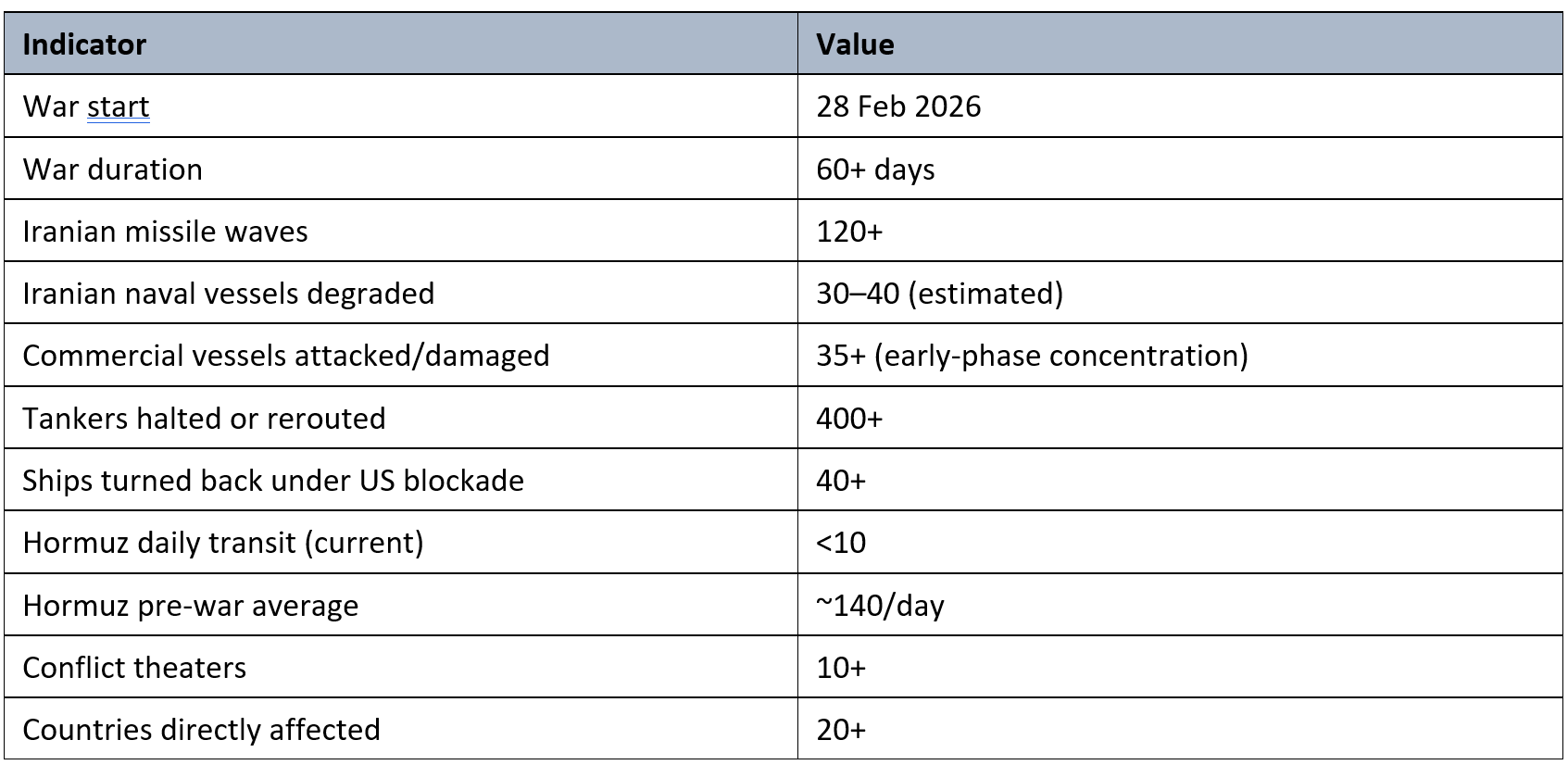
Operational Snapshot
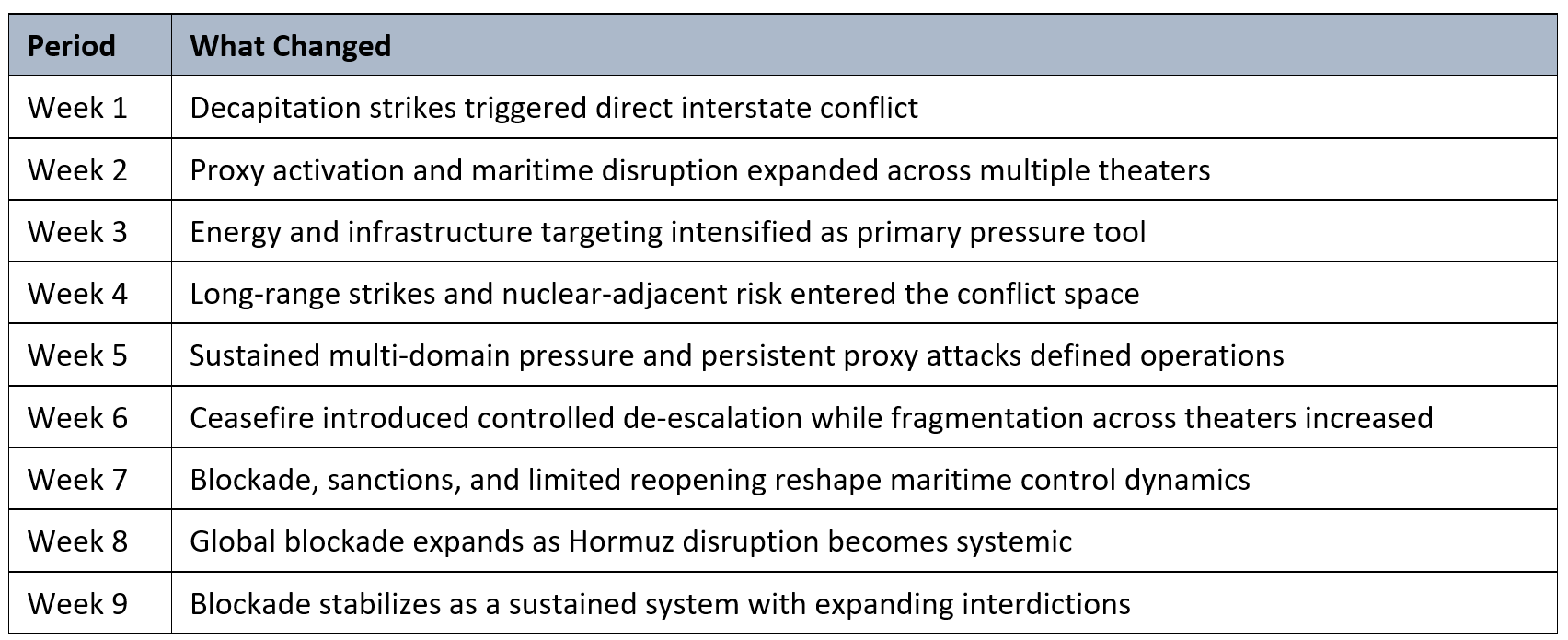
Conflict Evolution
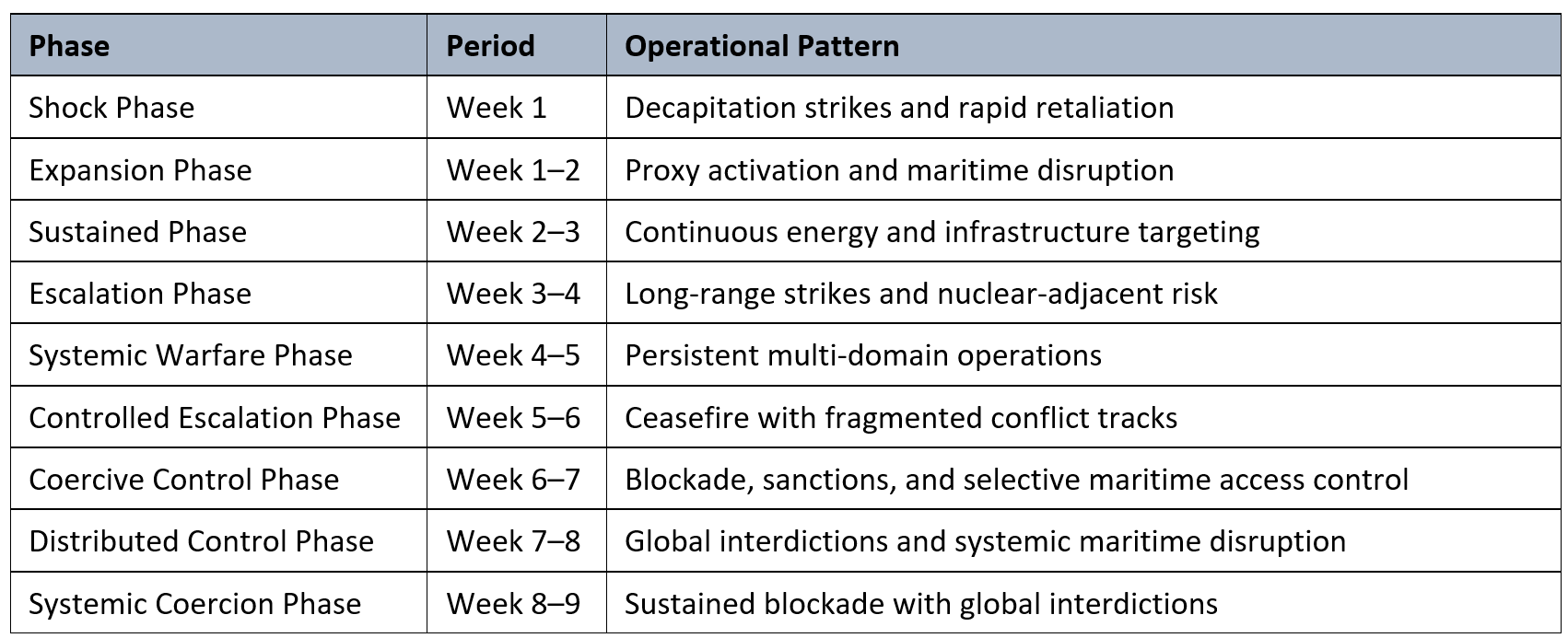
Operational Dynamics
The conflict now operates as a coercion system across military, economic, and maritime domains.
- The maritime domain has transitioned into a controlled coercion space
Blockade enforcement, selective transit permissions, and interdictions define a managed but contested environment.
- Economic warfare is now integrated with military operations
Secondary sanctions and financial pressure reinforce physical blockade mechanisms.
- Proxy warfare remains active but no longer drives escalation
While still operational, proxy activity plays a secondary role in current dynamics.
- Energy systems remain the central pressure node
Disruption, rerouting, and controlled reopening of flows shape global economic impact.
- Diplomatic channels have re-emerged without resolving core conflicts
Ceasefires and negotiations continue but remain fragile and conditional.
- Maritime control has expanded beyond the chokepoint into global interdiction space
US operations now target Iranian-linked shipping across wider maritime routes, reflecting a shift from localized blockade to distributed enforcement.
- Asymmetric naval tactics have re-emerged as a primary Iranian tool
Fast-boat swarms, vessel seizures, and selective access enforcement reinforce a denial-based control model.
- Systemic disruption of maritime traffic is now persistent
Shipping flows remain structurally degraded, marking a transition from temporary disruption to sustained operational condition.
- Blockade enforcement has matured into a persistent and scalable system
Interdictions now extend across multiple maritime zones.
- Selective enforcement has become a defining operational pattern
Some vessels are allowed to transit while others are redirected, indicating a controlled pressure model rather than absolute denial.
Weekly Strategic Shift
- Maritime control shifts from chokepoint pressure to distributed enforcement
- US blockade consolidates into a global interdiction system
- Iran reinforces asymmetric denial through seizures and swarm tactics
- Hormuz traffic remains structurally suppressed
- Conflict stabilizes into sustained coercion without resolution
- Diplomacy continues but remains secondary to coercive dynamics
Hormuz Maritime Dynamics
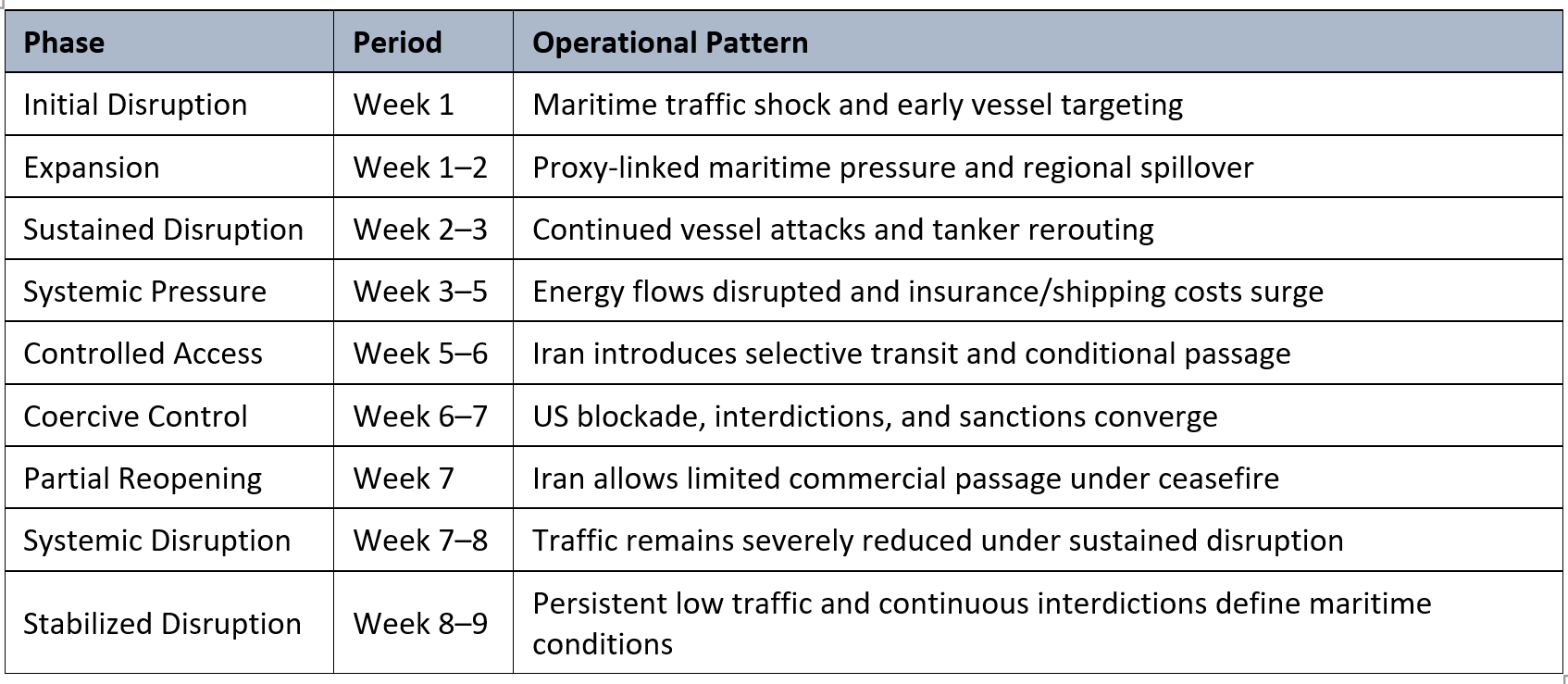
Phase Evolution
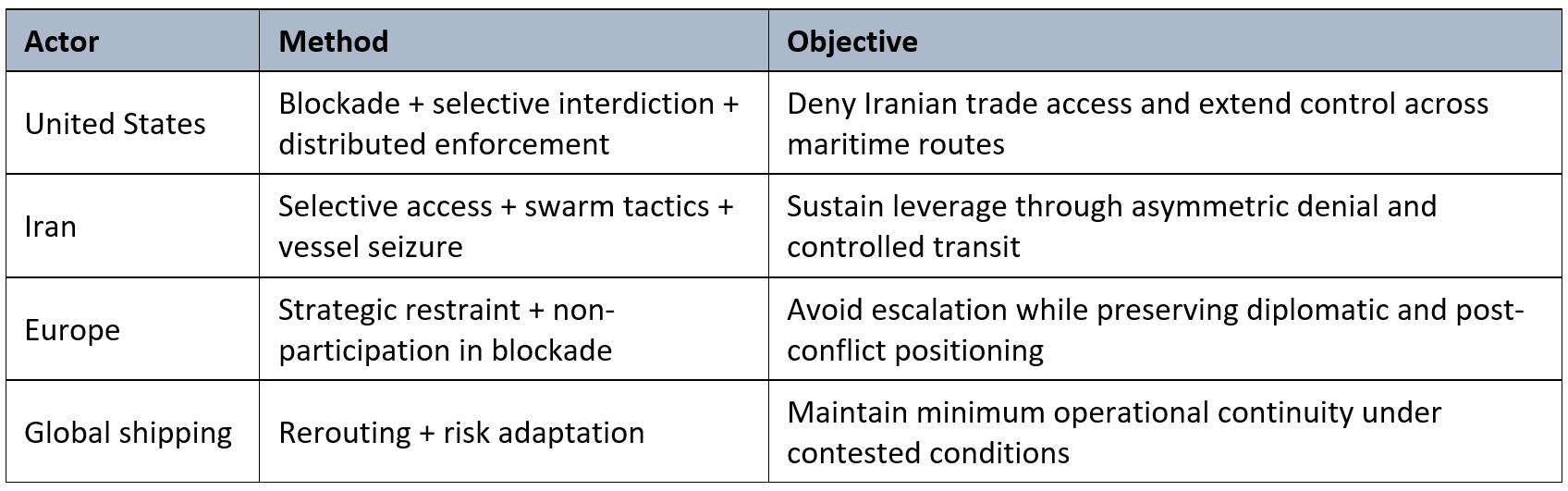
Control Competition Model
Strategic Note
The Strait of Hormuz has transitioned from a contested transit corridor into a persistently degraded and managed maritime system.
US and Iranian actions have converged into competing control systems shaping maritime access.
Traffic flows remain significantly reduced, with transits occurring under constrained conditions. This reflects not a temporary disruption, but a sustained pattern of limited maritime activity.
The resulting environment is neither restored navigation nor full denial, but controlled instability. Access is continuously shaped by competing coercive systems rather than stable rules of passage.
US-Iran Negotiation Breakdown
The US cancelled planned talks in Pakistan after failing to reach a breakthrough with Iran. Tehran continues to demand the removal of maritime restrictions as a precondition for negotiations. The collapse reinforces a shift from diplomacy toward coercion-driven conflict management.
Israeli Strike Expansion in Lebanon
Israel extended air operations into eastern Lebanon’s Bekaa Valley despite an active ceasefire framework. Continued exchanges with Hezbollah highlight the limited effectiveness of current de-escalation mechanisms. The expanded strike pattern increases the risk of renewed escalation.
Extended Blockade Enforcement at Sea
Israel intercepted Gaza-bound aid vessels in international waters near Greece. The operation reflects an expansion of blockade enforcement beyond the immediate conflict zone. This forward posture raises legal and political tensions surrounding humanitarian access.
Ukrainian Deep-Strike Campaign
Ukraine expanded long-range drone strikes targeting Russian energy and industrial infrastructure. These operations demonstrate growing reach into rear-area systems supporting the war effort. The approach prioritizes disruption of economic and logistical capacity over frontline engagement.
Pakistan-Afghanistan Border Clashes
Heavy exchanges of mortar and rocket fire caused significant civilian casualties in Kunar province. Despite ongoing mediation efforts, tensions remain unresolved. The pattern suggests a risk of transition toward sustained cross-border instability.
Energy & Maritime Security
Prolonged Blockade Strategy
US officials are considering a months-long naval blockade to restrict Iranian oil exports. This approach places maritime interdiction at the center of economic coercion. A sustained blockade risks prolonged disruption in global energy markets while increasing escalation exposure.
Hormuz Maritime Freedom Construct
The US proposed a coalition-based framework to restore navigation through the Strait of Hormuz. The model combines naval coordination with diplomatic and information-sharing mechanisms among selected partners. It reflects an effort to formalize external control over a critical maritime chokepoint.
Iranian Vision for Hormuz Management
Iran signaled its intent to reshape maritime governance by asserting itself as the primary security provider in the Gulf. Leadership messaging rejects external control and frames the current phase as a transition toward an Iranian-led order. This positions Tehran in direct competition with US-led maritime initiatives.
Hybrid Threats, Cognitive Warfare & Information Operations
Subsea Cable Vulnerabilities
The Iran war has exposed the vulnerability of critical subsea cables in the Strait of Hormuz. Ongoing conflict conditions complicate repair operations and increase the risk of prolonged digital disruption. These systems underpin regional connectivity, meaning even limited damage could have broader economic and communication impacts.
Russian Phishing via Signal
German authorities are investigating state-linked phishing attacks targeting politicians and military personnel through the Signal app. The operation exploits user behavior rather than technical vulnerabilities to access sensitive communications. This highlights the growing importance of human-layer targeting in cyber operations.
Legal Pressure on State Hackers
The US is expanding cyber deterrence through arrests and extradition of state-linked hackers operating abroad. This approach challenges the protection normally provided by national jurisdictions and increases exposure for actors operating beyond domestic borders. It reflects a shift toward integrating legal tools into cyber competition.
Defense Technology, Industry & Economic Security
Critical Minerals Coordination
The US and EU signed a memorandum to align trade policies and secure supply chains for critical minerals. The initiative aims to reduce structural dependence on China-dominated processing capacity. This reflects a broader effort to rebalance industrial inputs essential to advanced manufacturing and defense systems.
Chinese Export Controls on Defense Entities
China banned dual-use exports to several European defense firms over alleged involvement in Taiwan-related cooperation. The move demonstrates selective supply chain pressure targeting industrial actors beyond immediate conflict zones. It increases the risk of fragmentation in global defense technology networks.
Private Air Defense Integration in Ukraine
Ukraine launched a program integrating private firms into its national air defense structure. These units deploy interceptor drones and automated systems to protect infrastructure against persistent drone attacks. The model expands defensive capacity through distributed and hybrid force structures.
Deep-Strike Expansion Against Russian Infrastructure
Ukrainian drones struck an oil pumping station 1,500 km inside Russia, targeting core energy transport networks. The operation reflects increasing strike depth against economically critical infrastructure. This indicates a shift toward sustained disruption of revenue-generating systems.
AI and Unmanned Systems in Demining
Ukraine is deploying AI-driven detection and unmanned excavation systems to clear large-scale mine contamination. These technologies improve accuracy while reducing risk to personnel. The approach highlights the growing role of dual-use innovation in post-conflict environments.
AI-Driven Mine Warfare in Hormuz
The US Navy accelerated AI-based mine detection under Project AMMO to counter Iranian threats. The system enables rapid retraining of unmanned platforms to adapt to new mine types. This development reflects a shift toward data-driven and autonomous maritime operations.
Defense Transfers and Industrial Partnerships
Italy approved the transfer of an aircraft carrier to Indonesia, while Pakistan advanced submarine acquisition with China under a technology transfer model. These developments illustrate how defense cooperation is increasingly structured around capability building and industrial integration.
Global Power Competition & Systemic Transitions
EU-China Sanctions Friction
The EU included Chinese entities in sanctions targeting support to Russia’s military-industrial base. Beijing warned of retaliation, stating the move damages bilateral relations. This development extends conflict-related economic pressure into third-country industrial networks.
Falklands Policy Signaling
The US is considering a reassessment of its position on the Falkland Islands amid tensions with the UK over Iran war support. The discussion reflects the use of geopolitical signaling to exert pressure within alliance relationships. It indicates a growing linkage between strategic disputes and bilateral alignment dynamics.
Russia-Iran Strategic Alignment
Russia reaffirmed support for Iran while maintaining offers to mediate the conflict. The relationship includes ongoing nuclear cooperation and military-industrial ties. This alignment complicates efforts to isolate Iran and reinforces the emergence of parallel strategic blocs.
US-Germany Posture Friction
Tensions between Washington and Berlin over the Iran conflict have expanded into discussions on US troop presence in Germany. Germany’s push for greater military autonomy adds to the strain within NATO. This reflects increasing divergence in alliance priorities and defense posture.
Future Conflict, Climate & Humanity
Fertilizer Supply Disruptions
Disruptions in maritime trade through the Strait of Hormuz have reduced the availability of key fertilizer inputs. Rising costs are already affecting farmer decision-making and input usage, increasing the risk of lower crop yields. This dynamic links maritime conflict directly to global food production and agricultural stability.
Conflict-Driven Renewable Shift
Energy shocks triggered by the Iran war are accelerating the adoption of renewable energy and alternative systems. Countries are expanding solar capacity and electric mobility to reduce exposure to volatile fossil fuel supply chains. This reflects a structural shift toward energy diversification under sustained conflict pressure.
Cross-Domain Strategic Signals
Systemic Industrial Warfare
Strikes on energy and industrial infrastructure are becoming a sustained method of warfare. Attacks on refineries, oil networks, and fertilizer systems reflect a shift toward targeting economic resilience rather than frontline forces. This approach creates delayed but structural disruption across global supply chains.
Transactional Alliance Cohesion
Alliance dynamics are shifting as political disagreements begin to affect military posture and strategic commitments. Tensions between the US and European partners, including troop deployment discussions, reflect growing conditionality within alliances. This environment is pushing states toward greater defense autonomy.
Selective Maritime Governance
Control of strategic waterways is increasingly shaped by competing governance models. US-led coalition initiatives and Iran’s counter-positioning in Hormuz reflect parallel efforts to define authority and access. Maritime control is becoming a central tool for managing escalation and economic pressure.
Supply Chain Weaponization
Critical minerals and dual-use technologies are emerging as primary tools of strategic competition. Sanctions and export controls targeting industrial actors are reshaping supply dependencies. This dynamic is accelerating the fragmentation of global technology and production systems.
What to Watch Next Week
- US decision on sustaining or expanding the naval blockade of Iran.
- Partner responses to the proposed Hormuz maritime coalition.
- Outcome of the US review of Iran’s revised negotiation framework.
- Potential Iranian retaliation against prolonged maritime restrictions.
- Continuation of Ukraine’s deep-strike campaign against Russian energy infrastructure.
- Operational performance of private air defense integration in Ukraine.
- Potential Chinese countermeasures following EU sanctions and export tensions.
- Stability of the Pakistan–Afghanistan border following renewed clashes.
click here to download as PDF.