This Week at a Glance:
- Iran escalates with long-range strikes near nuclear infrastructure
- Israel enforces buffer zone in Lebanon amid widening conflict
- U.S. expands military posture while maintaining diplomatic track
- Regional fronts activate as cross-border and proxy dynamics intensify
- Energy infrastructure targeting disrupts LNG, refineries and exports
- Hormuz crisis triggers coalition response and conditional transit control
- Maritime threats expand across Red Sea, Black Sea and global routes
- Supply chains strain as food imports and energy markets destabilize
- NATO rearmament accelerates as alliances and partnerships expand
- Defense production expansion and undersea competition reshape strategic balance
Strategic Overview
Regional conflict centered on the Iran war is shifting from proxy engagements toward sustained territorial control and long-range strike exchanges across the Middle East. The inclusion of nuclear and energy infrastructure in targeting logic significantly increases the risk of miscalculation. As operational theaters expand and interconnect, containment dynamics are weakening.
Energy and food systems are increasingly being targeted as instruments of coercion, driven by disruptions originating in the Gulf conflict environment. The breakdown of maritime chokepoints and centralized production hubs is generating persistent supply chain instability across global markets. States are shifting toward selective transit control and managed access to project leverage over critical economic flows.
Global security architecture is adapting to sustained conflict pressure through fragmented coalitions and distributed defense-industrial networks. Rising defense spending and localized production reflect a shift toward long-term rearmament and resilience. At the same time, active neutrality by smaller states is emerging as a structural constraint on military access, logistics, and defense trade flows
The Iran war exemplifies how regional conflicts can evolve into systemic disruptions affecting global energy markets, alliance structures, and multi-domain security environments simultaneously.
Research Field Analysis
Regional Conflict & Stability
Iran War – Key Indicators (Weeks 1–4)
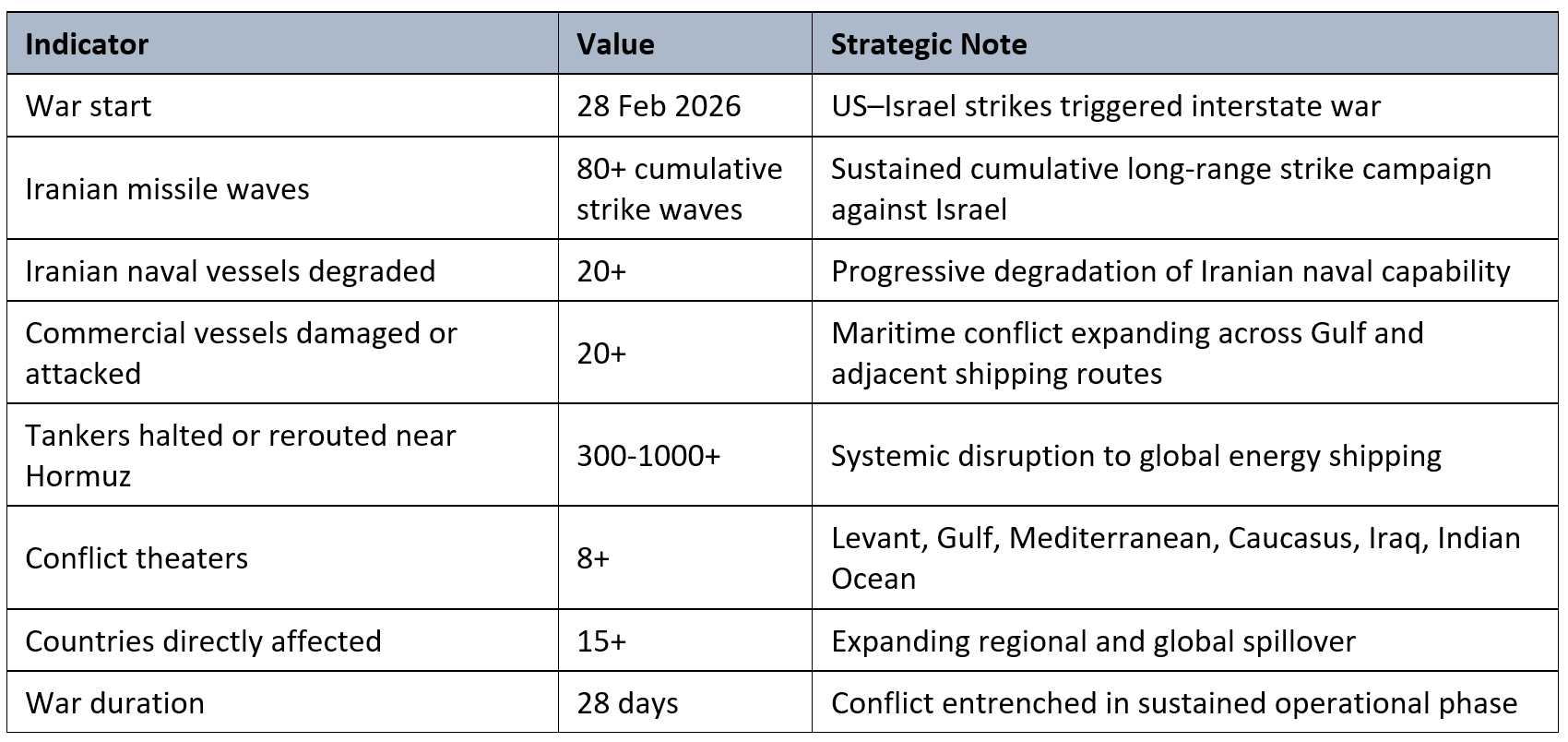
These indicators illustrate how the conflict has evolved from a limited strike exchange into a multi-theater confrontation with systemic implications for global energy and security systems.
Iran War – Conflict Scale
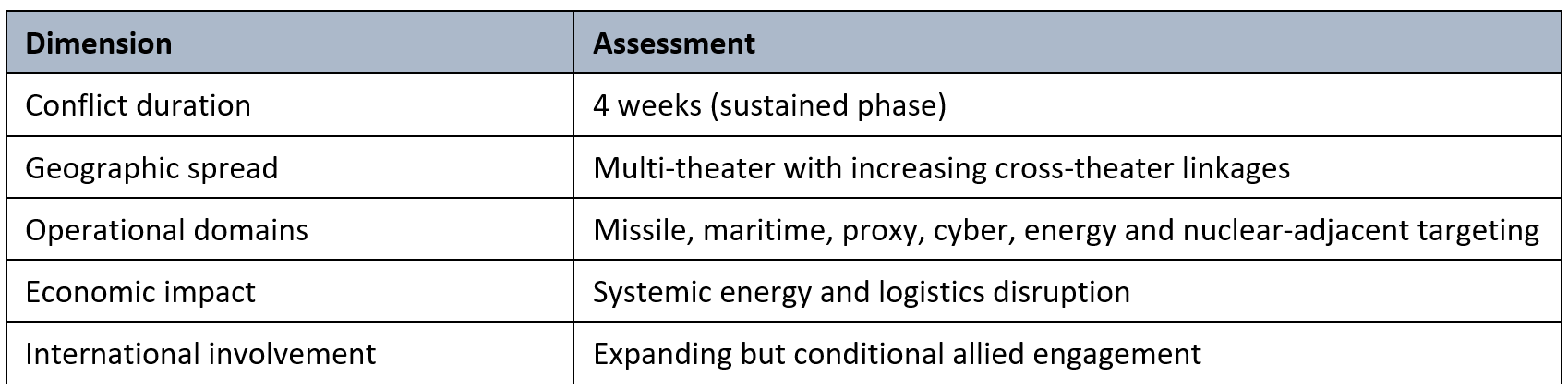
Iran War – Operational Snapshot (Weeks 1–4)
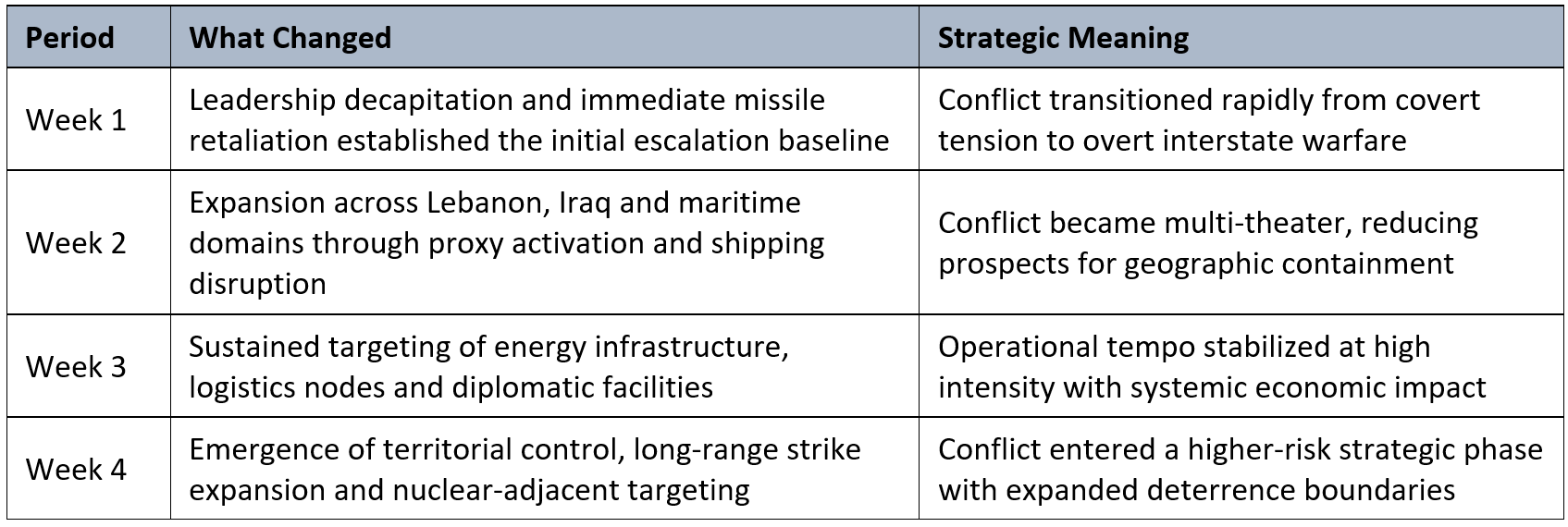
Iran War – Conflict Evolution
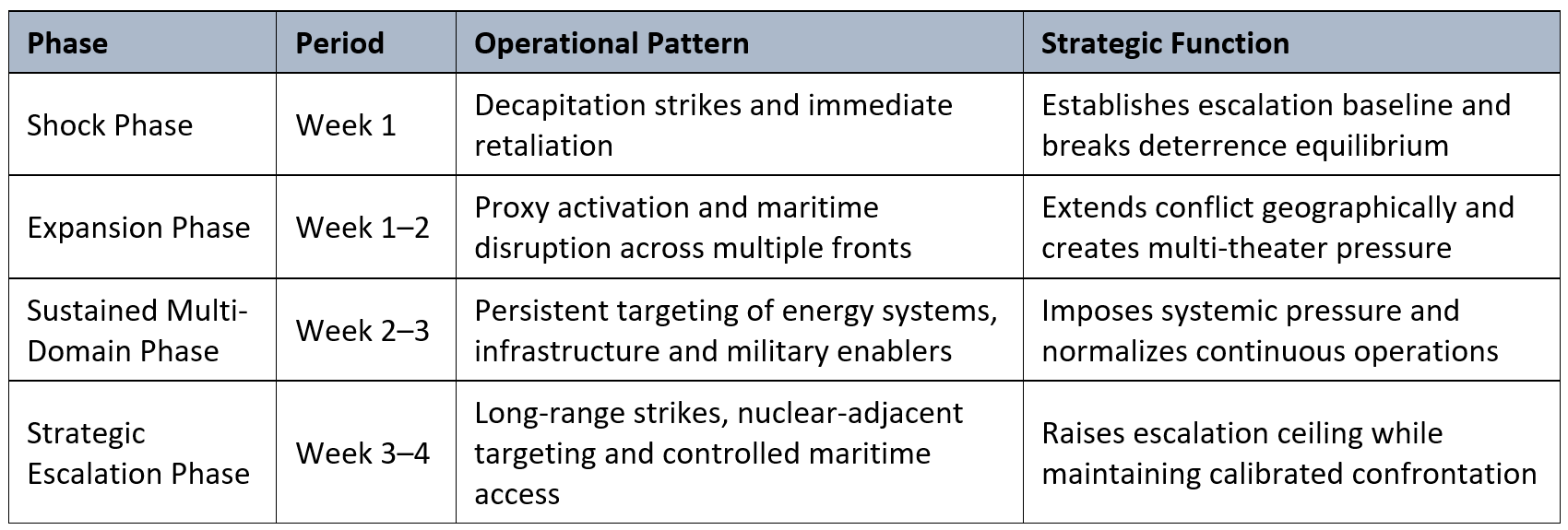
Iran War – Operational Dynamics
Recent developments indicate a structural shift in how the conflict is being conducted.
• From Decapitation to Systemic Degradation
Initial leadership targeting has expanded into sustained attacks on energy infrastructure, military enablers, and export nodes, increasing systemic economic impact.
• From Geographic Containment to Networked Conflict
Operational linkages across Lebanon, Iraq, the Gulf, and the Eastern Mediterranean have reduced the ability to isolate the conflict within a single theater.
• From Episodic Escalation to Persistent Pressure
Repeated attacks on US diplomatic sites, maritime traffic, and regional infrastructure indicate the emergence of a continuous operational tempo.
• From Direct Retaliation to Layered Proxy Warfare
Iran-aligned groups are sustaining pressure across multiple fronts, enabling escalation while maintaining strategic ambiguity.
• Emergence of Strategic Risk Layer
Strikes near nuclear infrastructure introduce high-consequence escalation dynamics beyond conventional deterrence.
• From Disruption to Controlled Access
Iran’s selective transit policy in the Strait of Hormuz reflects a shift from disruption toward managed maritime control.
The following developments illustrate how these operational patterns are materializing across regional theaters.
Long-Range Missile Escalation
Iran launched long-range ballistic missiles targeting regional bases and areas near sensitive nuclear infrastructure. These strikes extend the conflict’s reach and introduce broader deterrence dynamics affecting European security calculations. Proximity to nuclear sites significantly elevates the risk of unintended strategic escalation.
Iraq Escalation Dynamics
Rocket attacks from Iraq targeting U.S. positions in Syria, combined with expanded airstrikes against militia leadership, signal intensified cross-border escalation. These dynamics blur the line between proxy actors and state-linked forces, increasing attribution challenges and raising retaliatory risk across interconnected theaters.
U.S. Posture Expansion
The U.S. deployed additional Marine Expeditionary Units and naval assets to enhance regional strike flexibility. This layered posture supports a dual-track approach of military deterrence and diplomatic negotiation leverage. It reflects an adaptable framework for managing escalation without a ground deployment decision.
Sustained Lebanon Control
Israel established a security zone up to the Litani River through infrastructure targeting and forward deployments. This shift toward sustained territorial control redefines deterrence through physical depth rather than stand-off strikes. It increases the probability of prolonged confrontation and entrenched regional military presence.
NATO Force Relocation
NATO moved all mission personnel from Iraq to European bases to mitigate rising security risks. The mission continues training Iraqi forces remotely to maintain institutional continuity. This relocation highlights the limits of forward-deployed advisory roles during high-intensity regional conflict spillover.
Pakistan Border Operations
Pakistan resumed military operations against militants on the Afghanistan border following a brief ceasefire. The fighting reflects persistent cross-border tensions centered on contested responsibility for militant activity. This dynamic limits prospects for stabilization while increasing humanitarian and trade disruptions.
Conflict dynamics are shifting toward sustained territorial depth and long-range engagement. The expansion of operational theaters and the targeting of state-linked forces increase the risk of rapid, uncoordinated escalation. Deterrence is increasingly enforced through territorial control and forward military presence, reducing reliance on stand-off engagement.
Energy & Maritime Security
Haifa Refinery Strike
Iranian missiles targeted Israeli refineries in Haifa, causing temporary power outages and infrastructure damage. While operational impact was limited, the strike reinforces energy infrastructure as a primary target for symbolic and coercive pressure. Continued targeting suggests sustained efforts to degrade regional economic resilience.
Qatar LNG Disruption
Iranian attacks disabled 17 percent of Qatar’s LNG export capacity, necessitating long-term repairs. This structural disruption generates sustained uncertainty in global gas markets, particularly for Europe and Asia. It demonstrates the vulnerability of centralized production hubs to high-impact economic warfare.
Hormuz Security Governance Divide
Efforts to secure the Strait of Hormuz are advancing through coalition-building, while divisions within the UN Security Council continue to block unified authorization. This split is reinforcing a shift toward parallel security frameworks, where maritime protection is increasingly pursued through coalitions rather than consensus-based international mandates.
Alternative Energy Corridors
Israel proposed bypassing the Strait of Hormuz via new pipelines across the Arabian Peninsula. This vision attempts to reshape regional energy geography in response to chokepoint vulnerability. It links current conflict dynamics with long-term infrastructure planning and strategic competition.
Red Sea Activation
Houthis signaled readiness to target the Bab al-Mandab Strait in coordination with regional developments. This prospective front creates a layered chokepoint risk for global trade and energy corridors, increasing the probability of sustained multi-route disruption.
Calibrated Strike Threats
The U.S. extended its strike deadline for Iranian infrastructure to preserve diplomatic pathways. This use of conditional threats integrates military coercion directly into negotiation strategy. Energy infrastructure is now a central bargaining instrument for shaping conflict outcomes.
Integrated Energy Coercion Model
Iran is consolidating a retaliation framework centered on energy systems and conditional maritime access. By linking infrastructure targeting with selective transit control, Tehran is transforming chokepoints into instruments of calibrated pressure. This approach enables coercion without full disruption while maintaining escalation flexibility.
Gulf Mine Warfare Threat
Tehran warned of a Gulf-wide mining campaign if its coastal territories are targeted. This strategy signals a shift from chokepoint disruption to theater-wide maritime denial. Mine warfare would impose prolonged constraints on shipping and increase operational complexity.
Maritime Enforcement Escalation
The UK authorized U.S. base use for strikes, while France intercepted shadow fleet tankers. These actions reflect a move toward active maritime enforcement of sanctions and navigation security. They link naval operations directly to broader financial and trade restriction regimes.
Calibrated Basing Posture
The UK excluded its Cyprus airbase from offensive operations to manage geographic exposure and risk. This selective basing demonstrates how states compartmentalize contributions to avoid domestic sensitivities and escalation. Basing geography remains a critical factor in shaping operational boundaries.
Russian Energy Disruption
Coordinated drone strikes targeted Russian refineries and Baltic export terminals, causing significant output loss. This indicates a shift toward system-wide disruption of energy value chains rather than isolated incidents. Sustained targeting is constraining export capacity and reinforcing systemic pressure on global energy markets.
Black Sea Maritime Risk
A drone strike on a tanker near the Bosphorus reflects the diffusion of unmanned tactics into commercial waterways. This incident increases the risk of conflict spillover into NATO-adjacent maritime zones. Unmanned systems are normalizing low-cost disruption in strategic maritime chokepoints, raising the risk of spillover into NATO-adjacent security environments.
Renewable Energy Outlook
Rising energy prices are strengthening the rationale for Europe’s transition while capital costs slow deployment. This creates a dual-speed transition dynamic influenced by financial constraints and regulatory bottlenecks. Conflict trajectory will determine the long-term pace of systemic energy transformation.
Urgent Food Supply Risks
Maritime disruptions in the Gulf have nearly halted food imports, threatening import-dependent regional economies. This crisis illustrates how chokepoint instability generates secondary humanitarian and civilian sector stress. Human security is now directly tied to maritime transit stability.
Energy systems and maritime chokepoints are now the primary domain of strategic coercion, redefining how economic and military pressure is applied. The transition toward selective transit control and systematic infrastructure targeting challenges global trade norms. Coordinated disruptions are generating structural economic instability.
Hybrid Threats, Cognitive Warfare & Information Operations
Russian Internet Consolidation
Russia expanded internet controls and banned VPNs to strengthen domestic information governance during the war. These measures grant security services broader control over communications networks and societal behavior. Centralized digital governance is now a critical tool for war resilience.
State control over digital infrastructure is shifting toward integrated information governance as a war sustainment tool. Centralized management of communication platforms supports regime stability during prolonged conflict. This mirrors control models used by other systemic actors.
Defense Technology, Industry & Economic Security
Regional Defense Reinforcement
The U.S. approved $16.5 billion in arms sales to regional partners, focusing on air and missile defense. These transfers strengthen defensive resilience against asymmetric threats while embedding long-term dependency on U.S. ecosystems. Industrial capacity remains essential for sustaining regional deterrence.
Exported Combat Expertise
Ukraine deployed air defense specialists to the Middle East to share battlefield-tested anti-drone capabilities. This development signals a shift where operational expertise becomes a transferable and influence-building strategic asset. Technological adaptation is driving new forms of security cooperation.
Distributed Defense Production
U.S.-led partnerships expanded missile motor and drone production lines across the Indo-Pacific region. Localizing manufacturing near potential conflict zones reduces supply chain risks and improves rapid readiness. Networked defense production is becoming a core element of security architecture.
Brazilian Aerospace Autonomy
Brazil began domestic assembly of Gripen fighter jets under a technology transfer agreement. This establishment of a regional export hub signals a transition toward industrial participation in global supply chains. It reinforces the diffusion of advanced manufacturing beyond traditional producers.
China Undersea Mapping
China is conducting large-scale seabed mapping to support submarine navigation and detection capabilities across multiple oceans. This systematic effort builds a persistent knowledge advantage near key maritime chokepoints. It directly challenges established undersea advantages held by the United States.
NATO Eastern Flank Integration
The UK and Turkey advanced a defense agreement for pilot training and Eurofighter integration. This deal enhances operational interoperability within NATO’s combat air architecture through shared standards. It strengthens regional readiness by embedding advanced capabilities into a broader framework.
Defense industrial strategies are prioritizing localized production and the export of battle-tested operational expertise. Distributed manufacturing networks and undersea environmental dominance are reshaping regional balances. Technological transfer is becoming a primary tool for security alignment.
Global Power Competition & Systemic Transitions
Coalition Operational Friction
Divergent targeting priorities between the U.S. and Israel led to friction regarding strikes on energy infrastructure. Misaligned tactical actions in coalition environments can generate systemic consequences beyond shared objectives. This complexity complicates escalation control and information flow among partners.
Iran Resistance Economy
Iran’s leadership declared a “resistance economy” to prioritize internal stability and national security. This framework links economic adaptation directly to the state’s broader war posture and resilience. It suggests internal consolidation alongside controlled external signaling to manage escalation.
Taiwan Deterrence Focus
Taiwan prioritized long-term capability development and risk imposition to shape Beijing’s cost-benefit calculations. This focus on deterrence highlights the centrality of perception management in maintaining cross-strait stability. Submarine fleet upgrades remain a core component of this strategy.
Russian Strategic Hedging
Vladimir Putin reaffirmed political support for Iran while maintaining strategic ambiguity regarding concrete military aid. This approach allows Moscow to maintain its partnership while avoiding direct escalation with Western actors. It reflects a pattern of symbolic support combined with operational restraint.
Neutrality in Defense Trade
Switzerland and Sri Lanka actively enforced neutrality by halting arms exports and denying military access. These decisions introduce friction into global supply chains and limit the flexibility of major powers. Neutrality is being operationalized as an active constraint on military flows.
Institutional Diplomatic Contest
Gulf states framed Iranian strikes as existential threats at the UN to build international legitimacy. This highlights a parallel contest over attribution and responsibility within multilateral institutions. Institutional arenas are becoming central to shaping the strategic trajectory of the conflict.
NATO Rearmament Shift
NATO allies adopted a 5 percent defense spending target to build long-term force expansion and resilience. This shift signals a transition from baseline readiness to sustained rearmament in a multi-domain threat environment. Transatlantic cohesion is increasingly tied to measurable capability contributions.
Networked Security Alignments
The Philippines and France signed a military pact to expand training and interoperability in the South China Sea. This agreement broadens the network of external actors engaged in regional security through coalitional presence. It contributes to a more distributed and networked international security architecture.
Global competition is increasingly shaped by fragmented orders and networked security alignments. Diverging coalition priorities and enforced neutrality are constraining escalation management. Institutional legitimacy remains a contested strategic domain.
Future Conflict, Climate & Humanity
Nuclear Infrastructure Risk
A projectile strike near Iran’s Bushehr plant prompted calls for a safety zone to prevent regional disaster. The proximity of conventional strikes to large quantities of fissile material elevates the stakes beyond military logic. This dynamic introduces a deterrence layer centered on catastrophic environmental fallout.
Strategic infrastructure exposure introduces a deterrence layer centered on catastrophic environmental and humanitarian risks. The potential for regional nuclear fallout alters conventional military calculations and targeting decisions. Protecting critical human security nodes is an emerging priority.
Cross-Domain Strategic Signals
Infrastructure-Based Deterrence
Energy infrastructure is emerging as a primary instrument of coercive deterrence, linking military escalation directly to economic systems. This dynamic increases the likelihood of sustained escalation cycles across interconnected domains.
Multi-Chokepoint Maritime Denial
The expansion of disruption from Hormuz to the Red Sea reflects a coordinated multi-chokepoint escalation strategy. This layered pressure is restructuring global trade flows and increasing systemic vulnerability across maritime corridors.
Strategic Neutrality as Supply Constraint
Neutrality policies are increasingly enforced to restrict military access and defense trade during active conflict. This introduces structural friction into global supply chains and constrains the operational flexibility of major powers.
Undersea Environmental Dominance
Control over the undersea environment is becoming a critical dimension of naval power. Persistent mapping and monitoring efforts are reducing uncertainty in submarine operations while challenging existing strategic advantages.
What to Watch Next Week
- UN Security Council negotiations on maritime navigation security resolutions.
- Possible backchannel U.S.-Iran talks via intermediaries.
- Expiration of the U.S. strike deadline on Iranian energy infrastructure.
- Implementation of the Litani River security zone and refugee movements.
- New defense industrial partnership announcements following the NATO spending shift.
click here to download as PDF.